
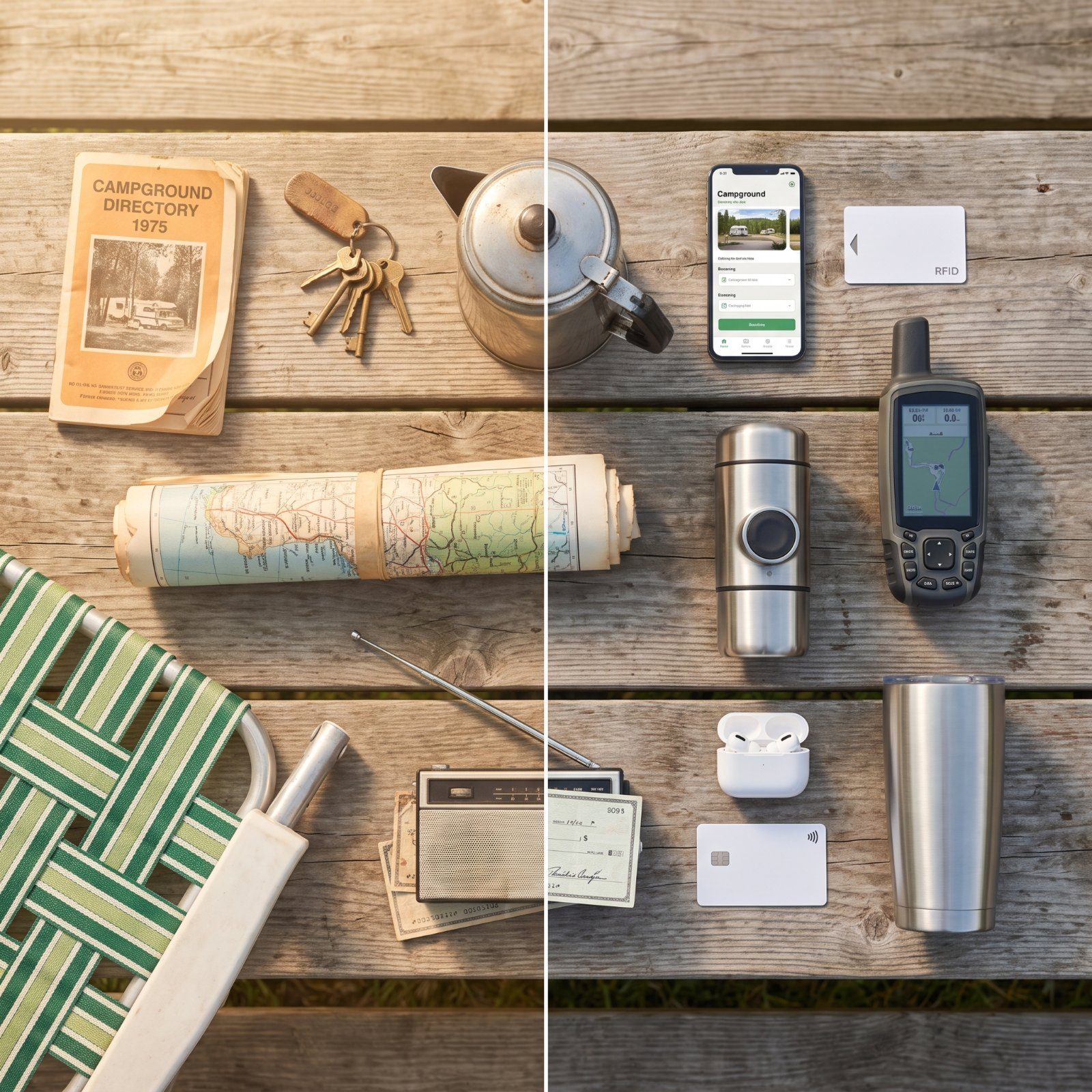
The smell of two-stroke exhaust and warm Coleman fuel. A gravel lot with sites close enough to hear your neighbor arguing about the awning, while a guy in a mesh trucker cap waved you into a slot barely wider than your trailer. That was an RV park in 1975, and plenty of us remember it fondly. We pulled ten of those familiar park spaces side by side with what they look like today. Some changes you’ll cheer. A couple you might miss.
49. The Compact Travel Trailer vs. Today’s Towering Luxury Motorhome
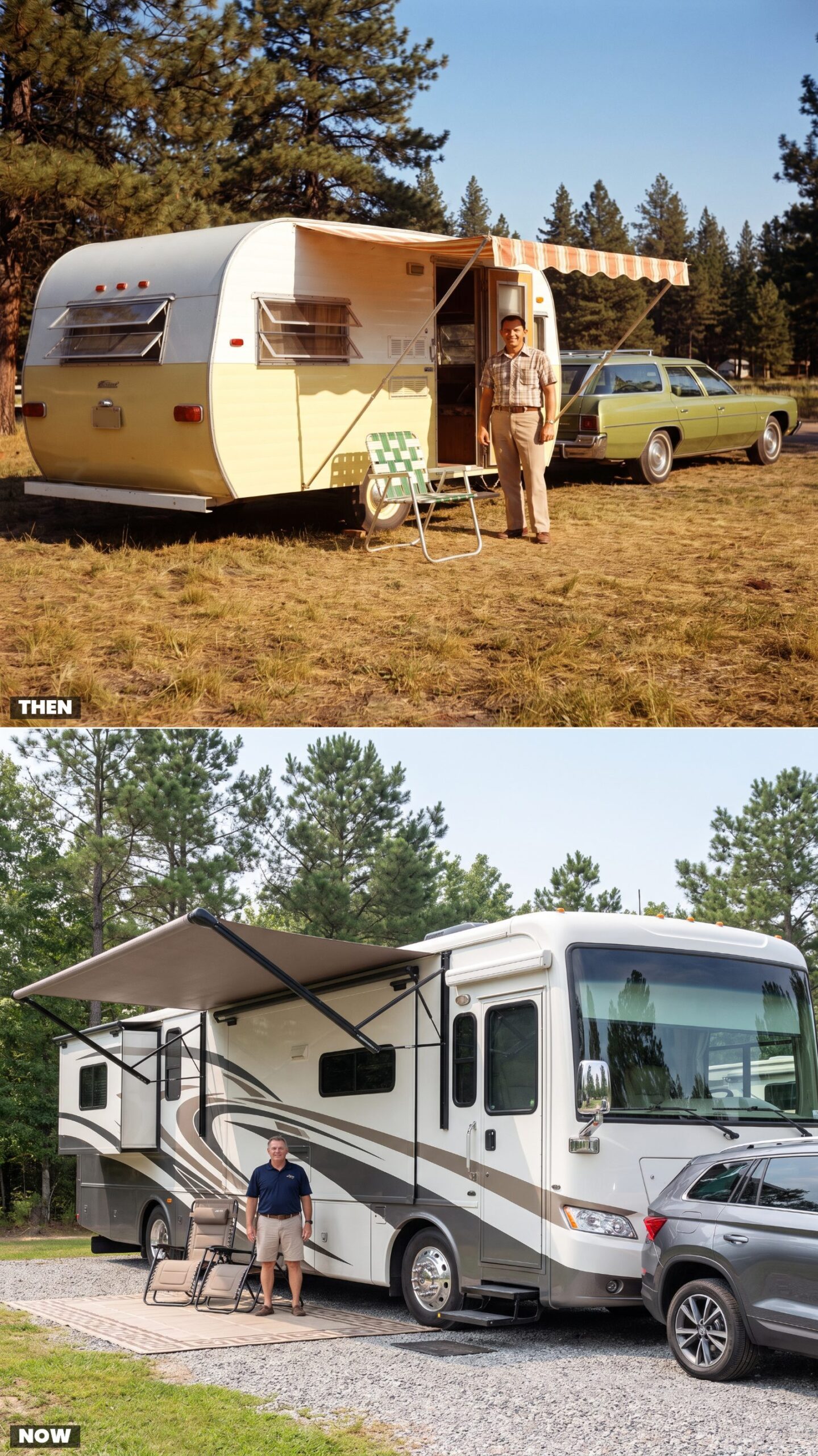
A 16-foot single-axle trailer in 1975 weighed less than the slide-out room on a modern coach. You towed it behind the family wagon, cranked open the jalousie windows, and called it a palace because it had a sink and a place to sleep that wasn’t the ground.
Today’s 40-foot diesel pushers roll in with three slide-outs, a residential fridge, heated floors, and a king bed. They cost more than my parents’ first house. Something got lost when the camper stopped being small, and something real got gained. I’ll admit I don’t miss the jalousie windows. Those things leaked every time it rained.
48. The Narrow Gravel Back-In Site vs. the Extra-Long Concrete Big-Rig Pad
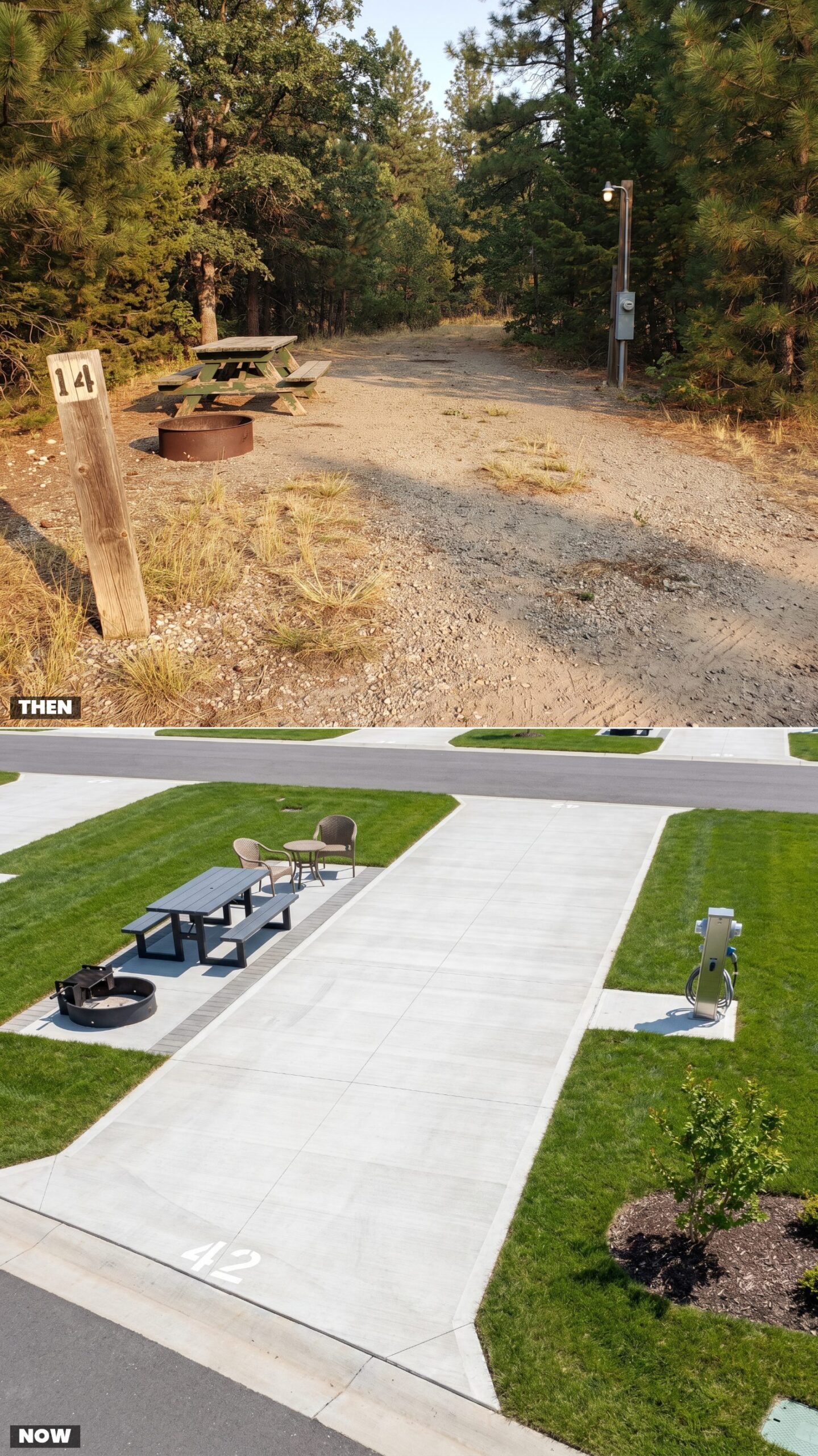
You remember the gravel site. Loose stone, a lean to one side, and a backing-in ritual that drew a small crowd every time: one spouse outside waving arms, the other inside sweating and pretending to understand the hand signals. Marriages were tested on those sites.
Modern big-rig pads are poured concrete, level, long enough to pull straight through, and wide enough to open every slide without clipping a tree. Full hookups wait at a tidy pedestal. Easier, sure. And, if I’m honest, a little less of a story to tell later.
47. Closely Packed Campsites vs. Today’s Landscaped Privacy Lots
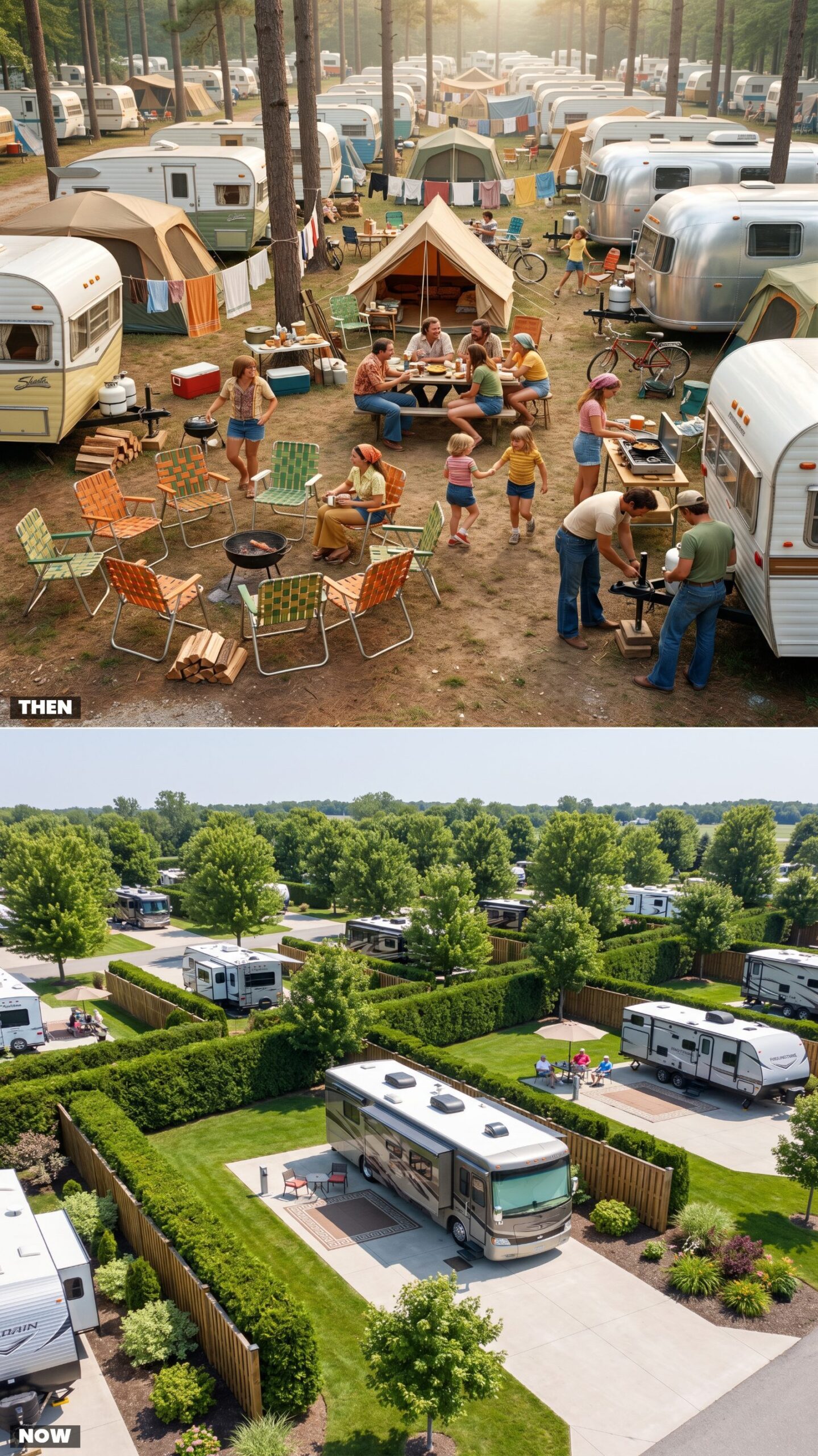
Sites in 1975 were close. You could hand your neighbor the ketchup without leaving your own picnic table, and you heard every card game, every sunburn argument, every transistor radio tuned to the ballgame three sites over.
Modern privacy lots put hedges, fences, and real distance between you and the next rig. Quieter. More civilized. But that old closeness is how strangers became camp friends by Saturday night. The packed campground had a social magic the landscaped lot quietly traded away.
You couldn’t help but know your neighbors. The campground made the introduction for you.
46. The Hand-Painted Highway Sign vs. the Illuminated Digital Entrance
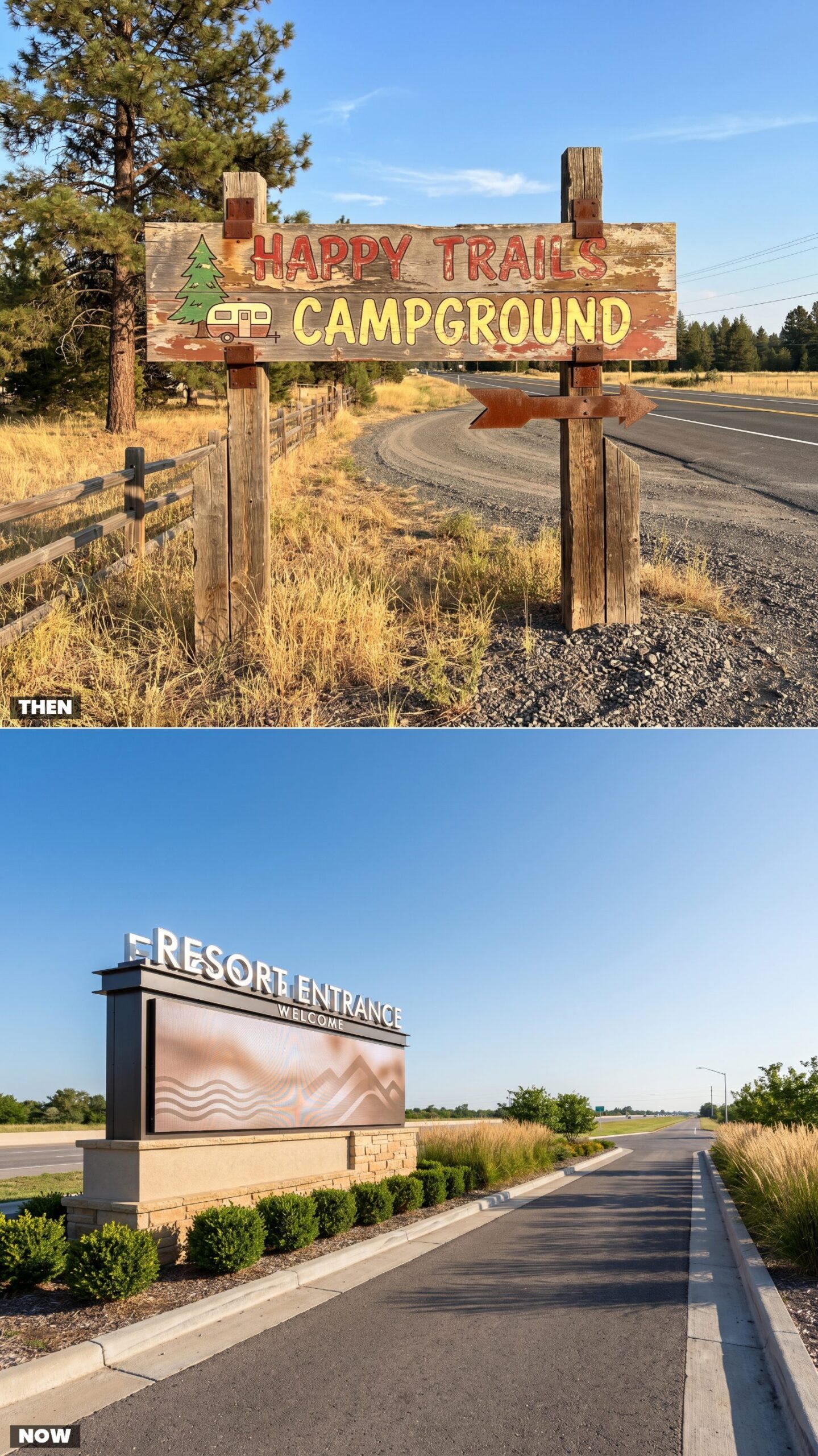
Somebody’s uncle painted that sign. You could tell. The cartoon camper leaned a little lopsided, the yellow had faded to mustard, and it still made you smile every single summer when it came around the bend.
Now the entrance is a lit stone monument with an LED panel and uplit landscaping that looks like a bank branch. Professional. Impressive at night. A tiny bit soulless. I’d swap the LED panel for one more lopsided painted camper, and I suspect you would too.
45. The Wood-Paneled Registration Office vs. the Resort-Style Lobby
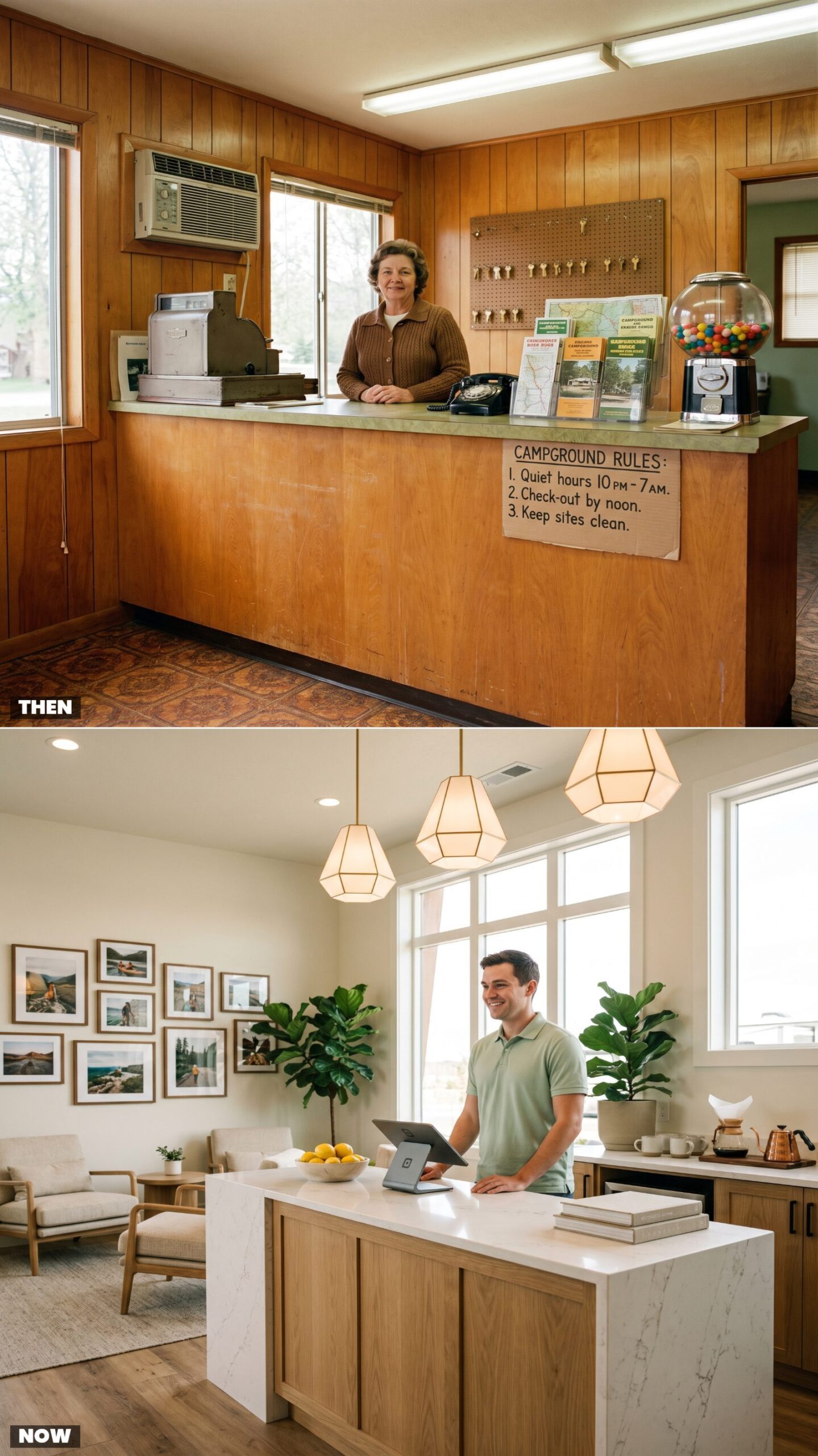
The 1975 camp office smelled like pine cleaner and the inside of a road map. Honey wood paneling, a metal cash register that rang like a dinner bell, a pegboard of brass keys, and a gumball machine the kids orbited the second you walked in.
Today’s lobbies have quartz counters, a coffee station, cushioned seating, and a tablet where the cash register used to live. Lovely, genuinely. But nobody has ever felt the same cozy as that paneled little office with the window AC rattling in the corner.
44. The Holiday-Weekend Check-In Line vs. the Contactless Arrival Lane
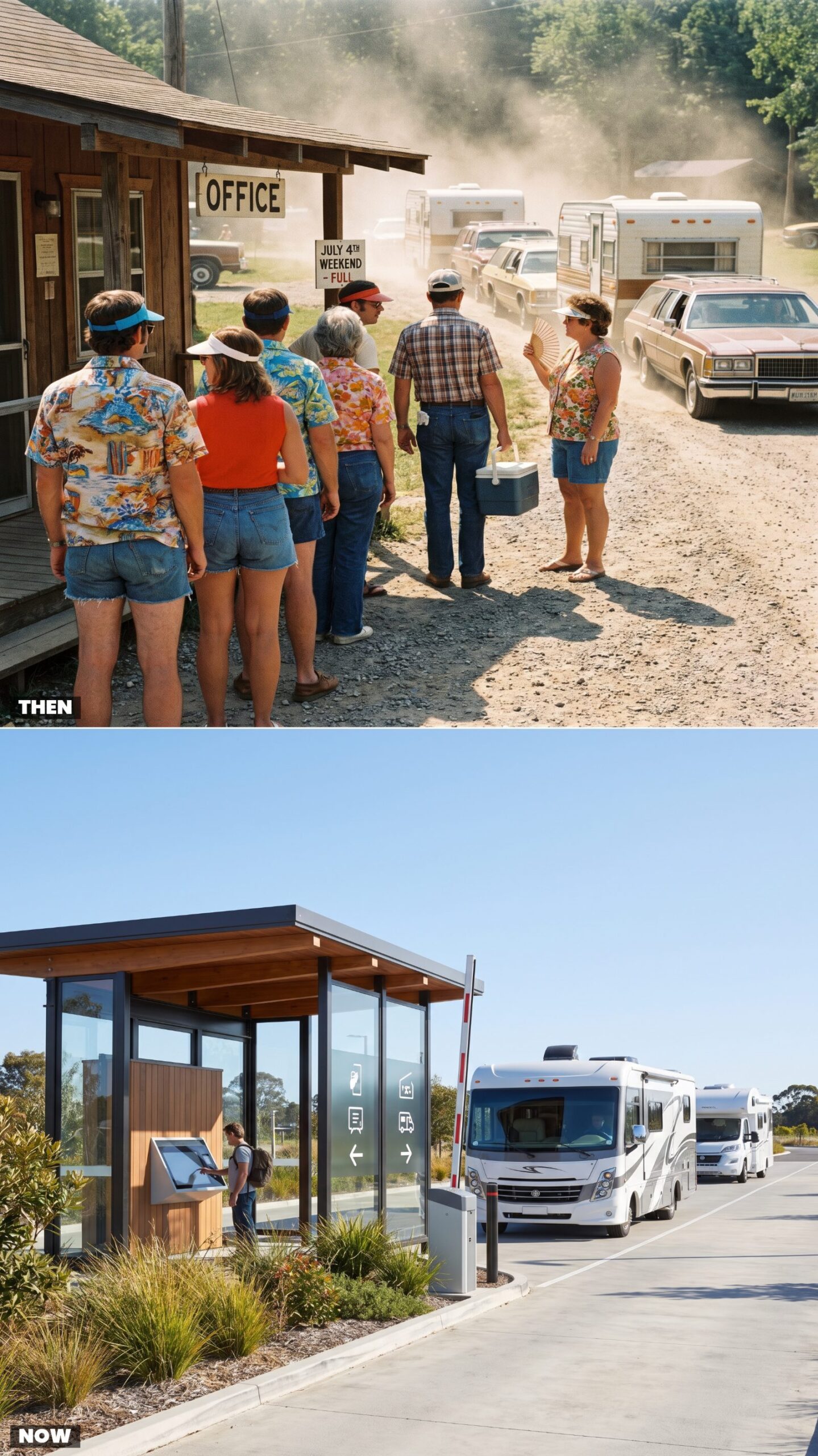
Holiday weekend, 1975. You arrived to a line out the office door, engines idling in the gravel, kids melting in the back seat, and a clerk working a paper ledger one entry at a time. Checking in could eat the better part of an hour.
Now you roll up to a covered kiosk, scan a code, and the gate arm lifts. Some parks text your site number before you even arrive. Faster, cooler, far less dusty. The downside? You no longer meet four families in line while you wait, and sometimes those line conversations were the best part of the weekend.
43. The Handwritten Reservation Ledger vs. the Online Booking System
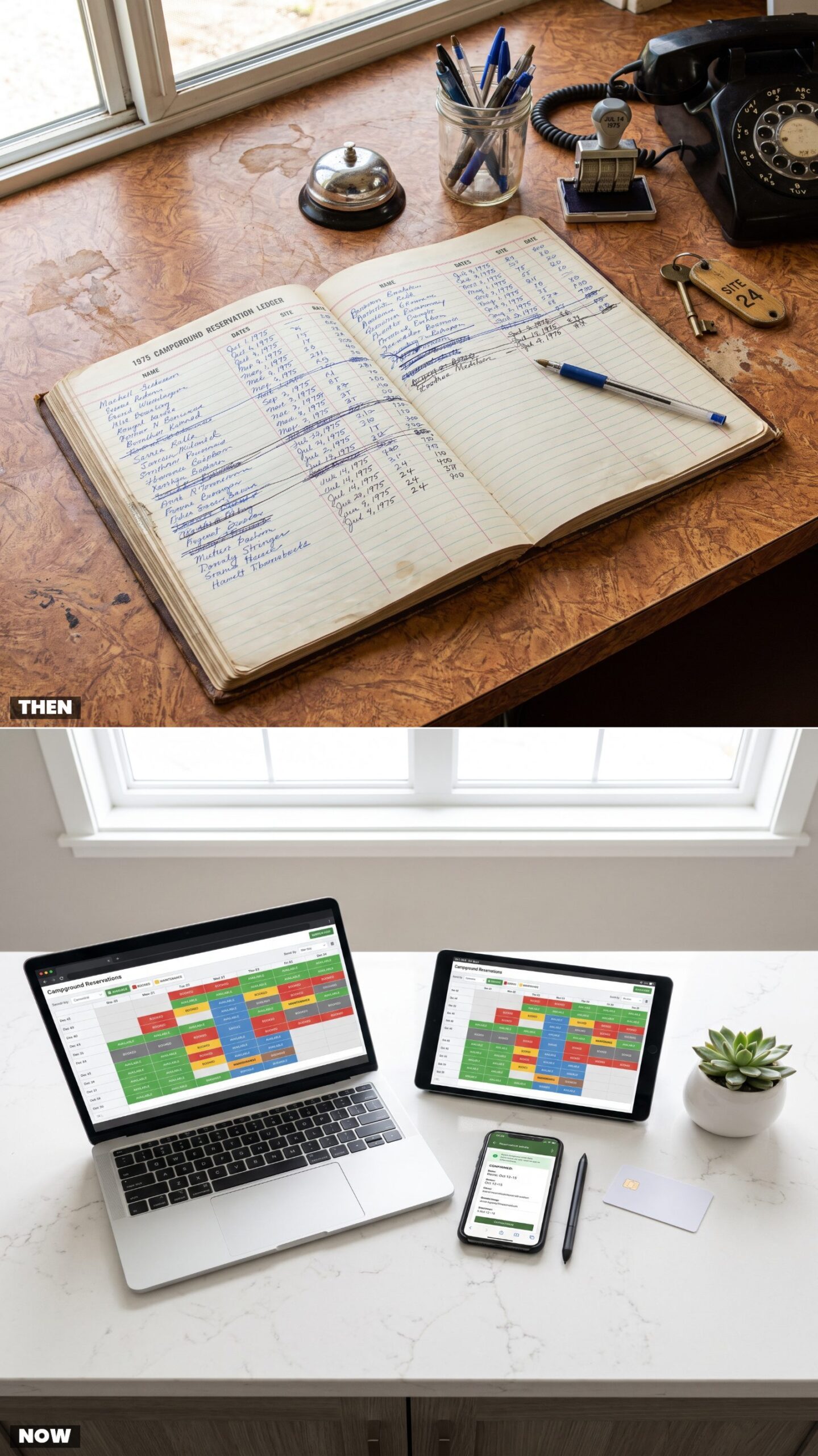
The reservation ledger ran the whole operation. One big lined book, blue ballpoint, entries crossed out and penciled back in, and a clerk who knew from memory which sites flooded after a hard rain. Lose that book and you lost the summer.
Now it’s a color-coded grid you book from your couch in February. Real-time availability, instant confirmation, no phone tag. Progress, no argument. Still, there was something trustworthy about a human who remembered that site 14 sat in a puddle every July.
42. The Cash-and-Traveler’s-Checks Counter vs. the Tap-to-Pay Terminal
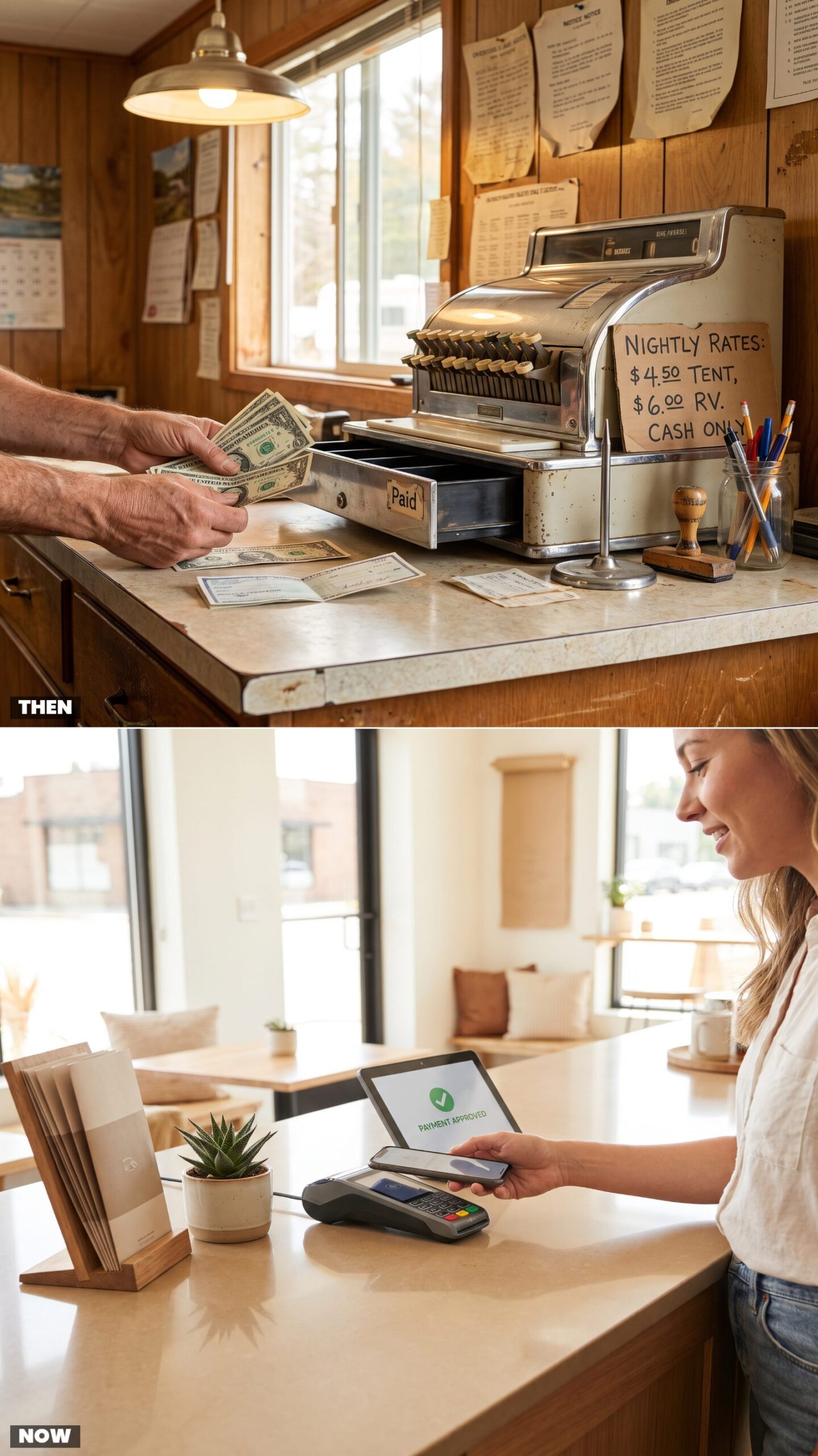
Paying in 1975 meant cash counted onto the counter, or a traveler’s check you signed twice while the clerk checked the signature against the one you’d scrawled that morning. The register rang, the drawer popped, and you got change plus a receipt stabbed onto a metal spike.
Tap-to-pay settles it in a second now. No signature, no counting, no running out of small bills at a rural park with no ATM for forty miles. I’ll say this much, though. A tap doesn’t make that satisfying ka-ching. We gave up a great sound for a great convenience.
41. The Pegboard Campsite Map vs. the Interactive Digital Site Map
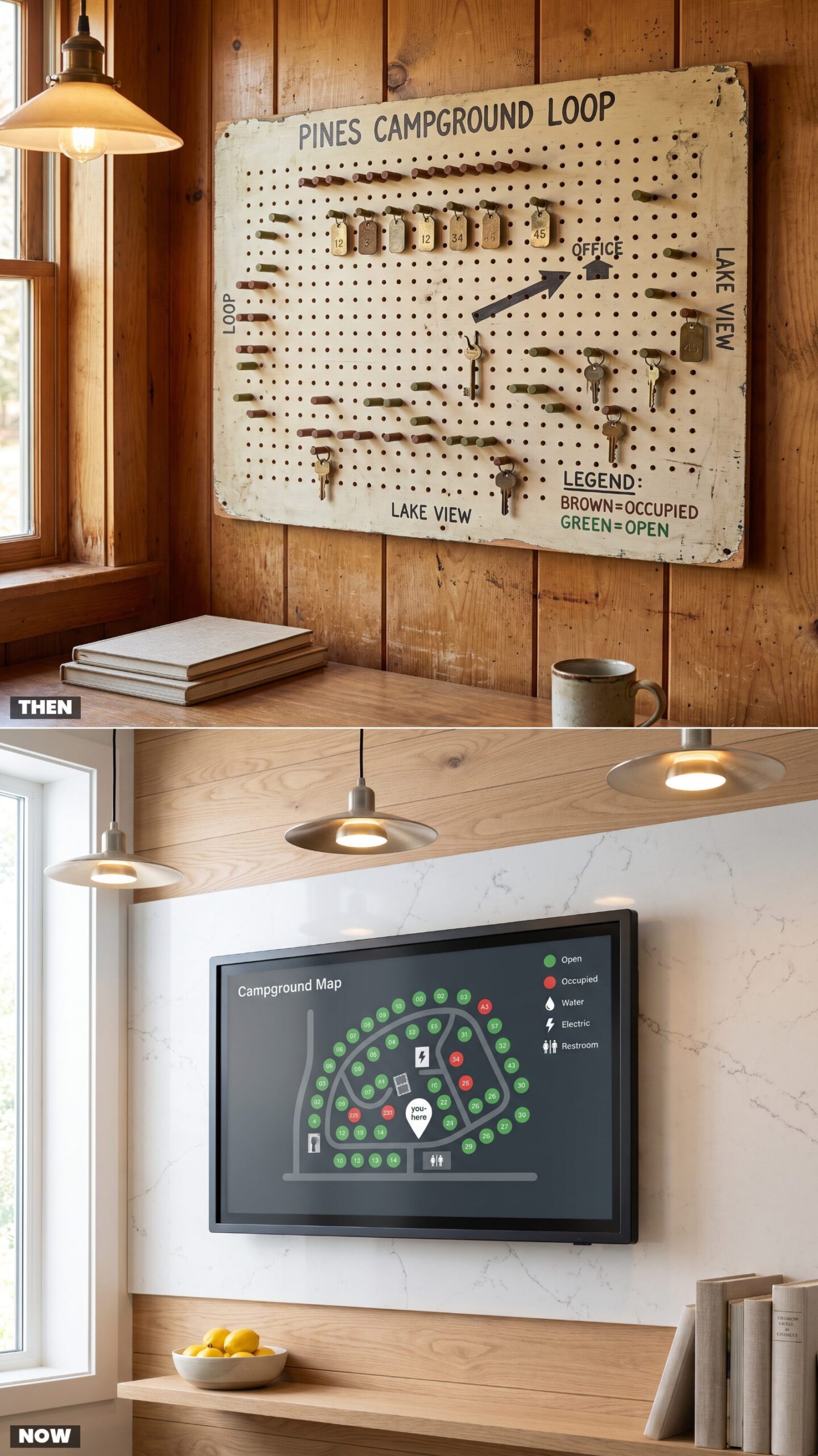
The pegboard map was a plywood work of art. Drilled holes for every site, little wooden pegs or brass tags marking who was in and who was out, and a legend hand-lettered in the corner by somebody with steady handwriting and real pride.
Now a touchscreen shows the whole loop in real time, green for open, red for taken, every hookup iconed and sortable. Faster to read, impossible to lose a peg. But that pegboard told you at a glance that a human ran this place, and that human knew every site by heart.
40. The Dusty Camp Road vs. the Paved, Curbed Resort Loop
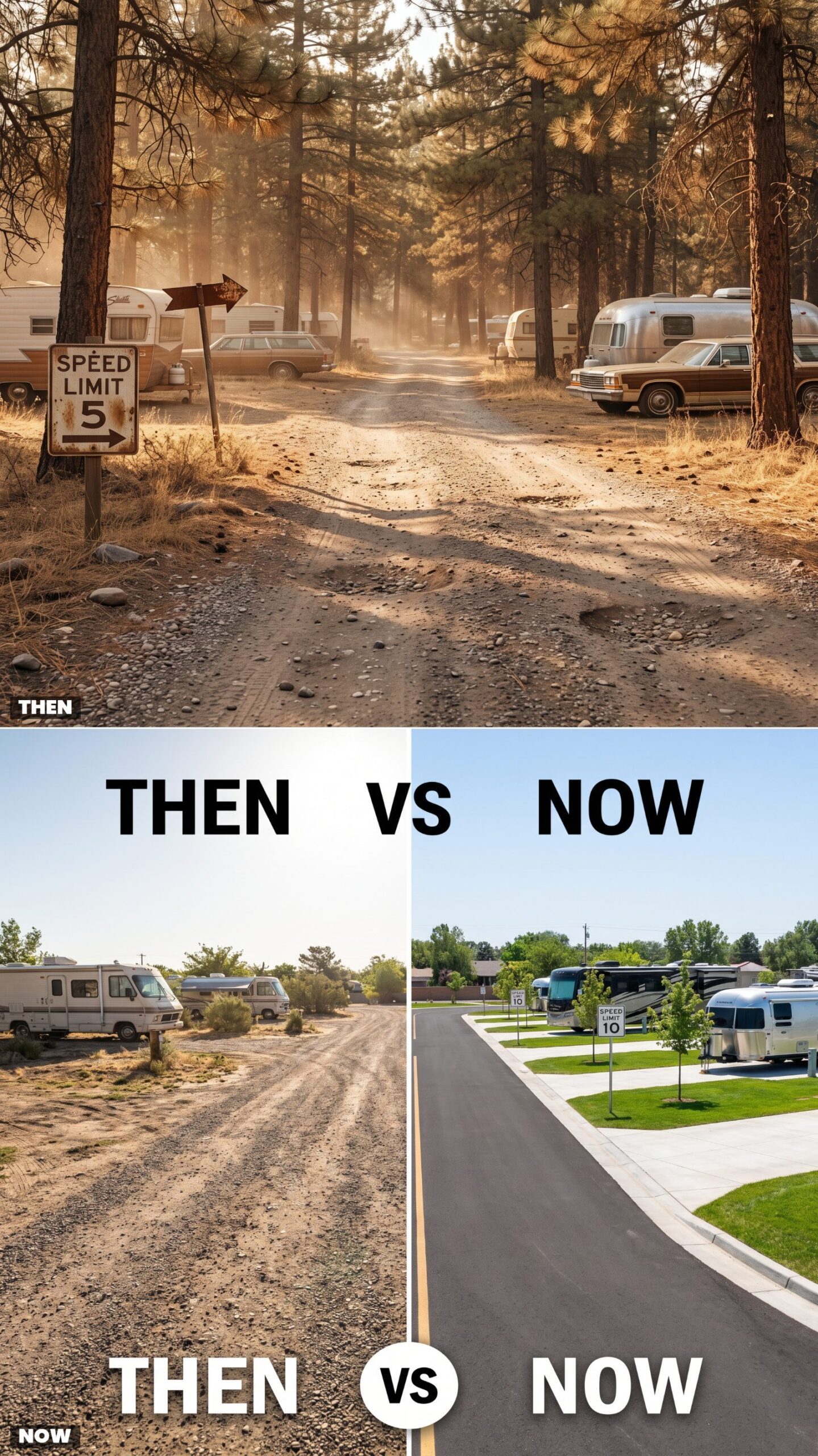
The old camp road was dust and ruts and a 5-mph sign nobody fully believed. By midafternoon a fine film coated your trailer, your windshield, and your sandwich if you left it out. You washed the car when you got home, every time.
Modern resort loops are paved, curbed, striped, and landscaped down the median. No dust, smooth tow, kids can ride bikes without eating gravel. It’s cleaner and safer and absolutely better. Doesn’t stop me picturing the dust hanging gold in the late sun, which is a strange thing to be nostalgic for and I am anyway.
39. The Open Entrance Road vs. Today’s Gated Access System
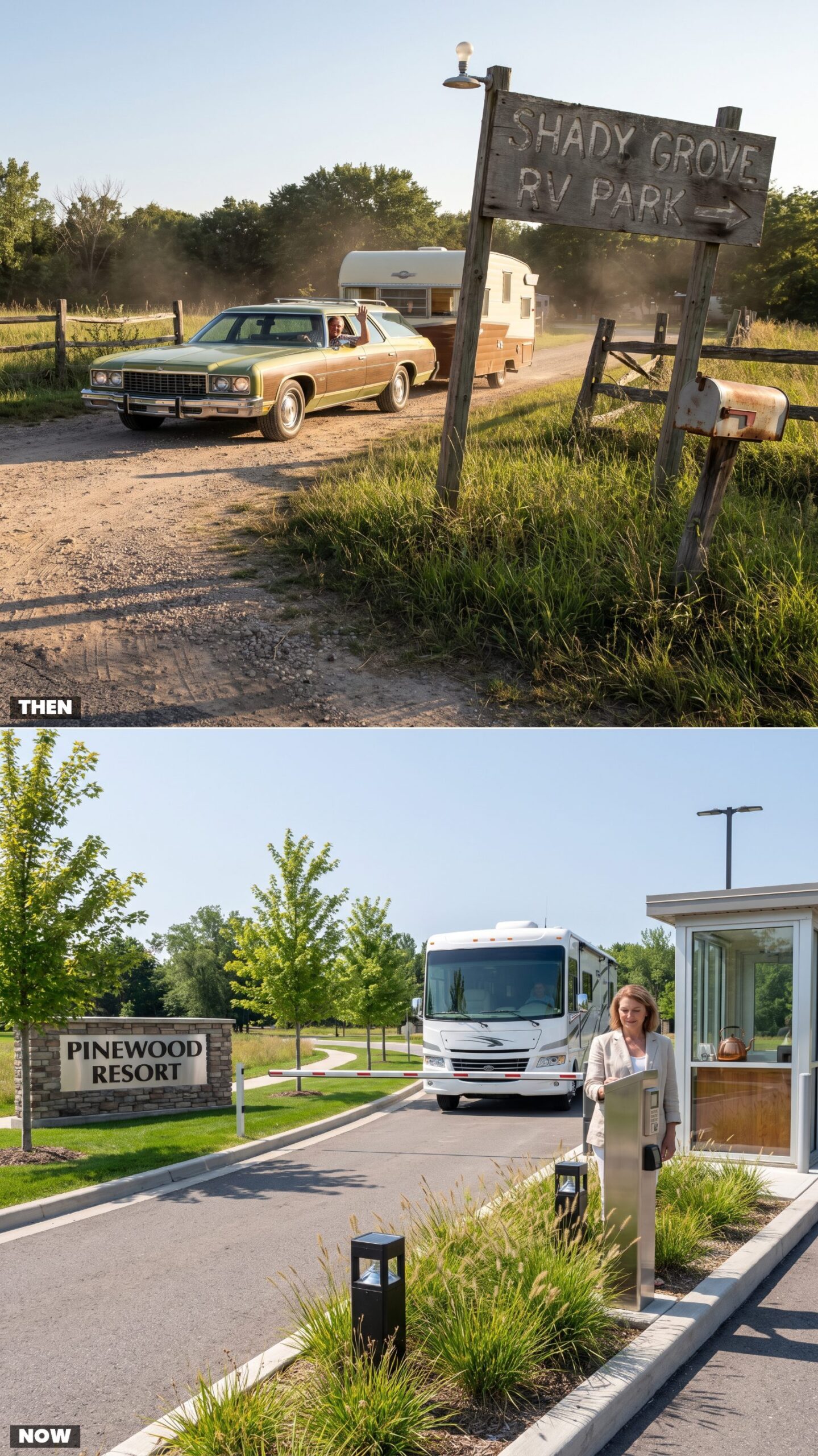
In 1975 you just drove in. The entrance was nothing but a gap in a split-rail fence and a hand-routed wooden sign, with maybe a bell on a string if the owner wanted to know a rig had arrived. Nobody checked you against a reservation because there wasn’t one. You pulled up to the farmhouse, paid cash, and got pointed toward a spot.
Now a gate arm reads your tag before you’ve rolled down the window. Keypad codes, guardhouses, license-plate cameras. It’s safer and it’s smoother. And something about that old open road still makes me a little nostalgic for the days when showing up was the whole reservation.
38. The 30-Amp Electrical Box vs. Today’s 50-Amp Smart Pedestal
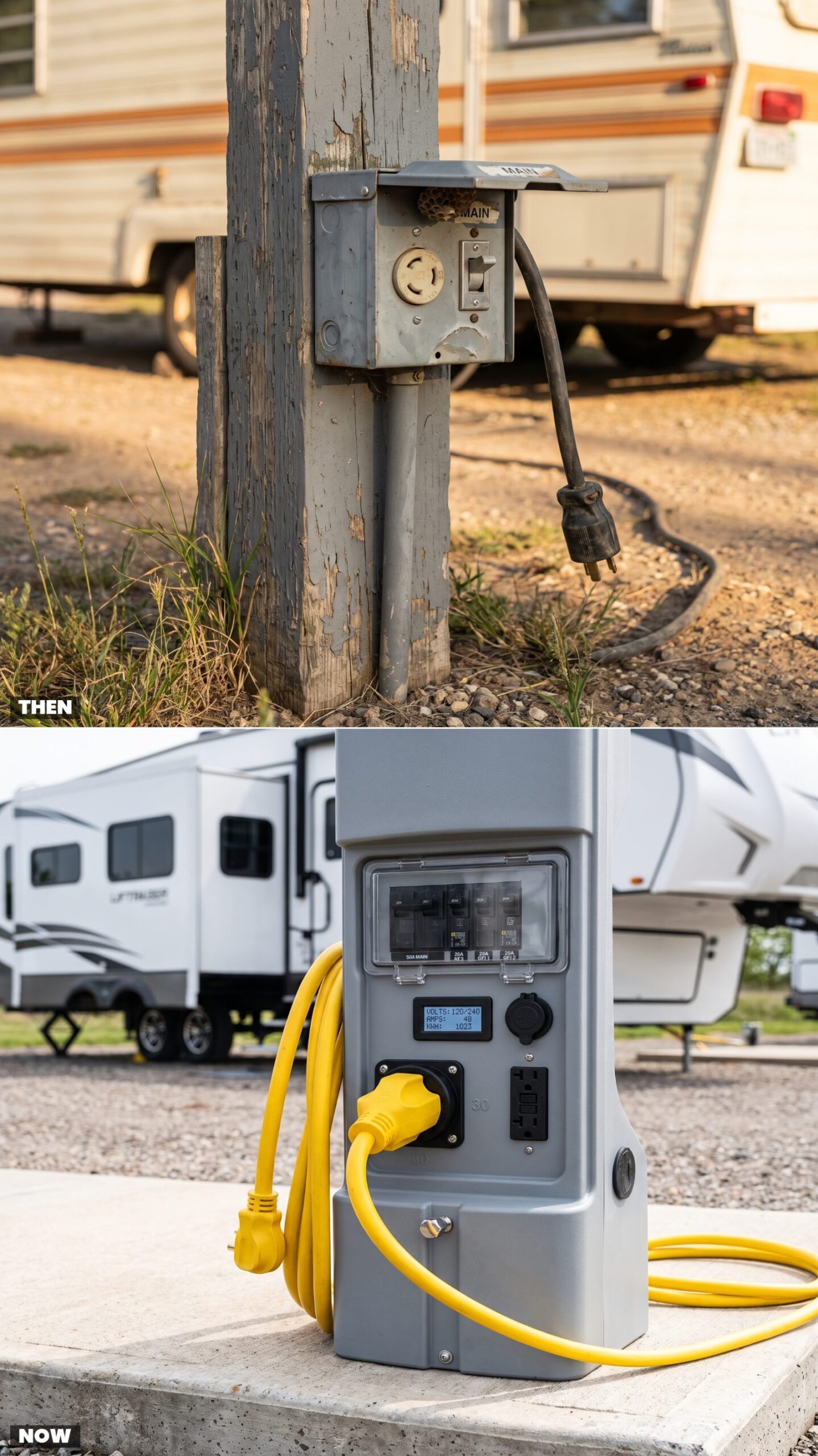
Thirty amps felt generous in 1975. You ran the lights, the water pump, maybe a single air conditioner if you were careful, and you learned fast that the coffee maker and the AC could not shake hands at the same time. That gray box on a splintery post was the whole electrical story, and half of them hummed with a wasp nest tucked under the lid.
Today’s pedestal hands you 50 amps, GFCI protection, a metering screen, and a USB port. Which means both AC units, the microwave, and your laptop charger can all run at once without you doing math in your head. Progress, honestly. I don’t miss tripping breakers in the dark.
37. The Shared Water Spigot vs. Today’s Full-Hookup Water Connection
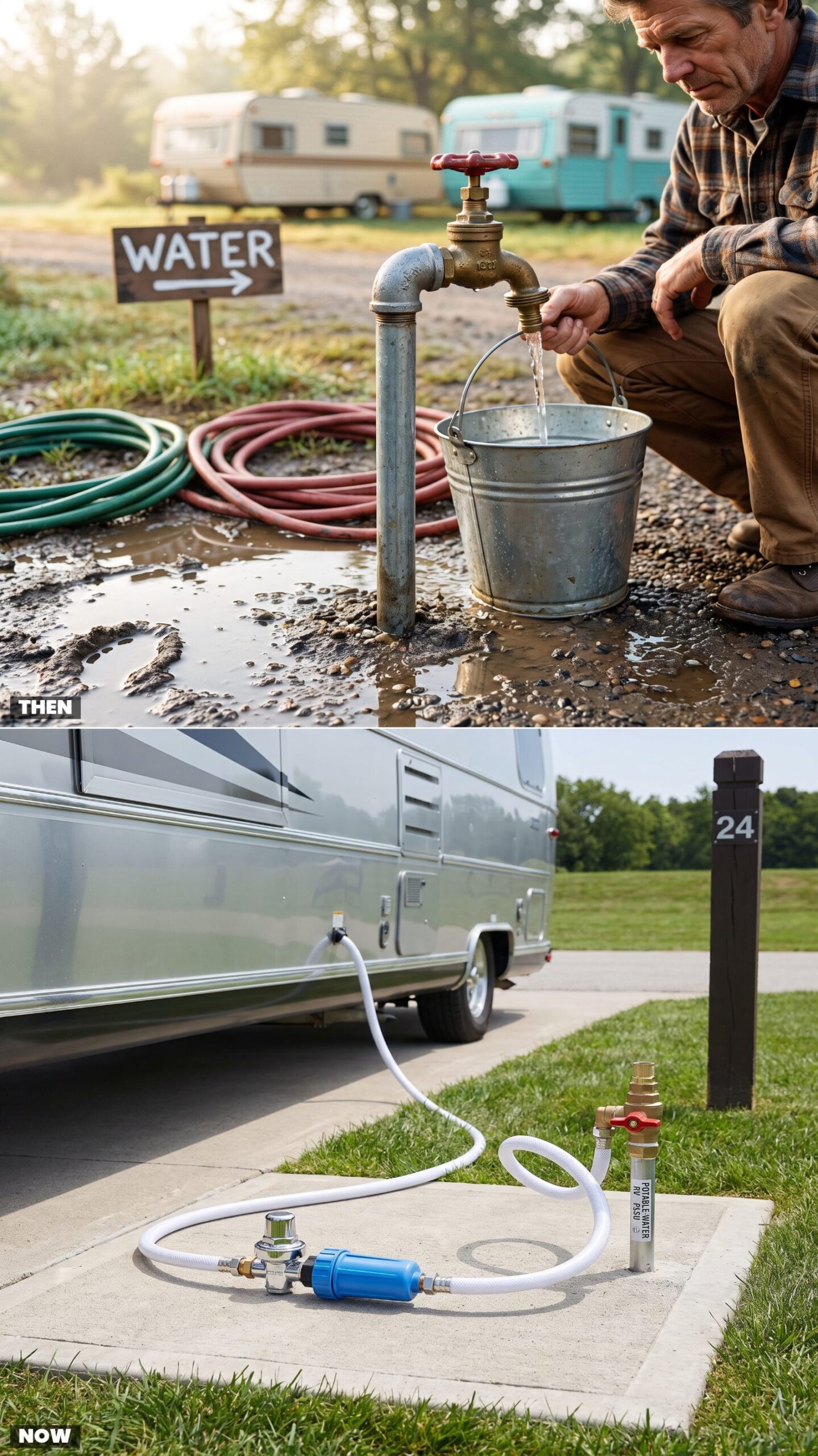
You walked to the water in 1975. One spigot served a dozen sites, and you filled your fresh tank a bucket at a time or ran a hose across the grass and hoped nobody tripped on it. The ground around that pipe stayed permanently muddy, and there was an unspoken etiquette about not hogging the wheel at suppertime.
Now water comes straight to your pad, filtered and pressure-regulated, with a valve you can leave connected all week. Less walking, no bucket, no muddy footprints. The old spigot built character. The new hookup builds longer showers.
36. The Bare Sewer Pipe vs. Today’s Sealed Full-Hookup Station
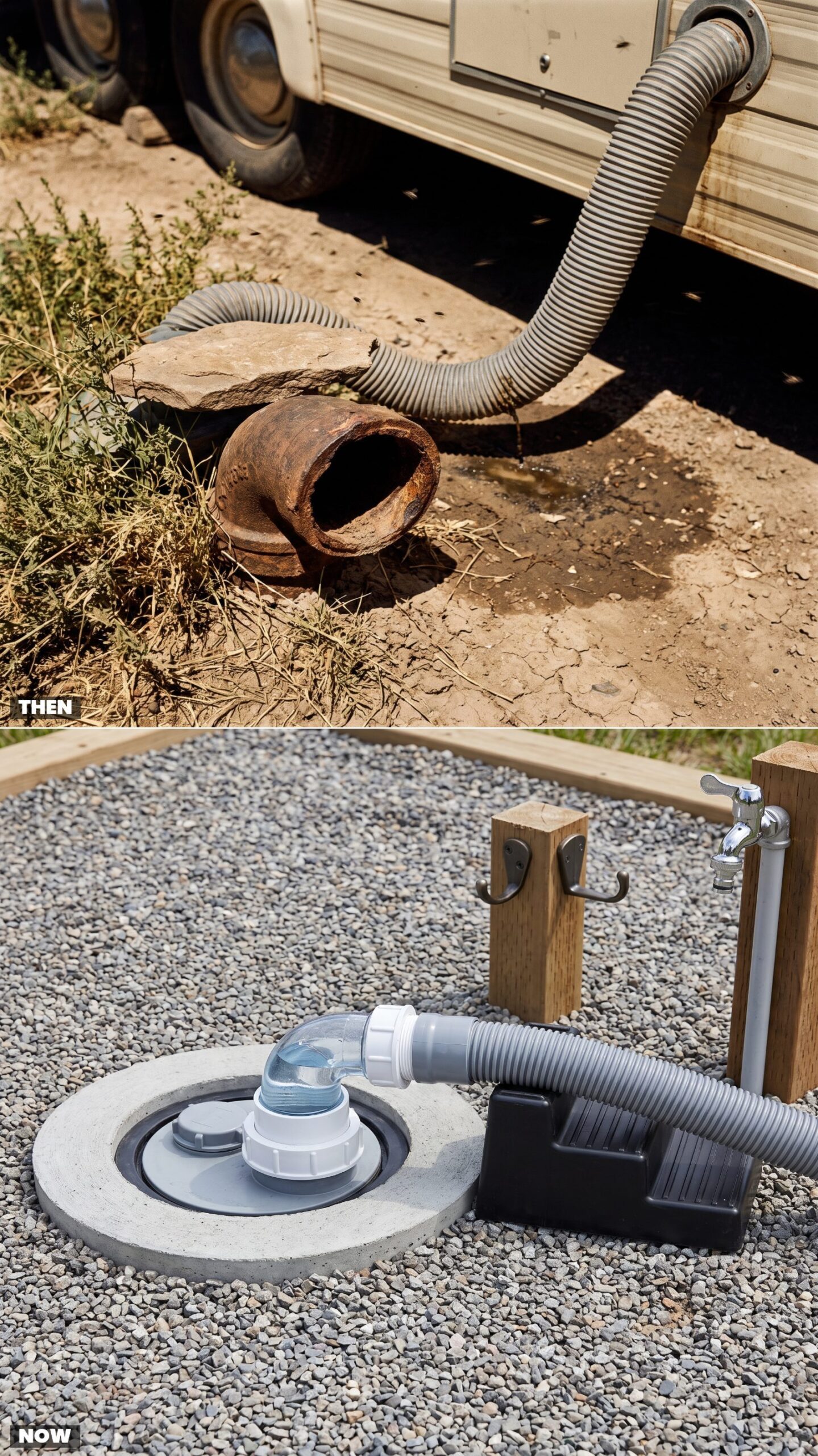
Here’s the one nobody photographed for the brochure. In 1975 the sewer connection was an open pipe in the dirt with a rock laid over the hole between uses. Your hose sagged in the middle, and if the ground sloped the wrong way, you found out the hard way. It worked. It also smelled like it worked.
The modern station seals everything up tight. Threaded adapters, clear elbows so you can watch the flow, a hose support that keeps the line sloped and off the ground, even a rinse spigot and a glove hook. The whole chore takes two minutes and your nose never gets involved. I’ll take modern plumbing on this one every single time.
35. The Picnic Table on Bare Dirt vs. Today’s Furnished Patio Site
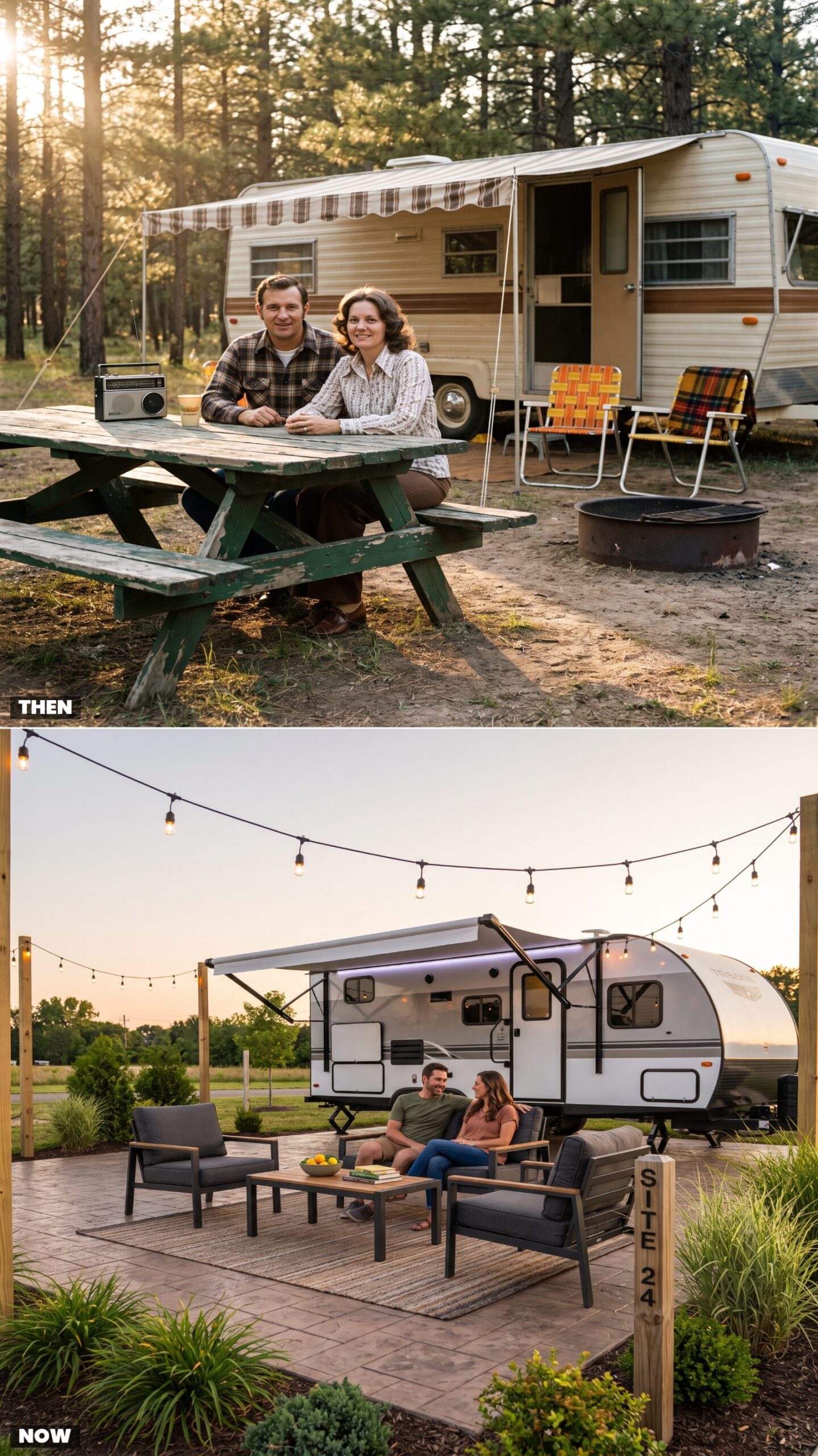
The outdoor room in 1975 was a splintery picnic table parked on whatever the ground happened to be. Dirt, mostly. You brought your own folding chairs with the woven nylon webbing that left waffle marks on the back of your legs, and the table did triple duty as kitchen, card table, and homework desk. Nobody minded. That was camping.
Premium sites now come furnished like somebody’s backyard patio. Stamped concrete pad, an outdoor rug, cushioned seating, little lights strung overhead. You arrive and the living room is already set up.
34. The Stone Fire Circle vs. Today’s Adjustable Smokeless Fire Pit
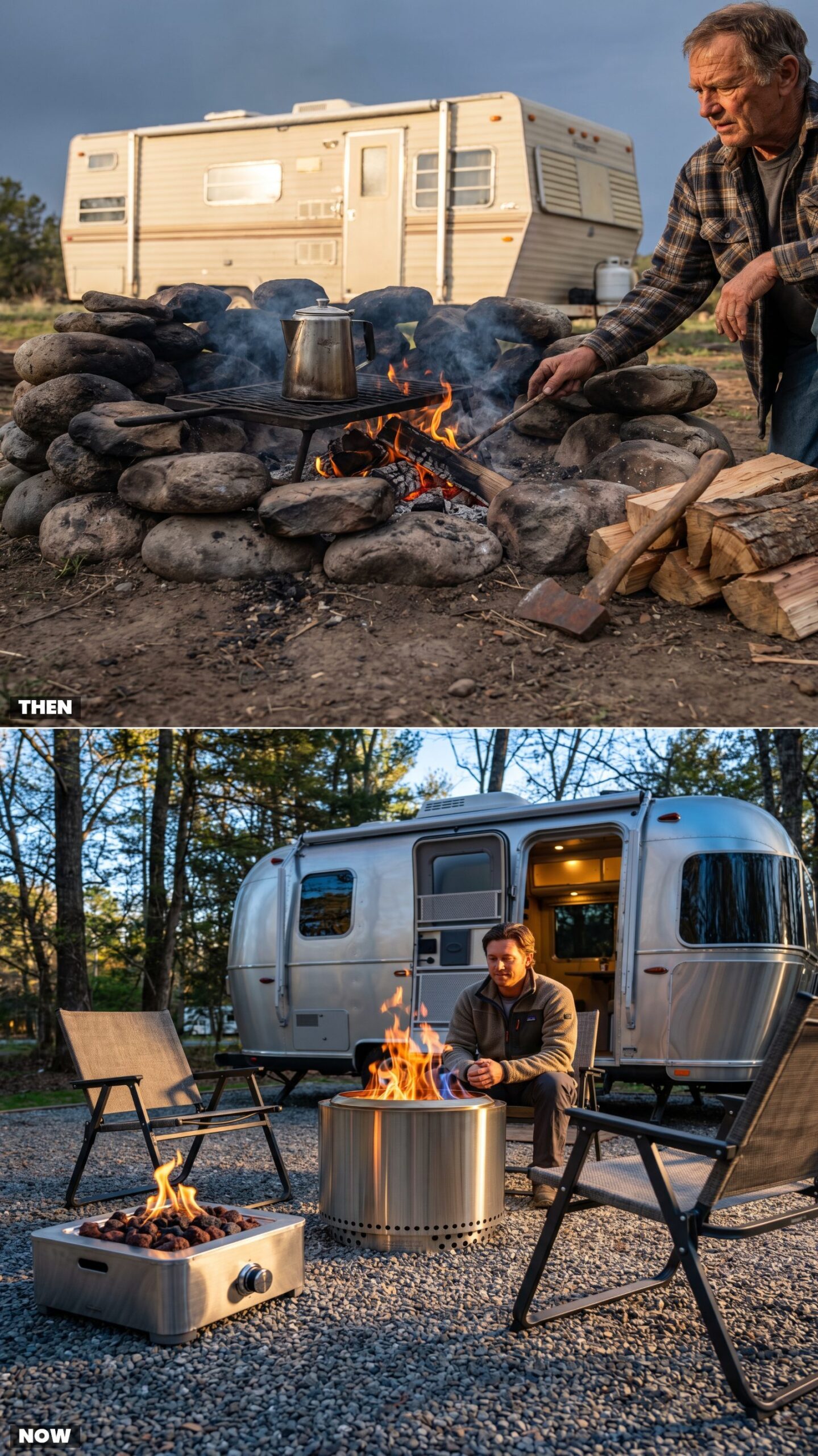
A fire circle in 1975 was whatever stones you could stack and a grate somebody left behind. The smoke followed you around the circle no matter where you sat, and your jacket smelled like campfire for three days afterward, which was half the reason you loved it. You cooked on a crooked grate and watched sparks climb into the pines.
Modern smokeless pits burn hotter and cleaner. Double-wall stainless steel pulls air through and reburns the smoke, so you get the flames without the eyes-watering haze. Some sites even throw in a propane pit with a knob, handy for fire bans and lazy nights.
33. The Cinder-Block Bathhouse vs. Today’s Spa-Inspired Comfort Station
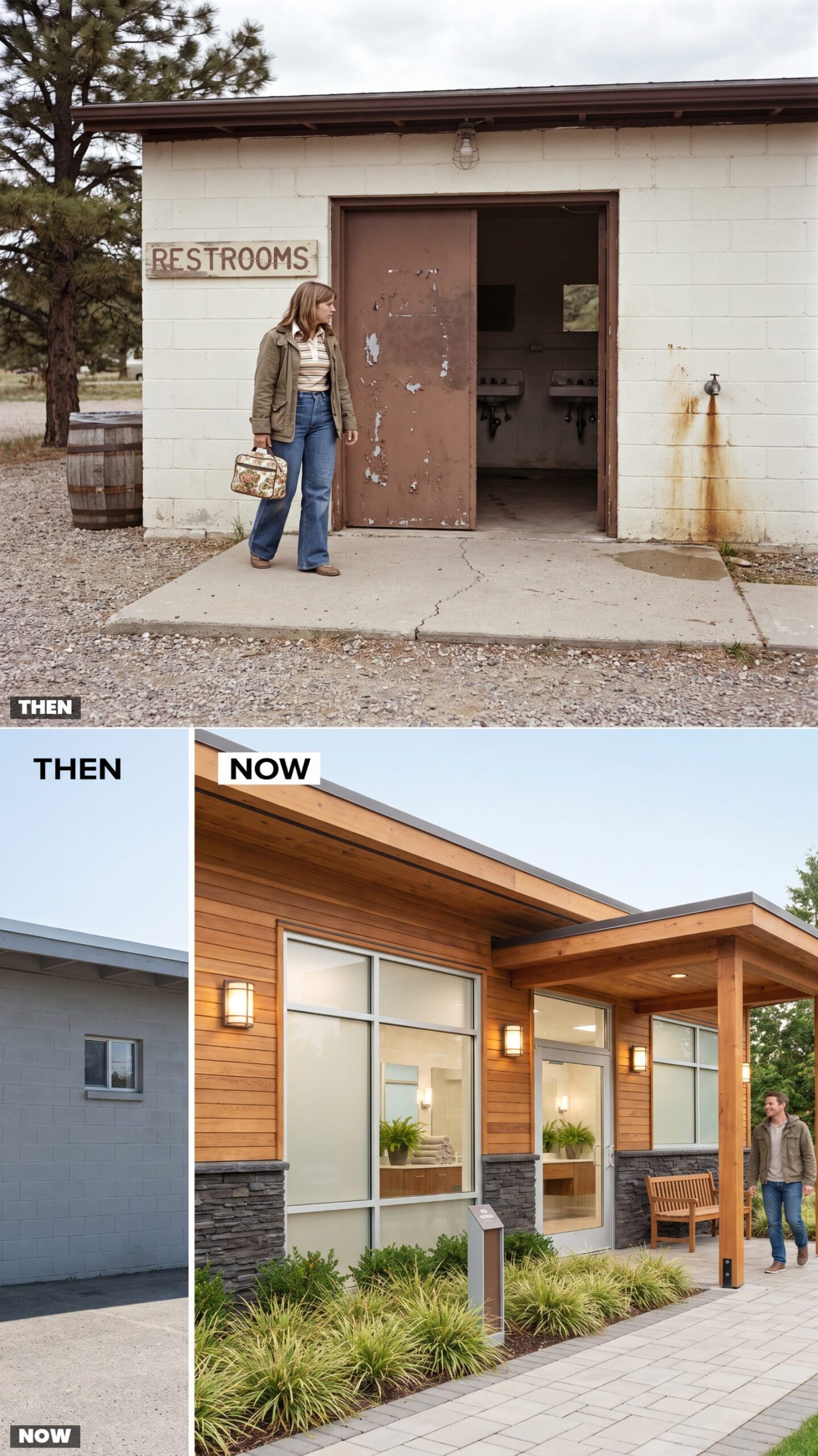
You remember the cinder-block bathhouse by its echo. White painted block, a bare bulb over a heavy metal door, a concrete floor that stayed cold in August, and a disinfectant smell that never quite won. It did the job and asked nothing more of itself. You wore your flip-flops in there, and you did not linger.
Comfort stations now look like a boutique hotel had a baby with a national park lodge. Wood cladding, tile floors, floating vanities, actual lighting you’d choose for your own bathroom, sometimes a little seating nook with plants. The word “bathhouse” barely applies anymore.
32. The Coin-Operated Shower Stall vs. Today’s Private Family Shower Suite
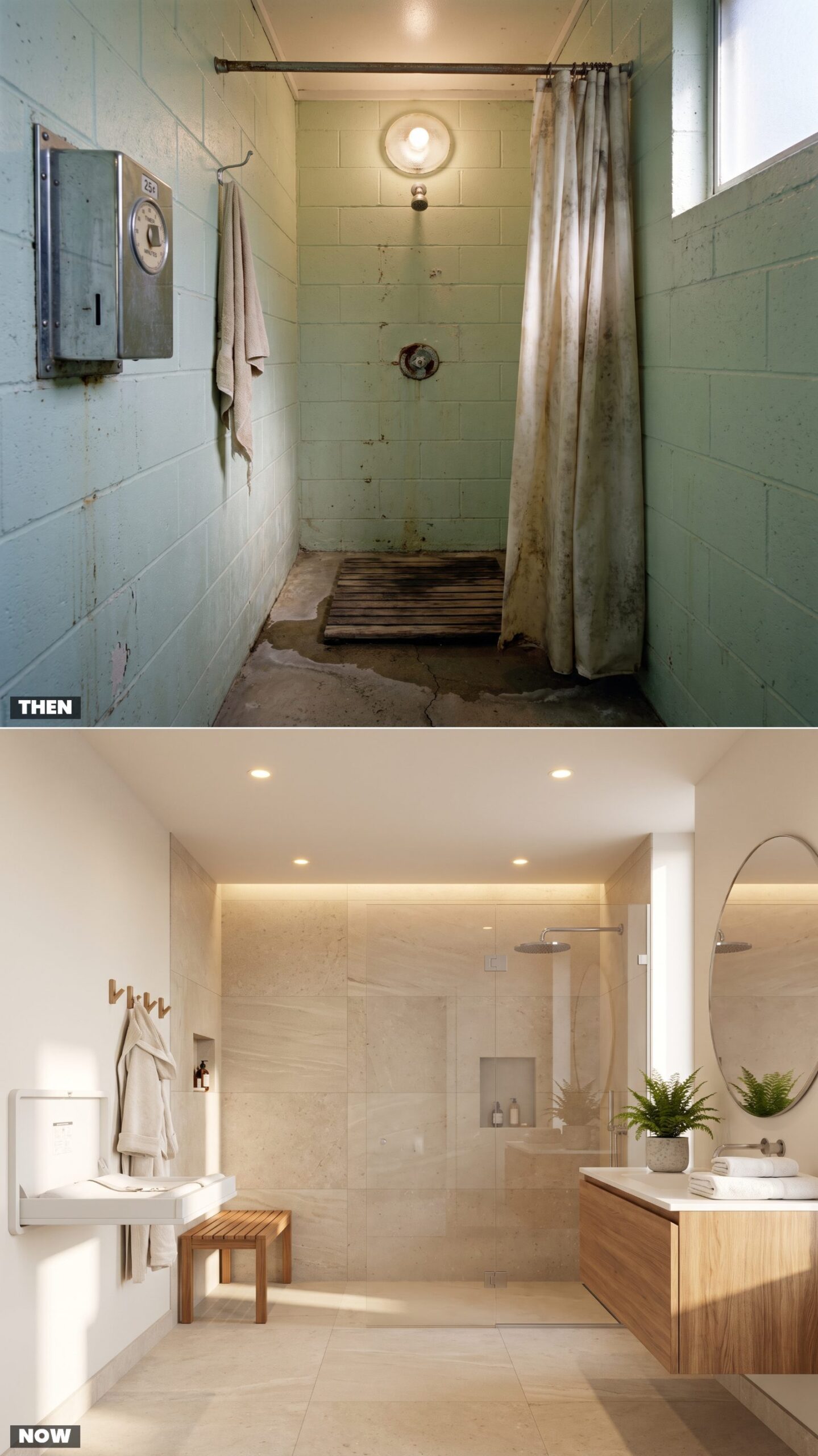
Quarters. You needed quarters. The 1975 shower ran on a coin timer, so you learned to get fully lathered before you fed the slot, because the water quit the second your time ran out, usually mid-rinse with soap in your eyes. The stall was the size of a phone booth, the curtain clung to your elbow, and that duckboard mat under your feet had seen things.
Private family suites now give you a whole room: a walk-in with a rainfall head, a bench, a vanity, a dry zone to change in, hooks that actually hold a towel. No coins, no clock, no soap-in-the-eyes panic.
31. The Two-Washer Laundry Room vs. Today’s App-Connected Laundry Center
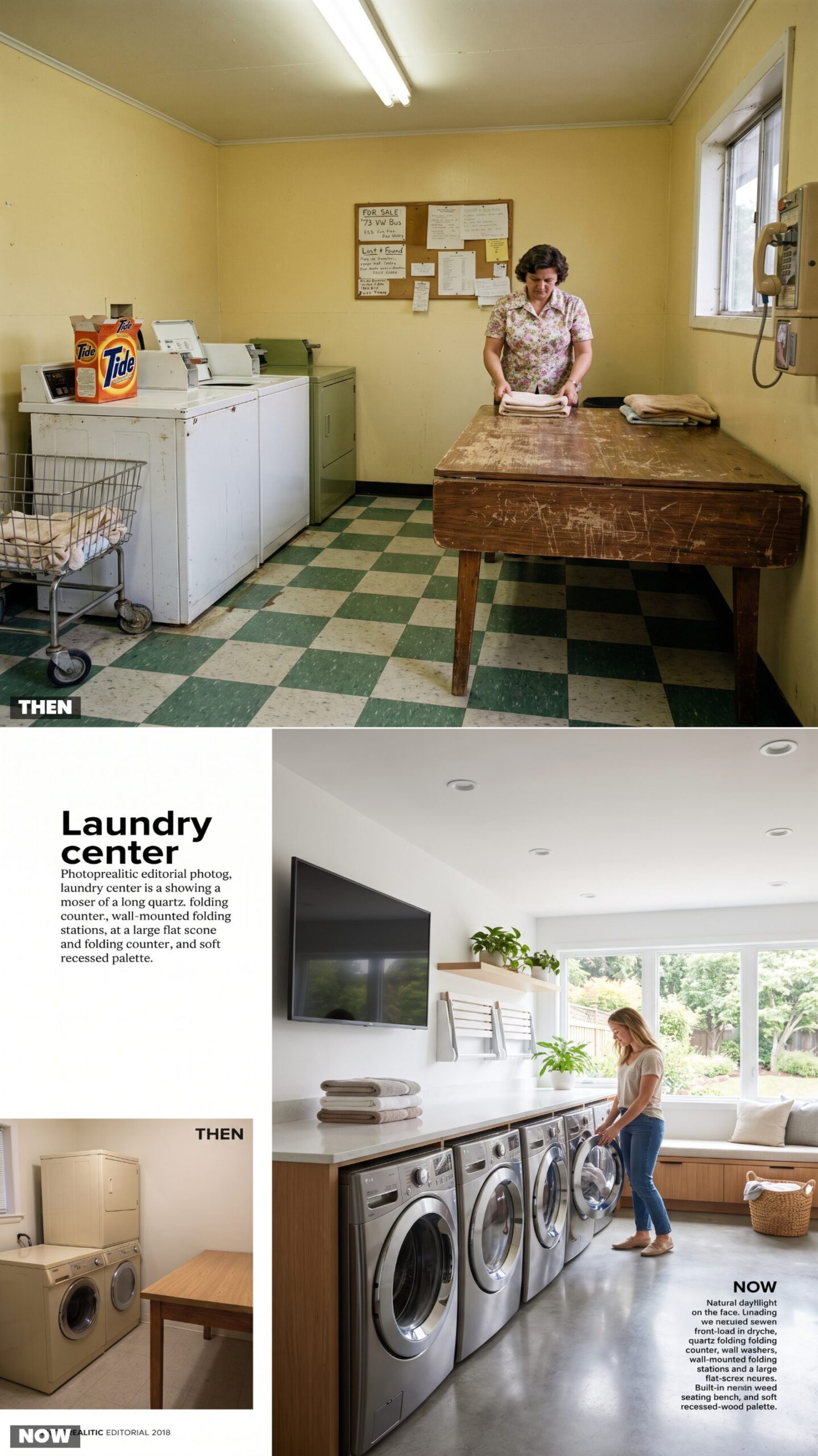
Two washers, one dryer, and a line of campers waiting their turn with a roll of quarters and a lot of patience. The 1975 laundry room was a cramped yellow box with a wobbly cart, a wooden folding table, and a bulletin board papered with thumb-tacked notes about lost dogs and firewood for sale. You guarded your load like a sentry so nobody dumped it on the table.
Modern laundry centers run on an app that pings your phone when the cycle’s done, so you can sit by your rig instead of standing guard. Front-loaders, quartz folding counters, a bench, sometimes a TV. Laundry day stopped being a hostage situation.
30. The Tiny Camp Store vs. Today’s Full-Service Market and Coffee Bar
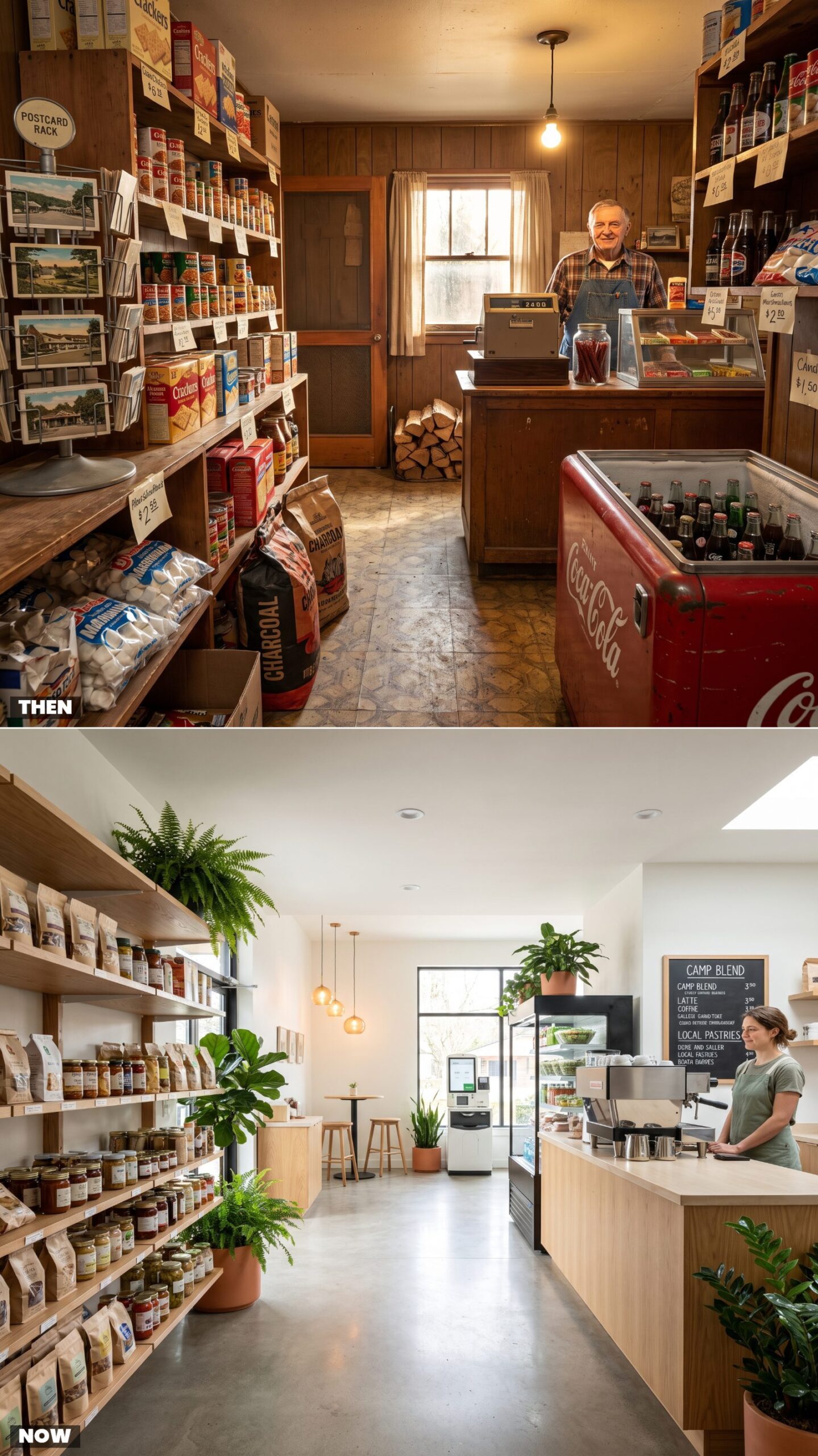
The 1975 camp store fit in one room and sold exactly what you forgot: charcoal, marshmallows, a loaf of bread, bug spray, and penny candy from a glass case that steamed up when a kid pressed his nose to it. A spinning rack of postcards, a cooler of glass-bottle sodas, firewood by the door, and a shopkeeper who knew which site you were on before you said it.
Now it’s a small market with a coffee bar. Espresso drinks, local provisions, grab-and-go, self-checkout, a stool by the window. Handy, and the coffee’s genuinely good. Still, nothing replaces that candy case and the postcard rack that squeaked when it turned.
29. The Portable Propane Tank Cage vs. Today’s Drive-Up Filling Station
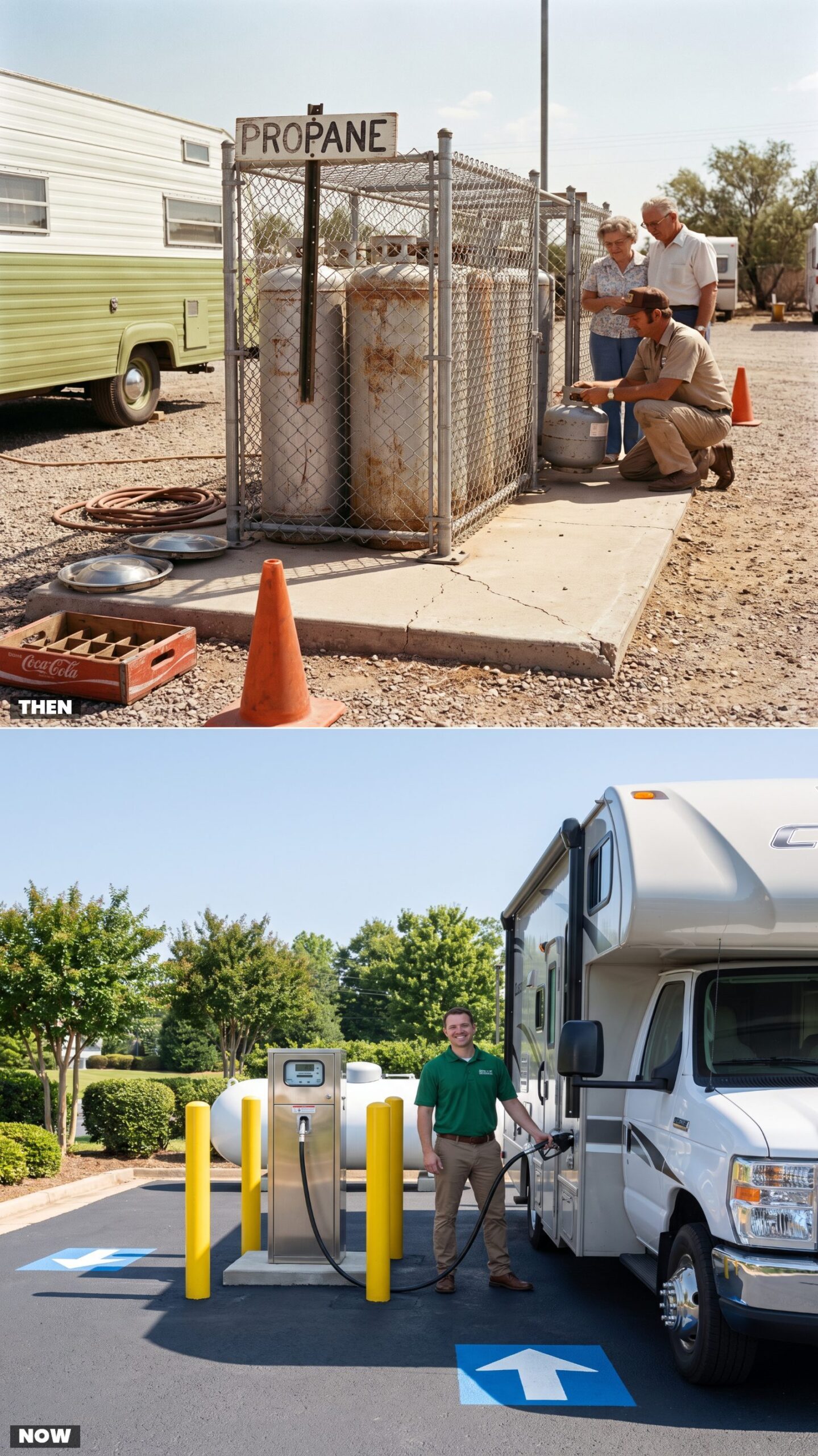
In 1975 you backed up to a chain-link cage, lifted your own empty bottle, and swapped it for whichever tank looked least rusty. The attendant eyeballed the fill, nobody weighed anything, and you paid in cash and hoped it lasted the weekend.
Now you pull up to a stainless dispenser with a digital readout, keep your tank mounted, and pay by the gallon down to the penny. Four minutes, and you never lift a thing.
28. The Open Concrete Dump Point vs. Today’s Sanitary Multi-Lane Dump Station
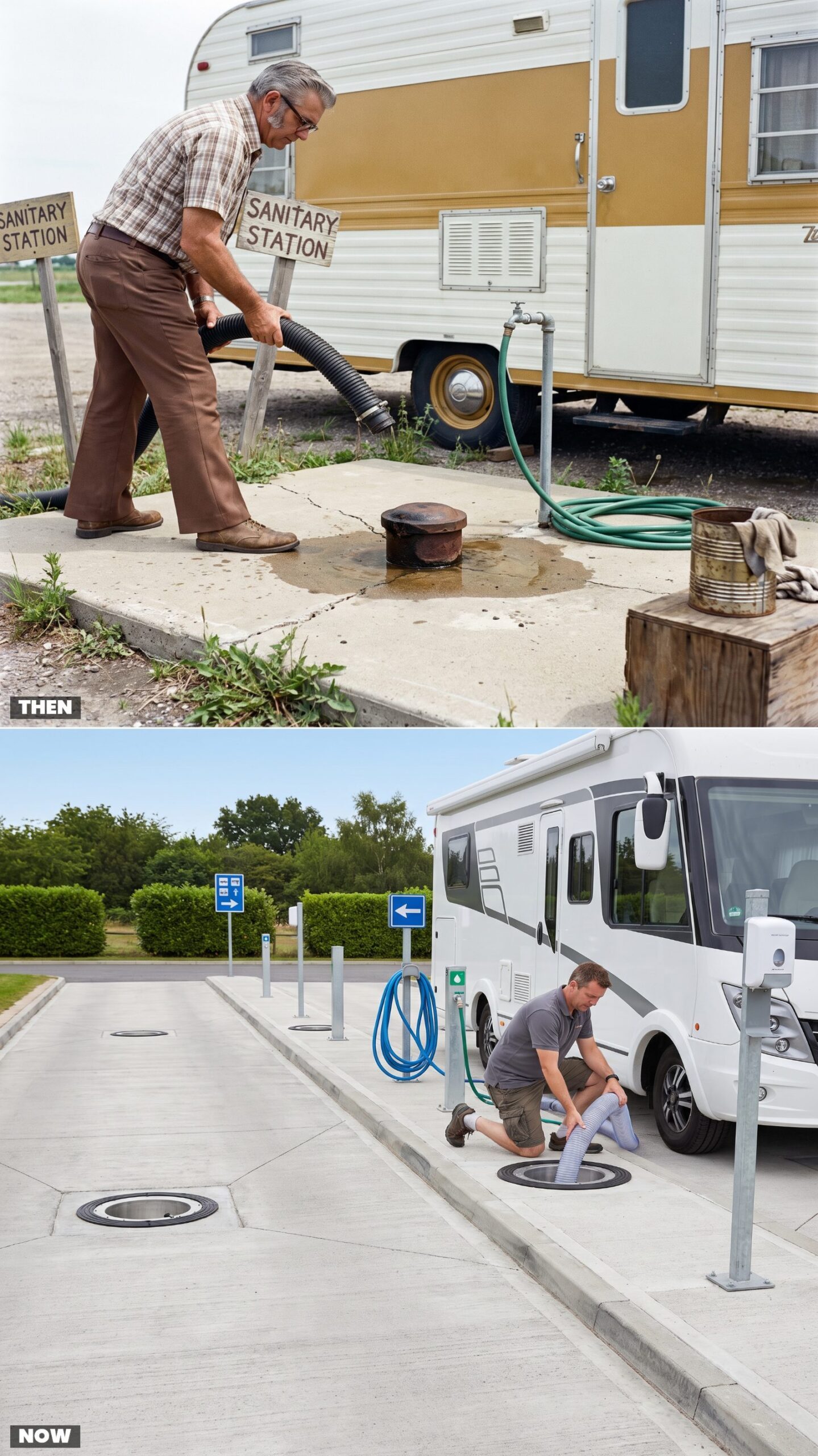
The 1975 dump point was one slab, one cap, and a lot of faith. You held the hose, prayed for a good seal, and rinsed with the same garden hose everyone used for drinking water the day before. Charming? No. This was the part of camping nobody photographed.
Modern stations keep potable separate from non-potable, hand you a clear elbow so you can actually see when you’re done, and park a hand-sanitizer station right where you need it. I’ll admit the clear elbow is the single best upgrade in all of RVing, and I don’t care how that sounds.
27. The Metal Trash Barrels vs. Today’s Enclosed Recycling and Waste Station
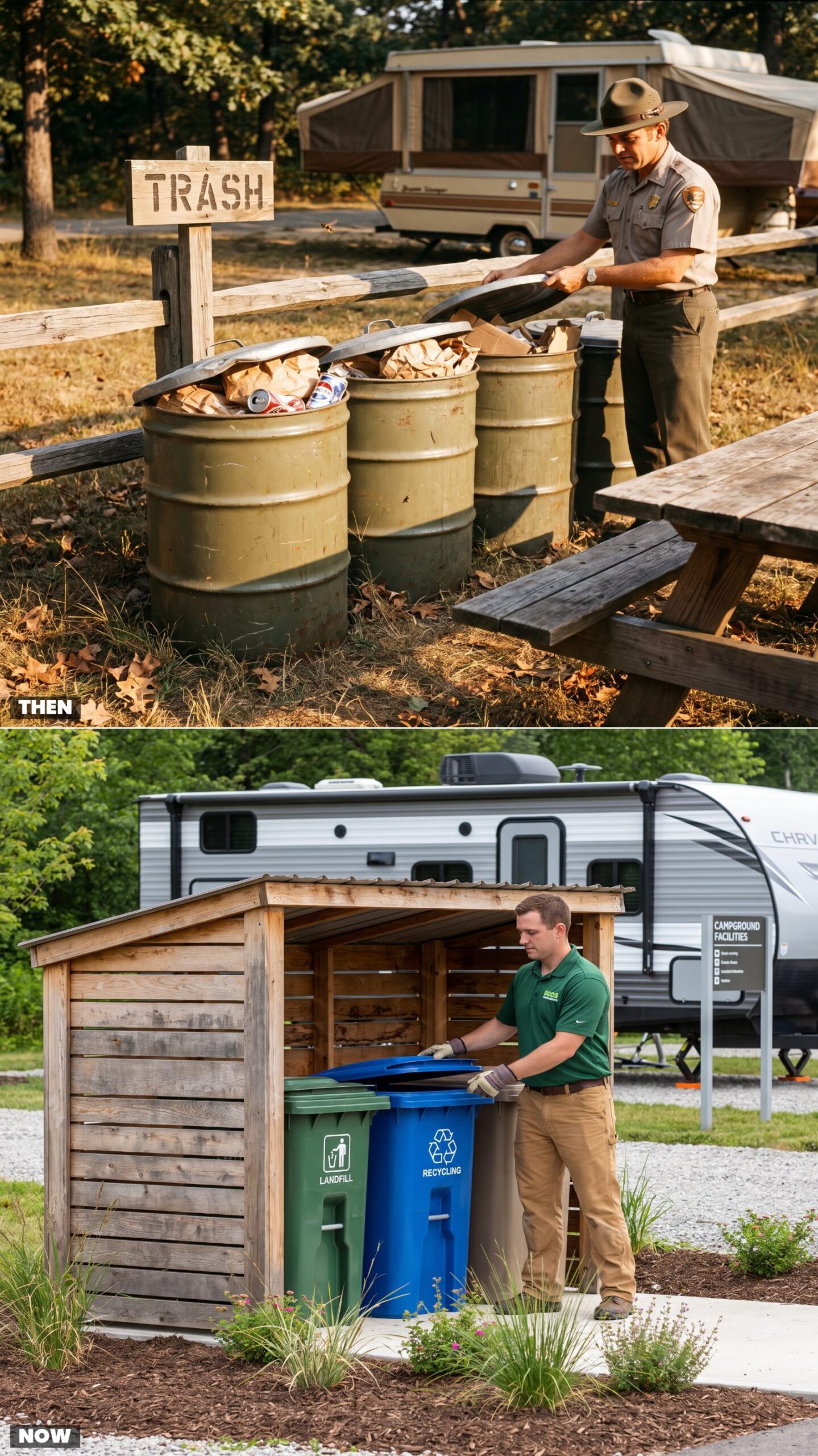
Everything went in the same olive barrel in 1975: food scraps, bottles, the melon rind, the paper plates. The lid never quite fit, the raccoons knew the schedule, and the smell on a July afternoon told you exactly where the barrels were without a sign.
Now you sort it. Cedar-slat enclosures, color-coded bins, lids that actually seal, and pictograms so you know where the crushed cans go. Less smell, fewer critters, and a park that looks like someone cares.
26. The Rectangular Community Pool vs. Today’s Resort Pool Complex
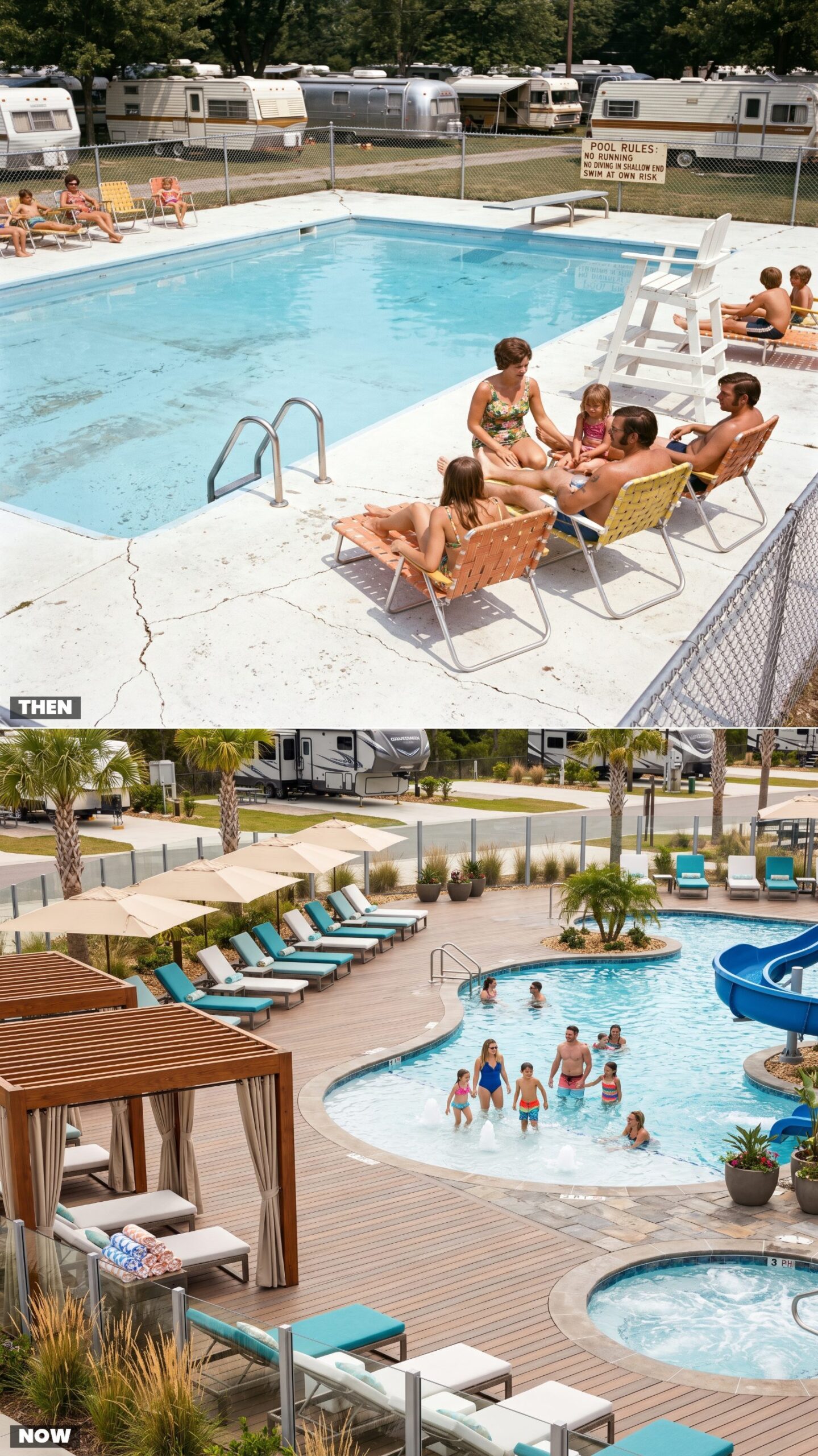
The 1975 pool was a blue rectangle with a diving board and a lifeguard who mostly watched for horseplay. You jumped off the board, got yelled at for running, and dried off on a scratchy aluminum lounger that pinched your thighs. It was enough. Honestly, it was plenty.
The modern version expands all of that into a zero-entry free-form pool with a slide, a hot tub, a shaded cabana, and loungers you don’t need to peel yourself off of. The diving board is mostly gone, and I miss it more than I should.
25. The Kiddie Pool vs. Today’s Interactive Splash Pad
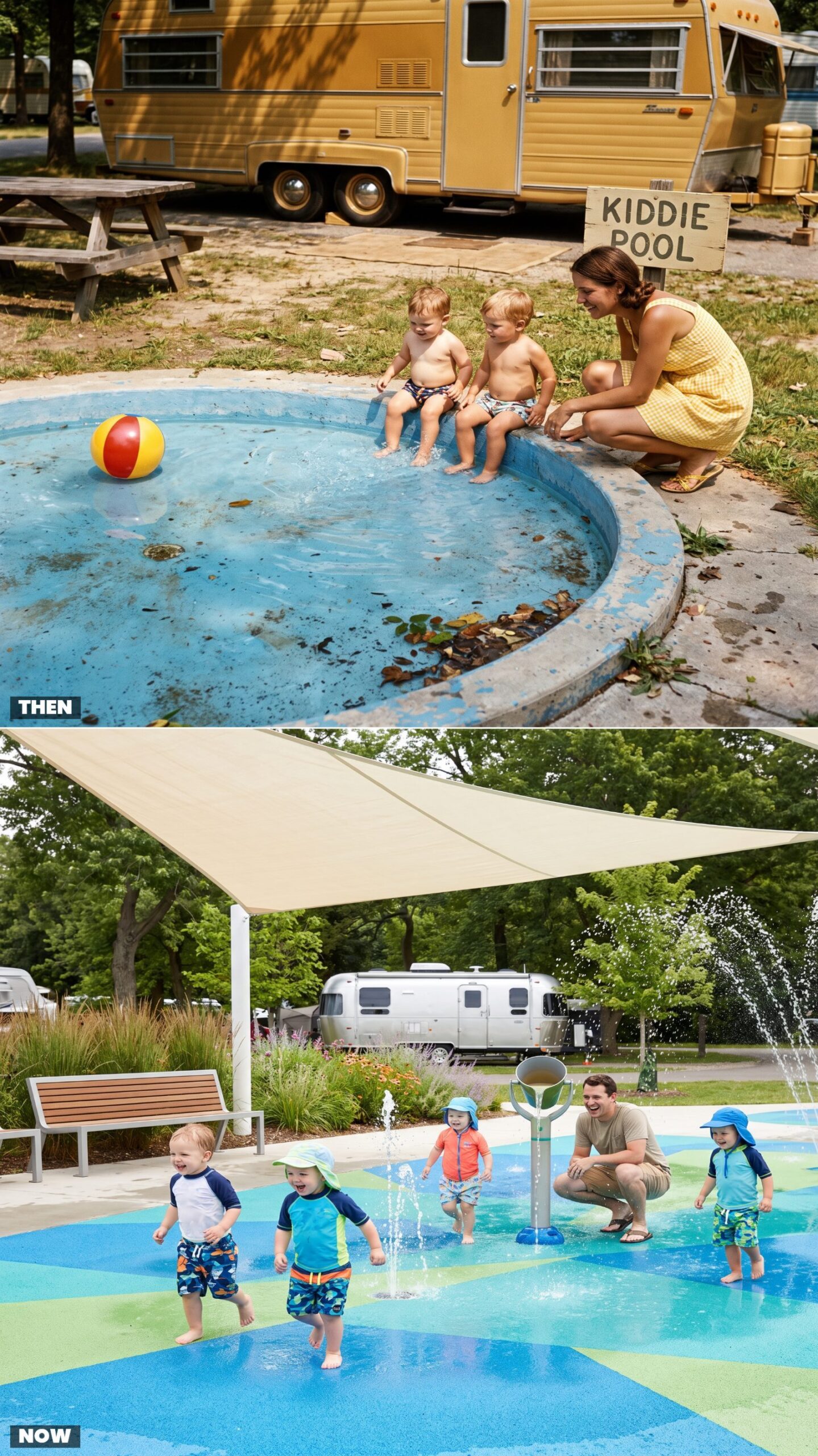
A foot of sun-warmed water in a round concrete dish. That was the kiddie pool. The leaves gathered at the edge, the water crept from cool to bathwater by noon, and nobody worried much about anything. It did the job.
Splash pads changed the math. No standing water, so no drowning risk and nothing to drain and refill. Sprayers, tipping buckets, and ground geysers keep kids busy for hours while the parents actually sit down.
24. The Metal-Slide Playground vs. Today’s Safety-Surfaced Adventure Playground
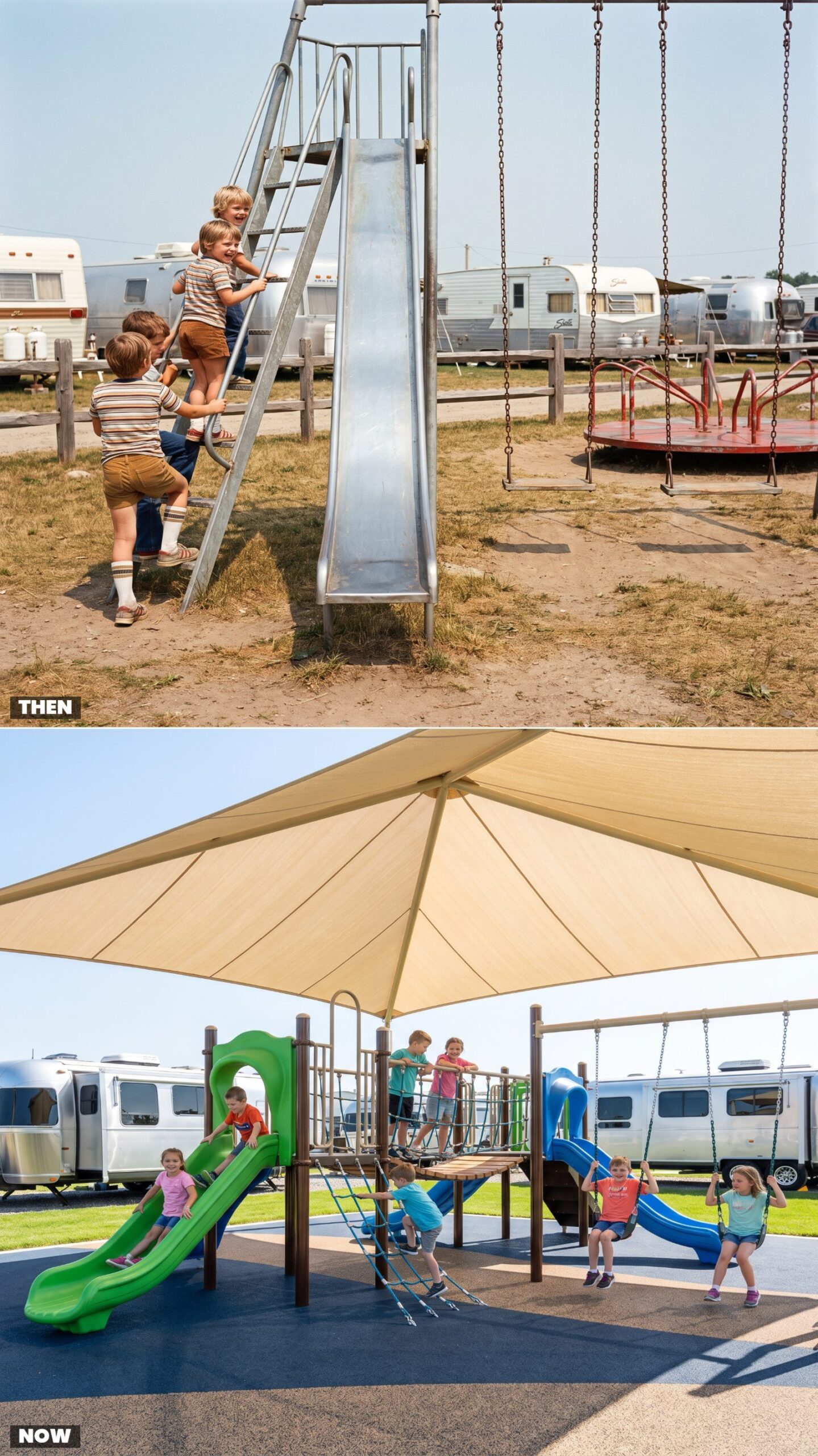
That 1975 slide was raw galvanized metal, and by two in the afternoon it would brand the back of your legs like a griddle. The landing was packed dirt. The merry-go-round spun until somebody flew off, and we all survived, mostly, and nobody thought twice.
Today the slides are molded plastic that stays cool, the structure sits over poured rubber, and a shade sail keeps the whole thing from turning into a skillet. Fewer skinned knees, fewer burns, and parents who can finally relax.
23. The Horseshoe Pit vs. Today’s Pickleball Courts
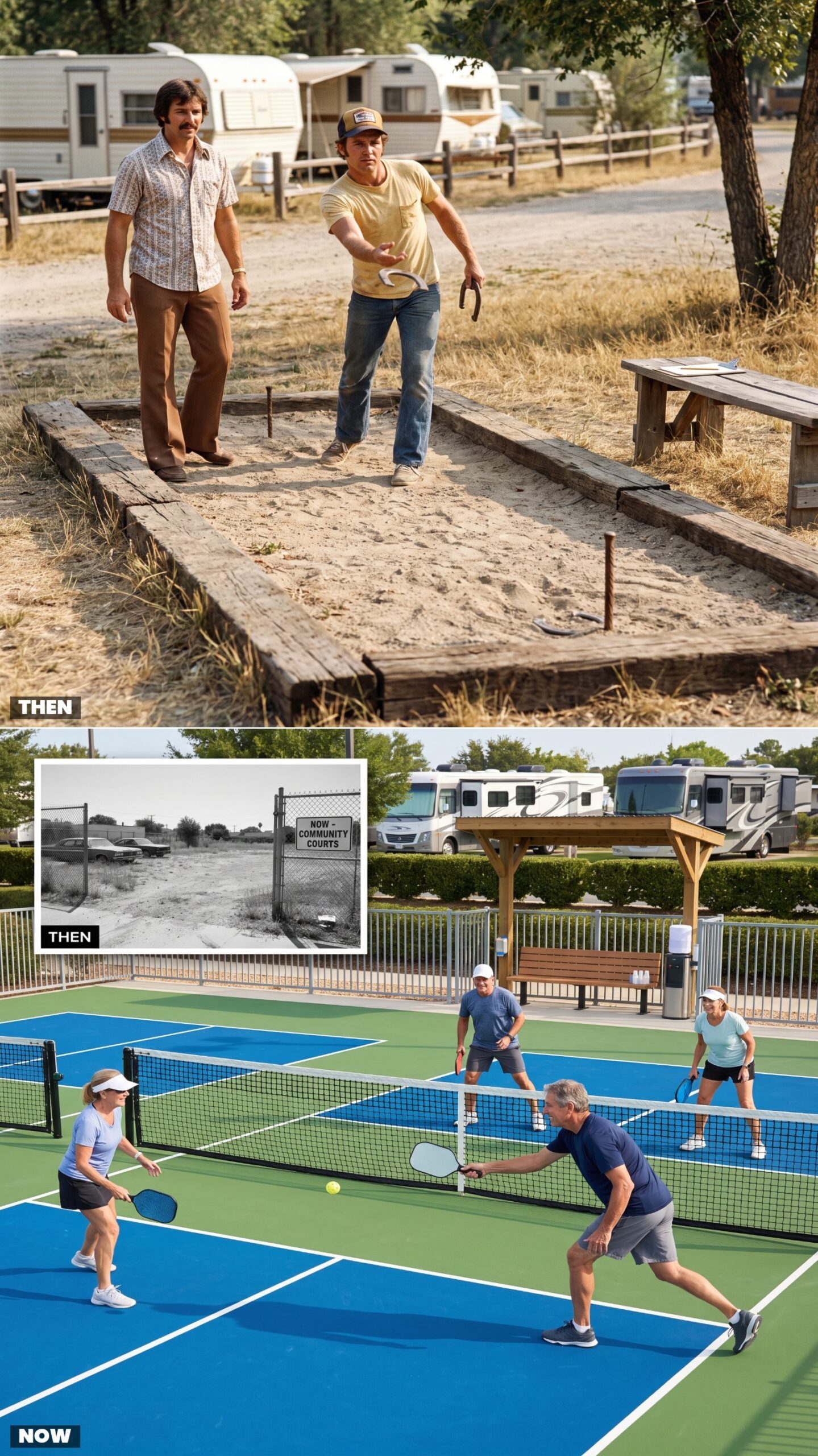
Horseshoes was the sound of a 1975 evening: the clang of iron on stake, the low talk, the slow walk between pits. It took no skill to start and a lifetime to master, and the stakes were lit by the glow coming off the rec hall windows.
Pickleball took that same patch of the park and turned it into the most-requested amenity in RV parks right now. Same social energy, same crowd, just with paddles and a whole lot more laughing.
22. The Ping-Pong Rec Room vs. Today’s Multimedia Game Lounge
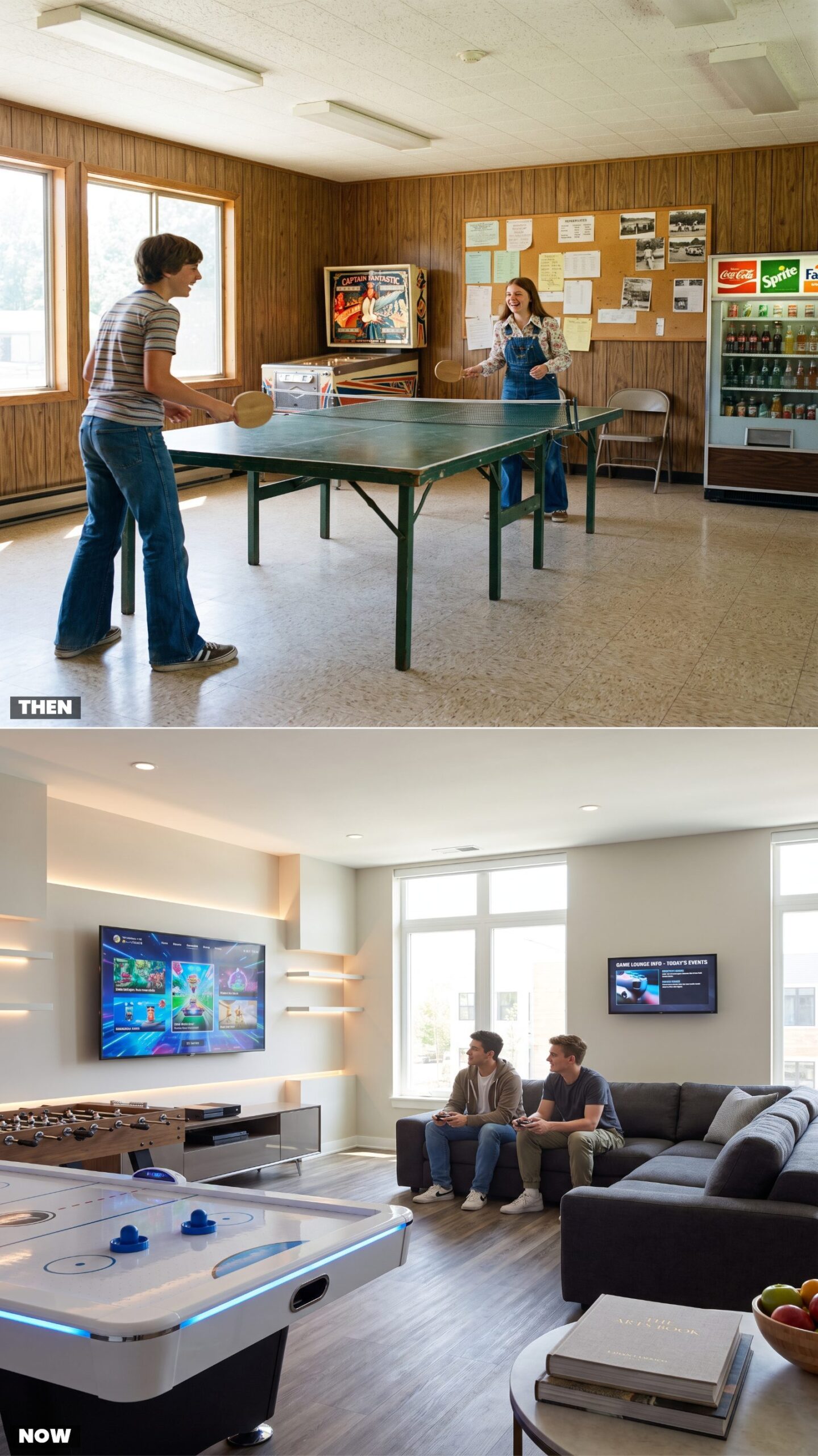
Wood paneling, a buzzing fluorescent tube, one green ping-pong table with a net that had given up, and a pinball machine that ate quarters. That was the whole rec room in 1975, and on a rainy night it was the center of the universe.
The modern game lounge has a big screen, a console, air hockey, foosball, and a sectional you’d actually want to sit on. More options, better seating, and a digital board telling you what’s happening tonight. I’ll say it: nothing beats the sound of a ping-pong rally, but the sectional wins.
21. The Folding-Chair Recreation Hall vs. Today’s Flexible Events Center
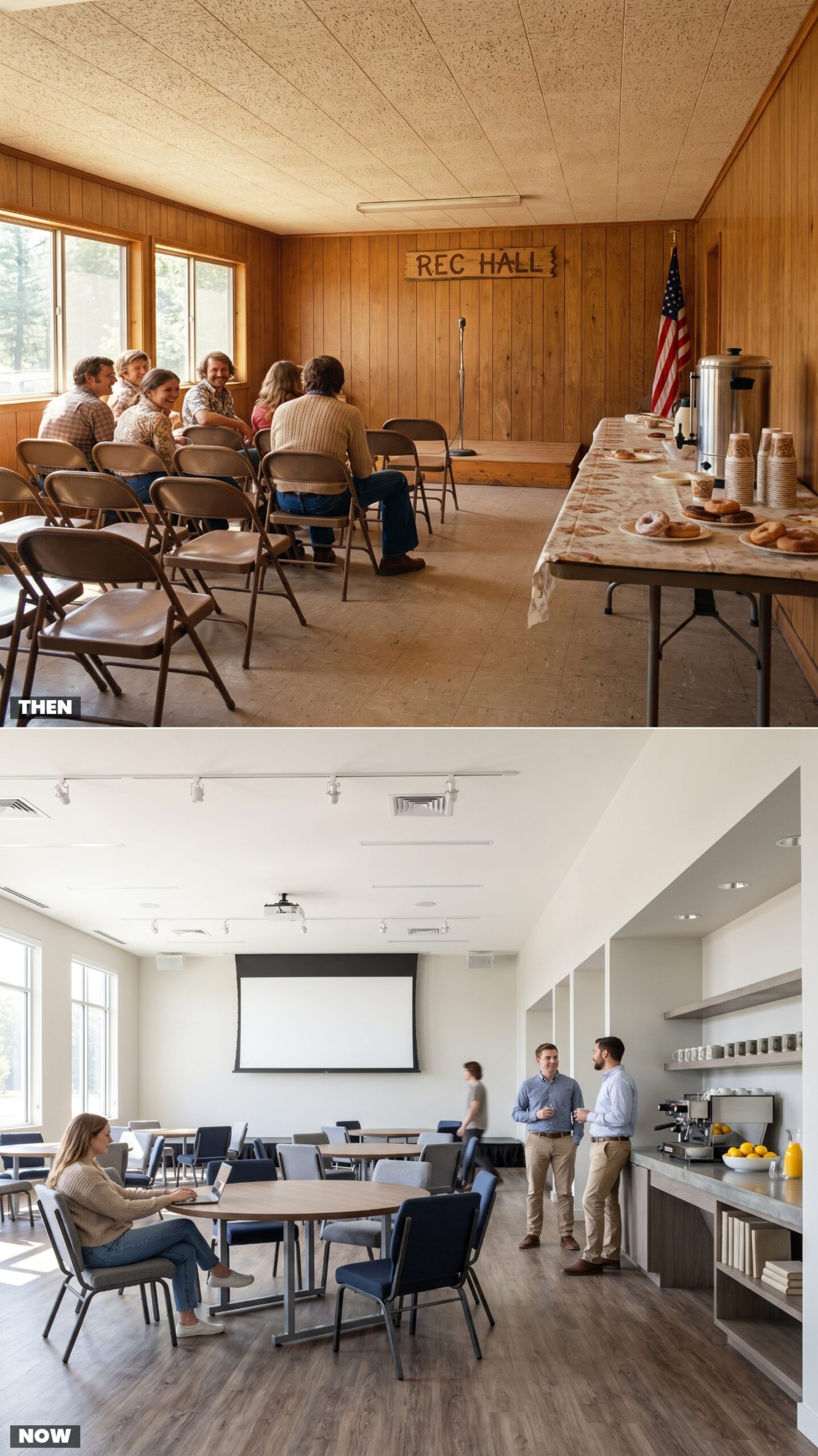
Brown metal folding chairs in crooked rows, a coffee urn that ran all day, and a riser stage with one microphone. The 1975 rec hall hosted bingo, potlucks, and the occasional accordion night, and those chairs left a mark on the backs of your legs by the second hour.
Flexible events centers do more with the same square footage: stackable cushioned seating, round tables for dinners, a projection screen for movie nights, and lighting you can actually dial up or down. Same community spirit, better chairs.
20. The Unfenced Dog-Walking Patch vs. Today’s Off-Leash Dog Park
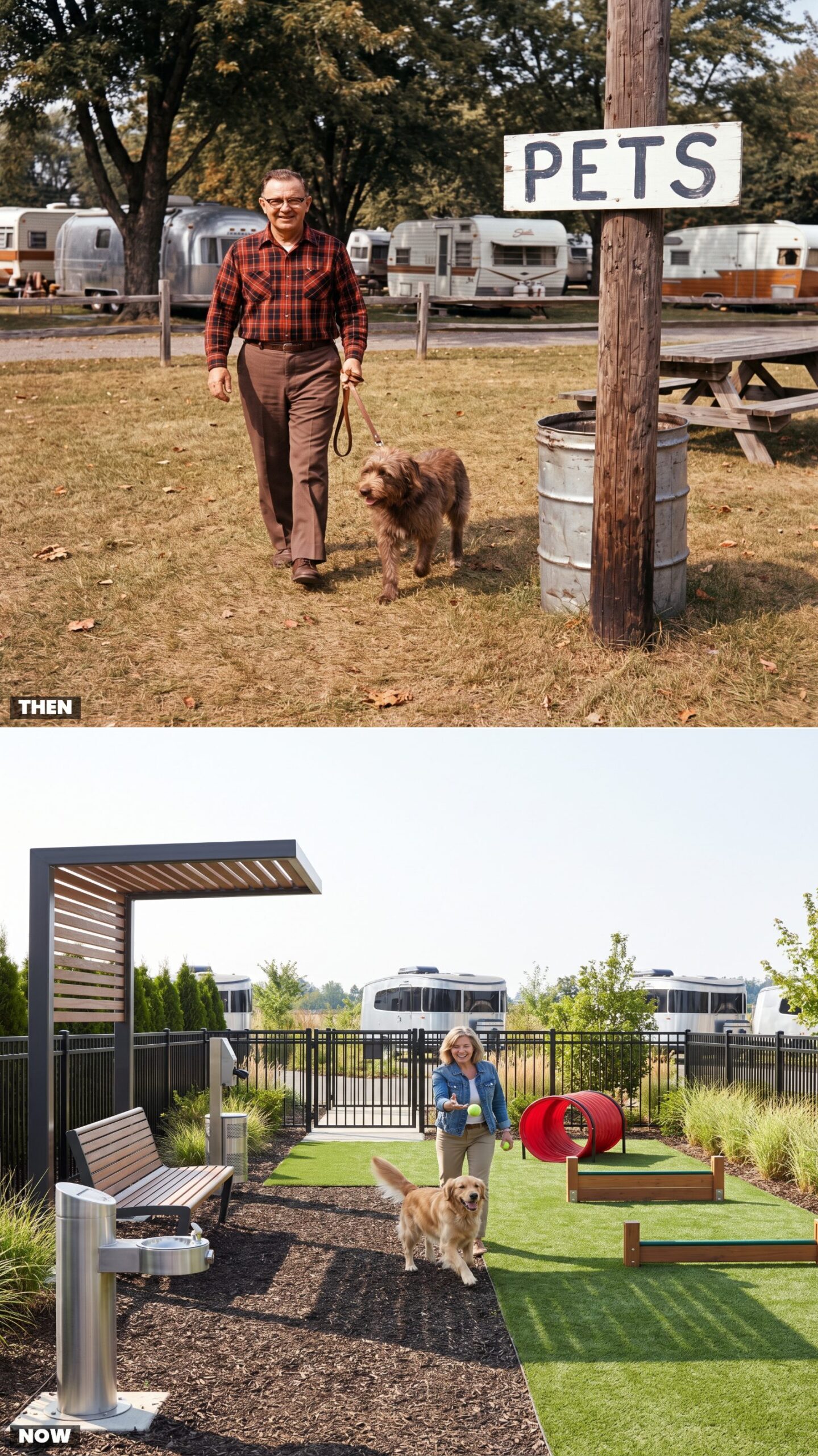
The 1975 dog area was a corner of grass with a painted sign and one trash barrel. You kept the leash on, walked the loop, and hoped nobody else’s dog came around the trailers at the wrong moment. It worked because everyone just knew the rules.
Modern off-leash parks changed the game for dog people. Double-gated entries so nobody bolts, real fencing, a water station, a few agility obstacles, and a waste-bag dispenser so you’re never caught empty-handed. The dog runs, you sit, and the whole park stays cleaner for it.
19. The Informal Footpath vs. Today’s Marked Nature Trail
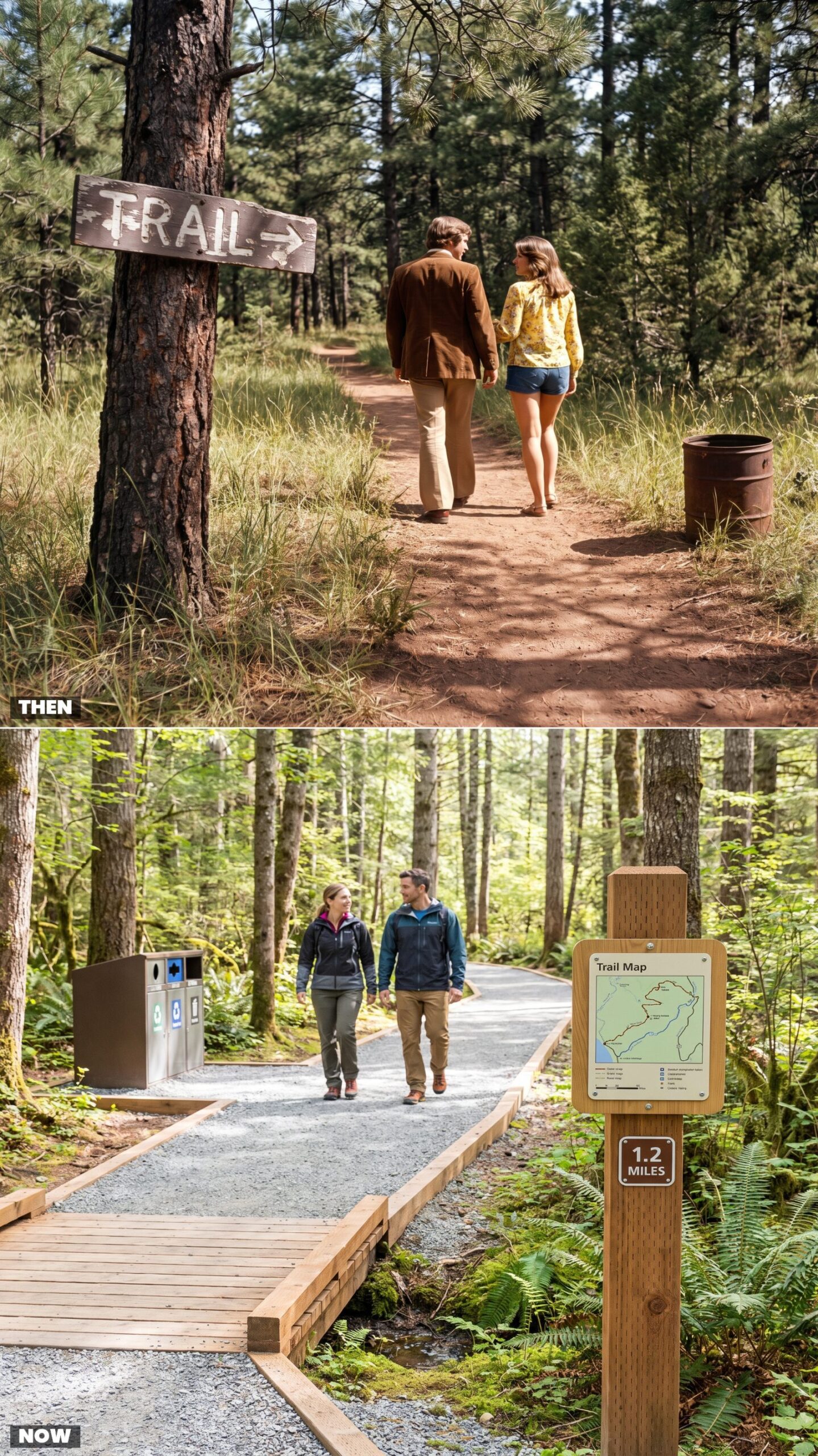
In 1975 a nature trail was wherever enough people had walked. You followed the dirt, trusted the arrow somebody nailed to a pine, and watched your ankles on the roots. Half the fun was not being completely sure where it went.
Now the same woods get crushed granite, a cedar boardwalk over the muddy stretch, and a routed sign telling you it’s a short hop to the overlook. Safer, drier, and a little less likely to end with you lost near the dumpster — which, I’ll admit, was part of the old charm.
18. The Simple Fishing Bank vs. Today’s Landscaped Catch-and-Release Pond
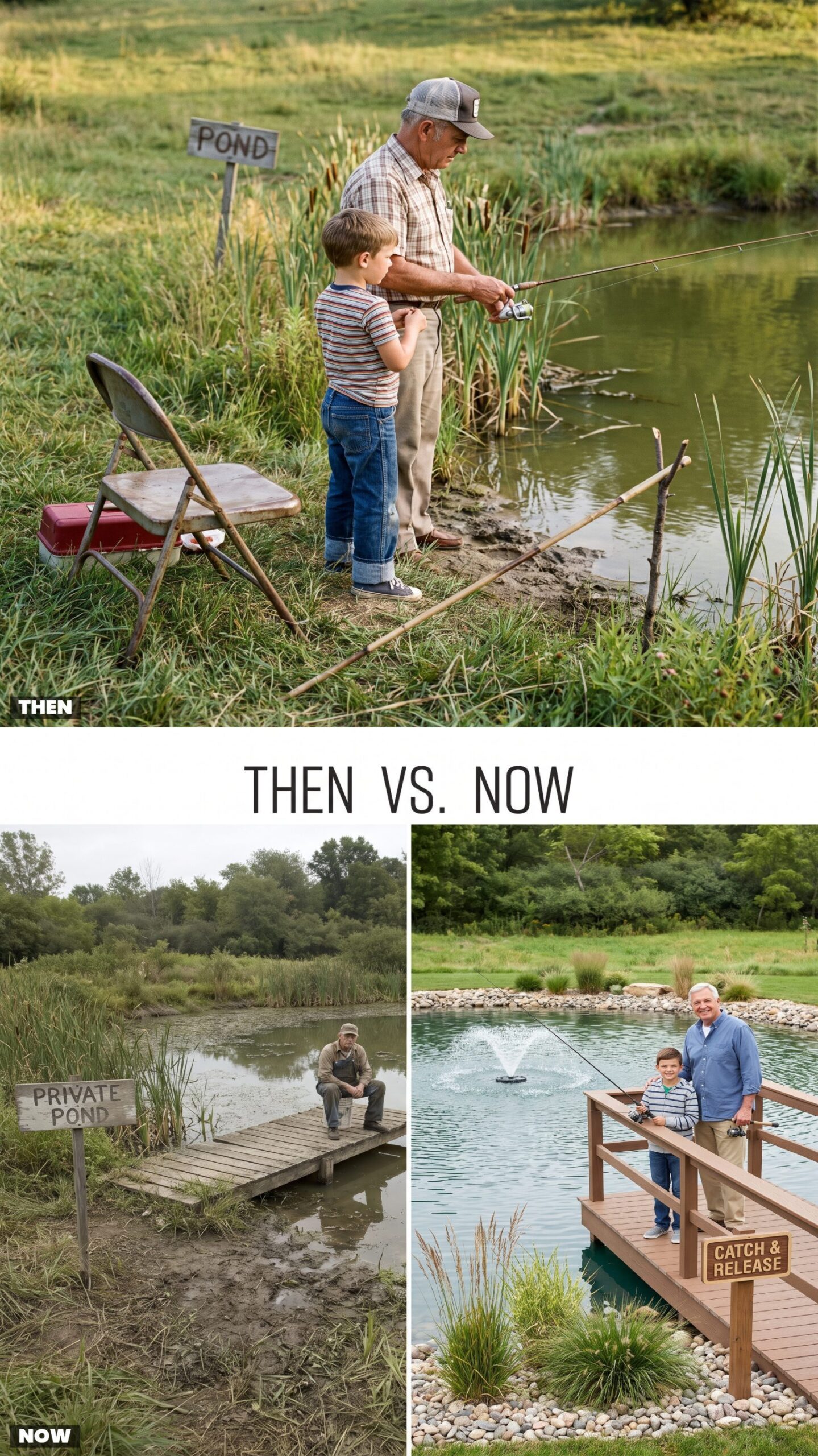
The fishing bank in 1975 asked almost nothing of you. Find the worn spot in the grass, plant the folding chair, bait the hook, and wait. The pond was murky, the cattails were thick, and nobody told you to throw anything back.
Today that same water gets a composite dock, river-rock edging, an aerator fountain keeping it clear, and a sign laying out the catch-and-release rules. Prettier, probably better managed. But I’d be lying if I said that bent metal chair in the mud didn’t still live rent-free in my head.
17. The Tin-Roof Picnic Shelter vs. Today’s Outdoor Kitchen Pavilion
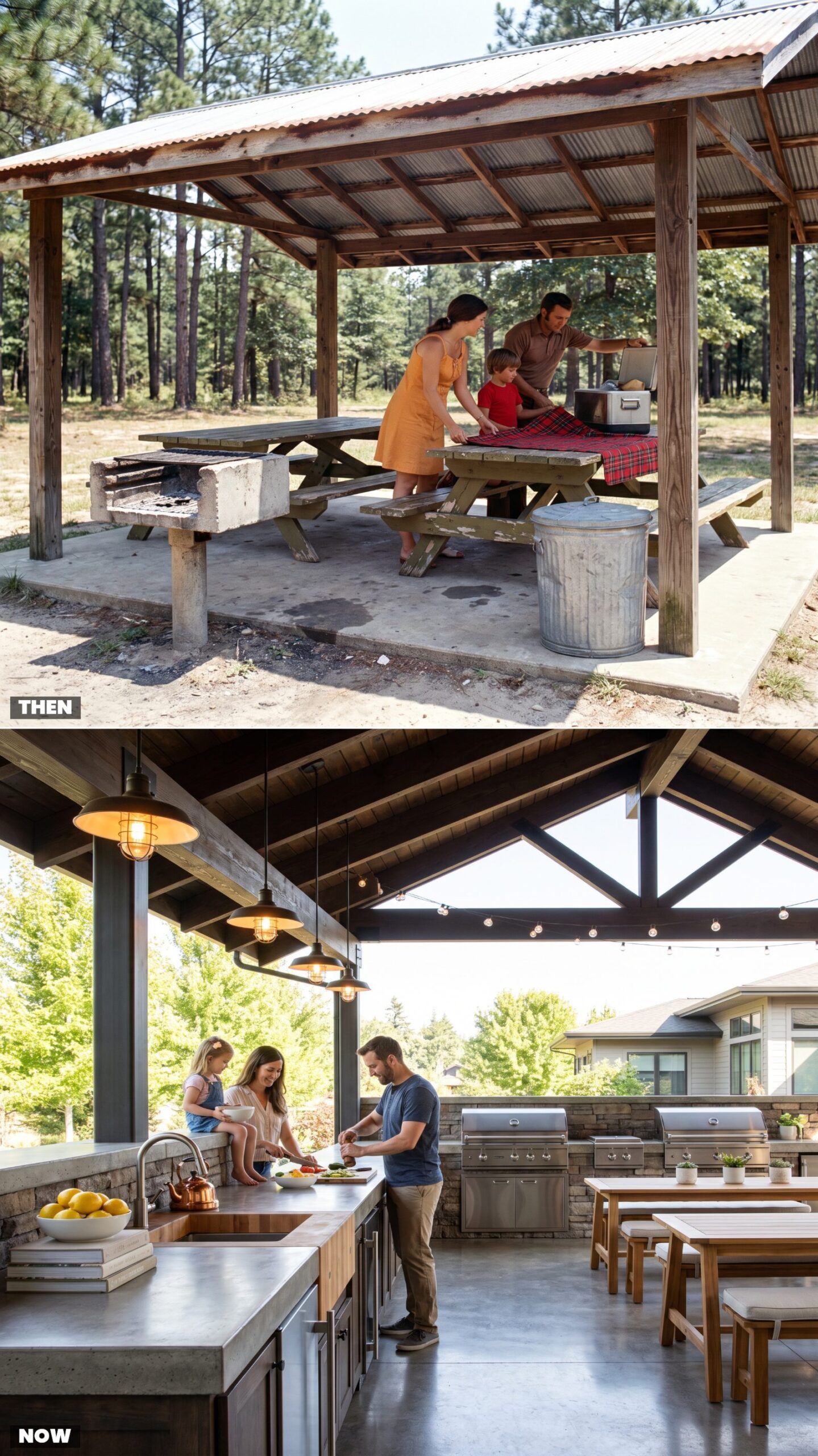
The tin roof was the whole experience. Rain drumming on corrugated metal, two olive-green tables with the paint flaking off, one stone grill you fought the next family for, and a galvanized can that smelled like every hot dog since 1968.
The modern version is basically a restaurant kitchen you don’t have to clean. Stainless grills, a prep counter with a real sink, pendant lights, cushioned benches. Lovely. Genuinely. I just miss the sound that old tin roof made when the afternoon storm rolled through.
16. The Evening Campfire Circle vs. Today’s Amphitheater-Style Gathering Area
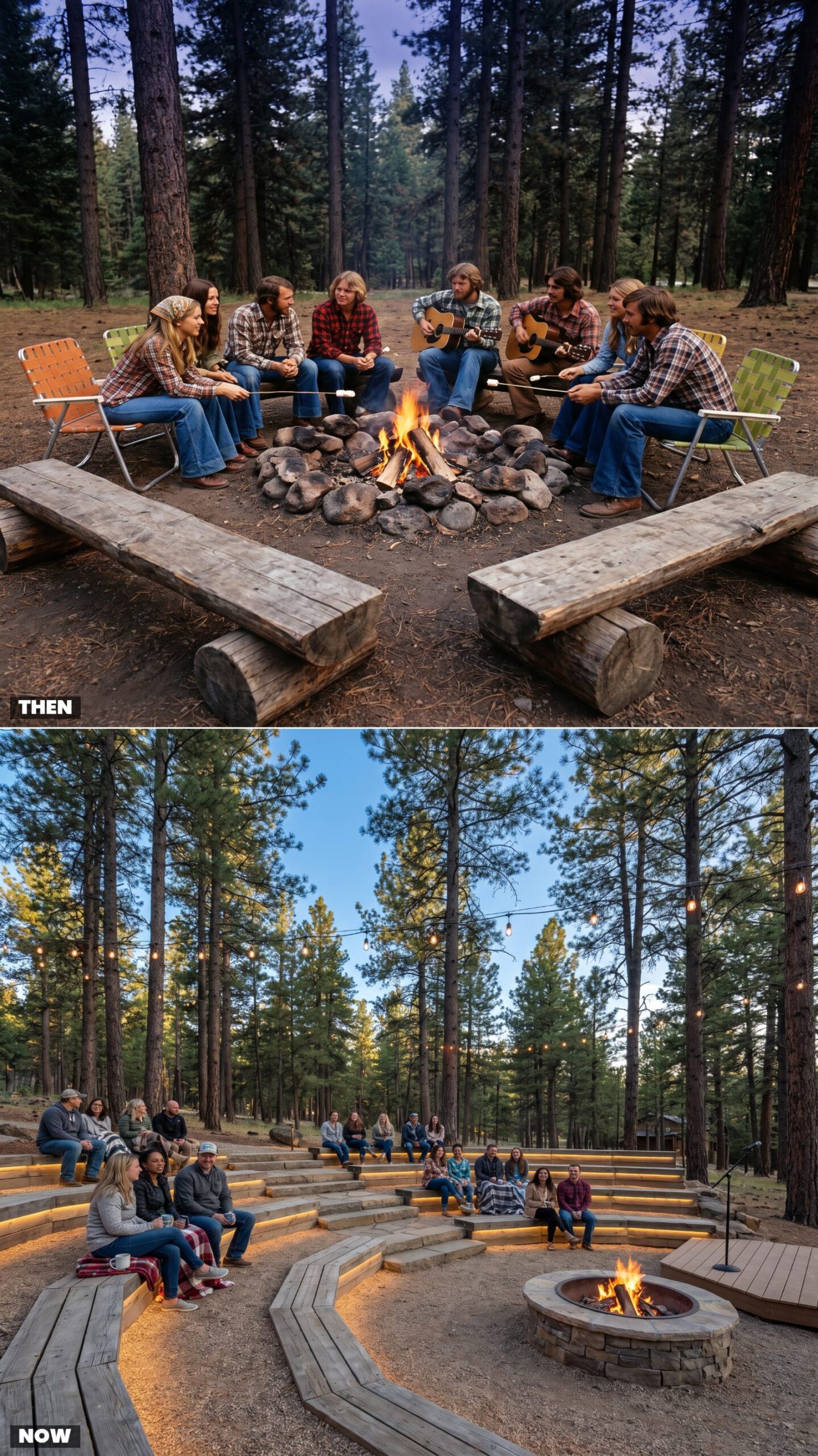
You remember the circle. Fire-blackened stones somebody stacked years ago, split-log benches, a couple of orange-and-avocado webbed lawn chairs, and whoever had a guitar running the setlist. Everybody faced the fire because there was nowhere else to look.
Now it’s an amphitheater — tiered timber seating curving toward a stone fire feature and a little platform for the ranger talk or the Saturday singalong, with path lighting so nobody breaks an ankle. It holds more people and it’s organized. Still, the best campfires never needed a stage.
The old fire circle had no front row because everyone was in it.
15. The Weekend Snack Wagon vs. Today’s Food-Truck Court
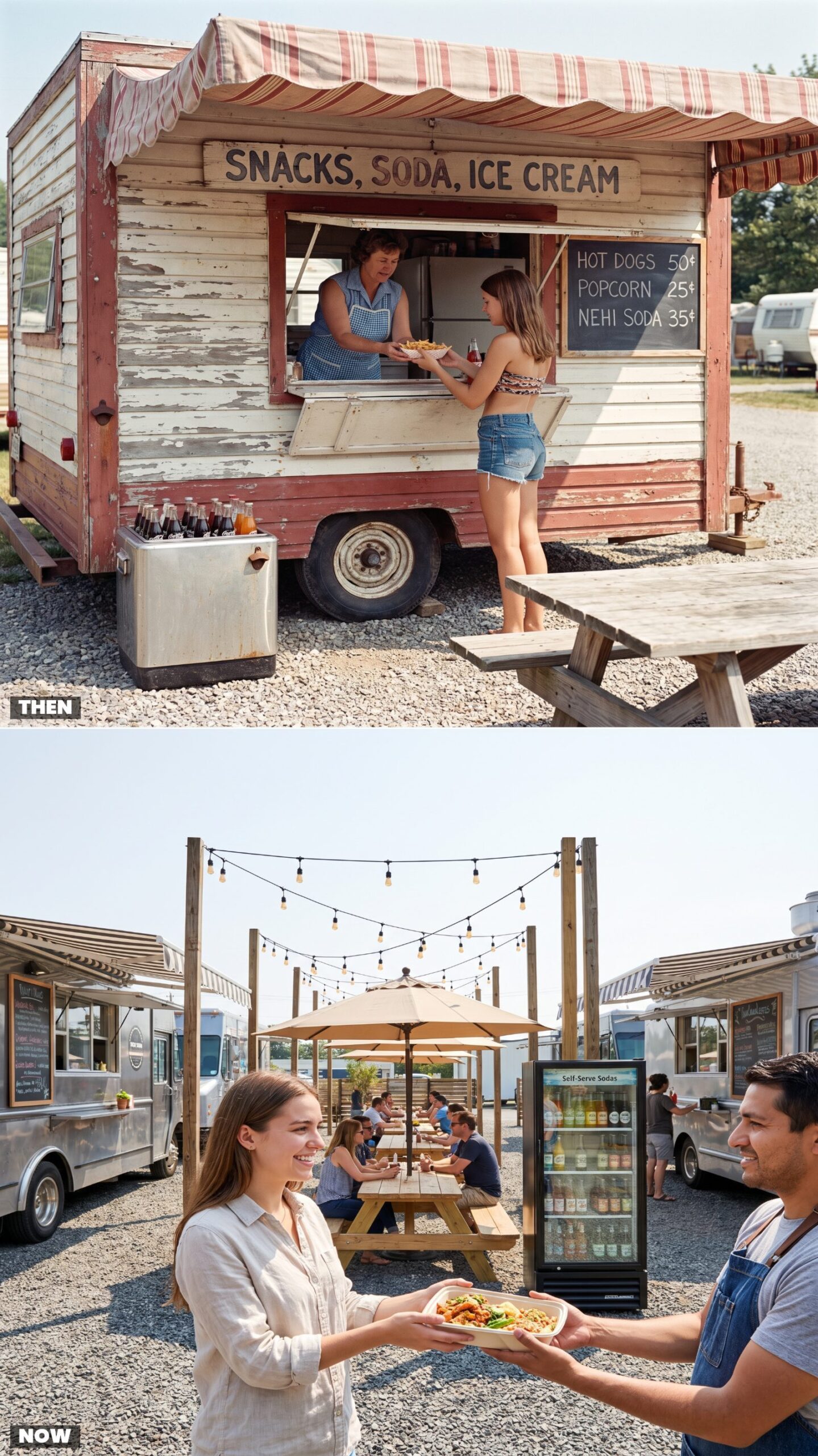
One wagon. Red-and-white awning, a chalkboard, hot dogs, popcorn, and bottled Nehi you cracked open on the rusty opener bolted to the frame. Wanted variety? You waited until next weekend.
The modern campground hands you a whole food-truck court. Tacos one night, barbecue the next, string lights overhead and umbrella tables so you don’t eat standing in the gravel.
14. The Hose-and-Bucket Wash Spot vs. Today’s Dedicated RV Wash Bay
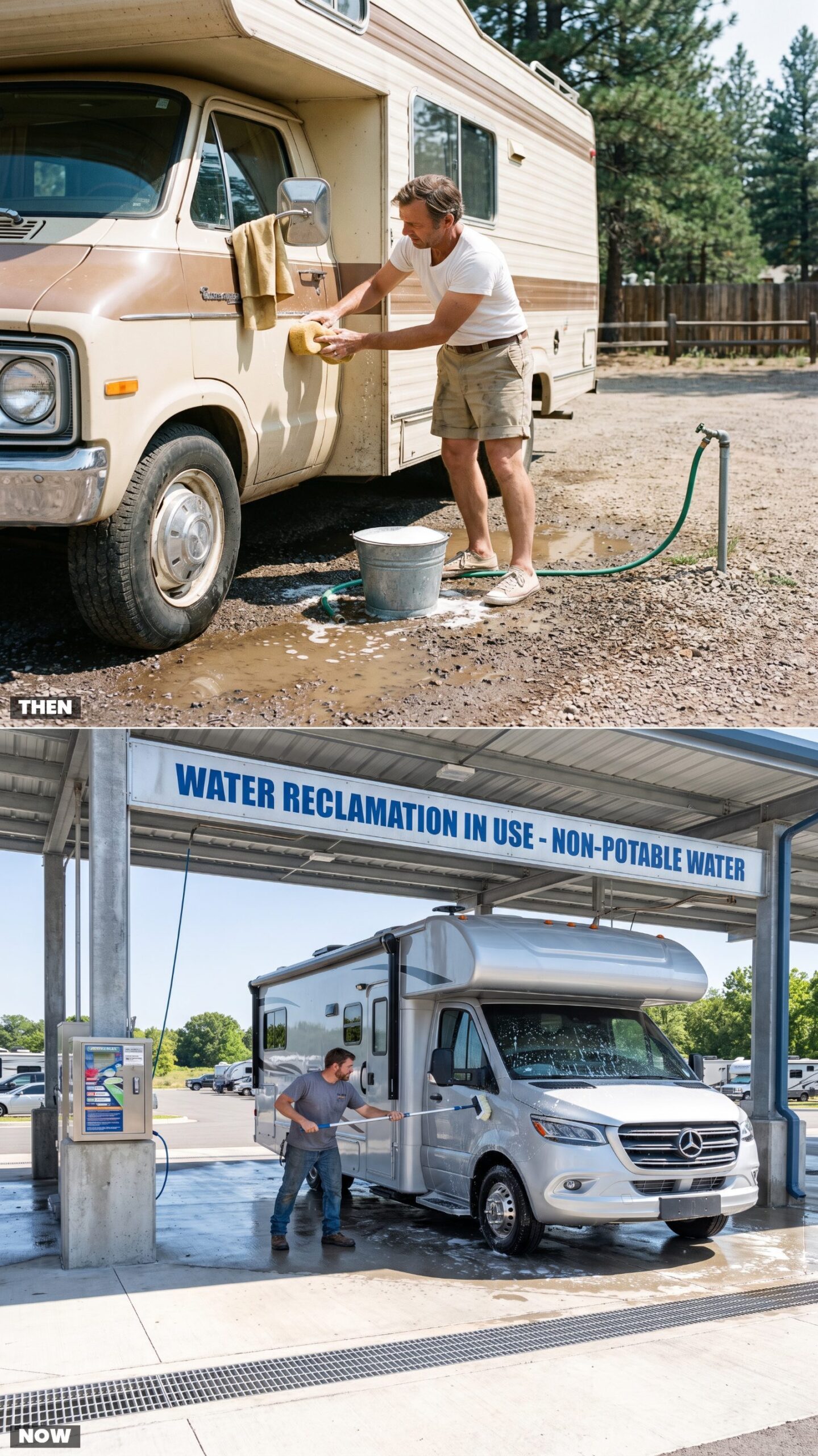
Washing the rig in 1975 meant the spigot, a green garden hose, and a galvanized bucket with a sponge bobbing in the suds. You scrubbed, the water ran off into the gravel, and the chamois went over the mirror to dry. That was the system, start to finish.
Now there’s a dedicated wash bay. Concrete pad with real drainage, a coin-op pressure washer, a foam-brush wand, and a sign about water reclamation. Faster, and your feet stay out of the mud.
13. The Overflow Tent Field vs. Today’s Designated Tent-Camping Zone
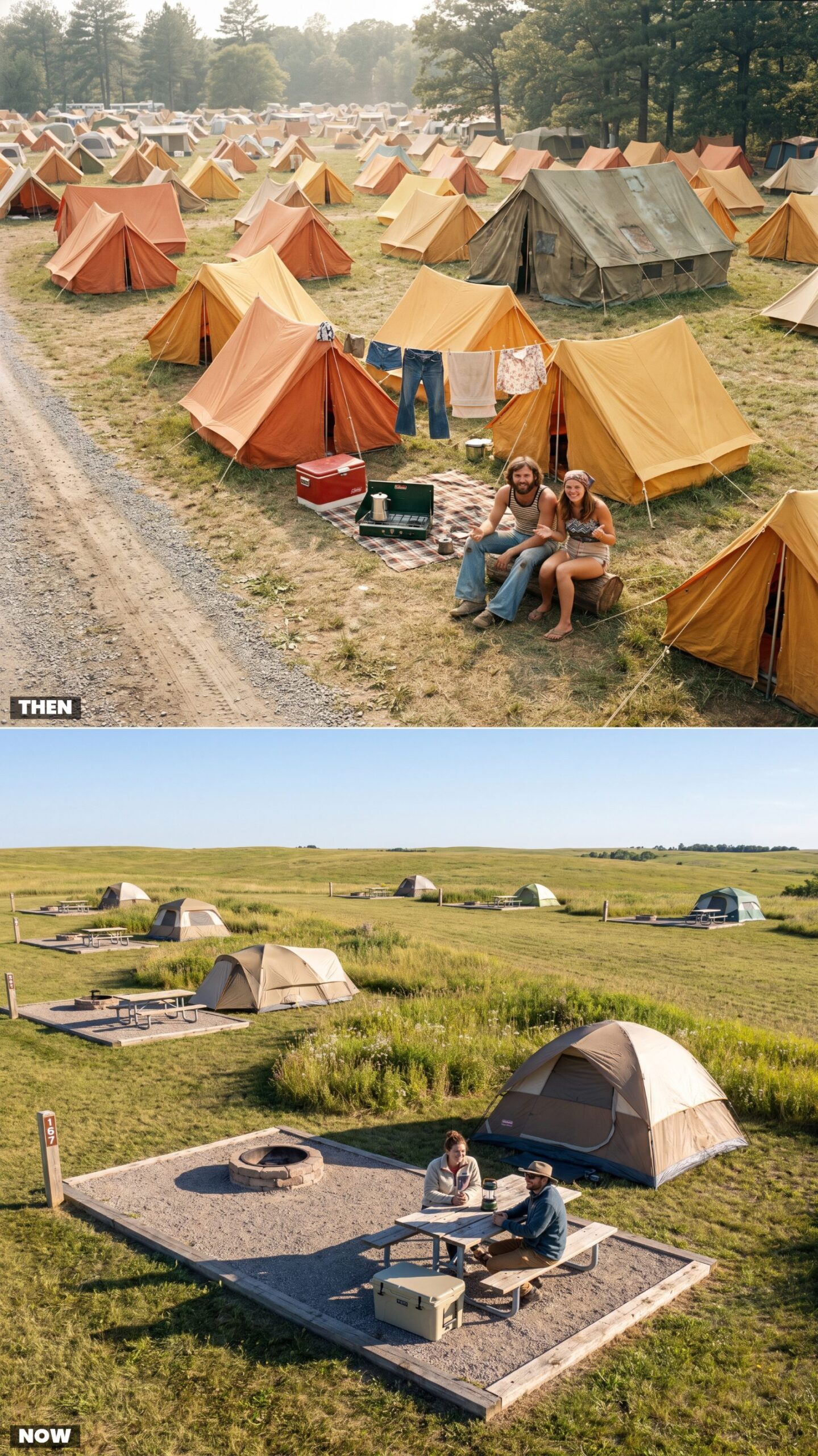
The overflow field had one rule: find a flat spot. Orange canvas pup tents, one big olive cabin tent, guy lines crossing each other, a clothesline strung between whoever’s poles were closest. You were practically sharing a tent with the family next door.
The modern tent zone draws the lines for you. Level pads with borders, numbered posts, a fire ring and table at each one, and native grass buffers so you can’t hear your neighbor snore. More comfortable, a little less neighborly. I go back and forth on which I’d pick.
12. The Homemade Seasonal Campsite vs. Today’s Curated Long-Term Site
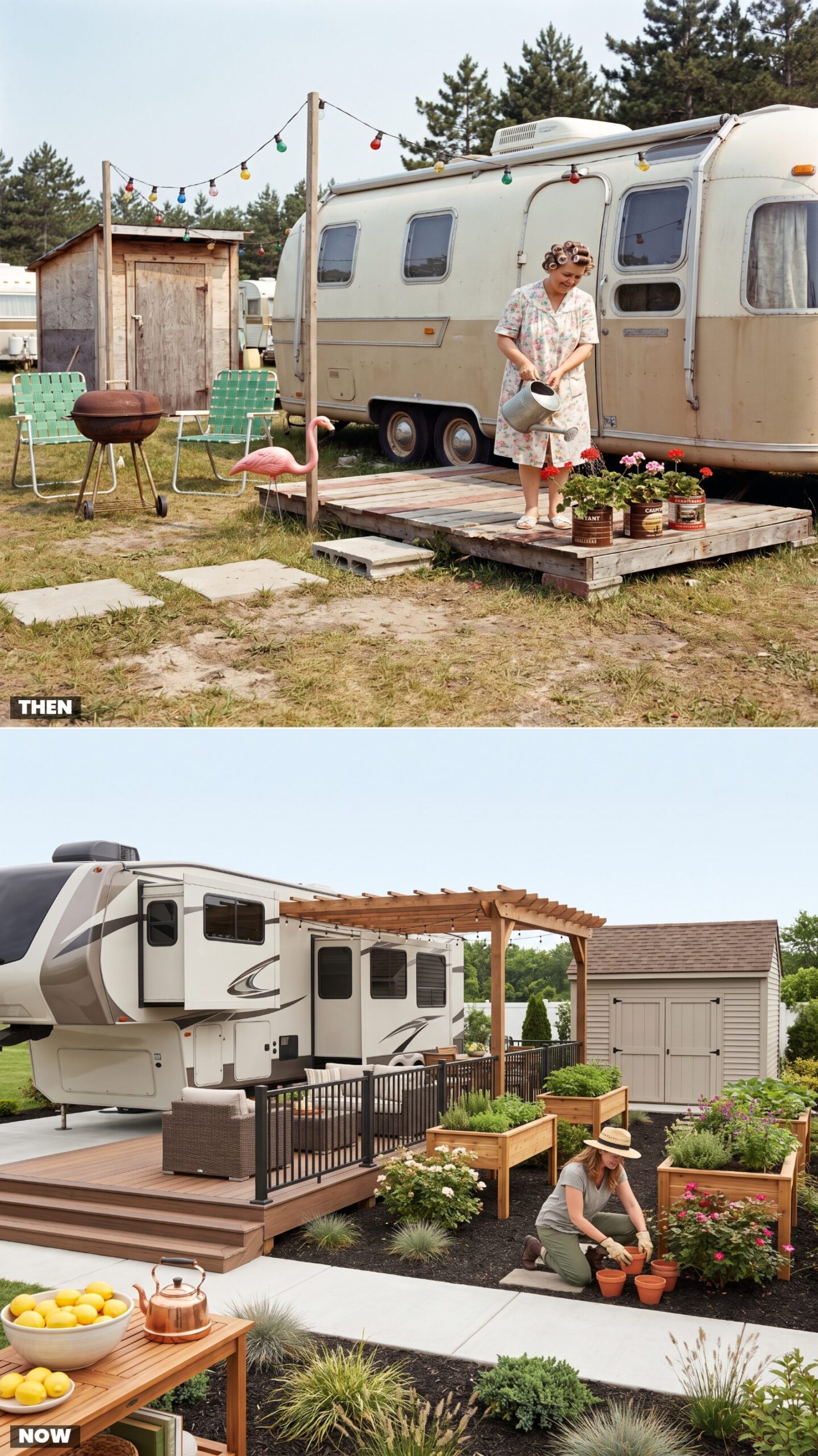
Seasonal sites in 1975 were little kingdoms. A homemade deck of mismatched boards, a plastic flamingo, patio bulbs sagging between poles, geraniums growing out of coffee cans, and a shed somebody banged together over one weekend. Every one looked different because every one was built by hand.
The curated long-term site today comes with a paved pad, a composite deck, a pergola strung with café lights, and raised planters. Tidier, and it photographs beautifully. But the flamingo and the coffee-can geraniums had a personality you can’t buy at the landscape supply.
11. The Bare-Bones Rental Trailer vs. Today’s Glamping Cabin
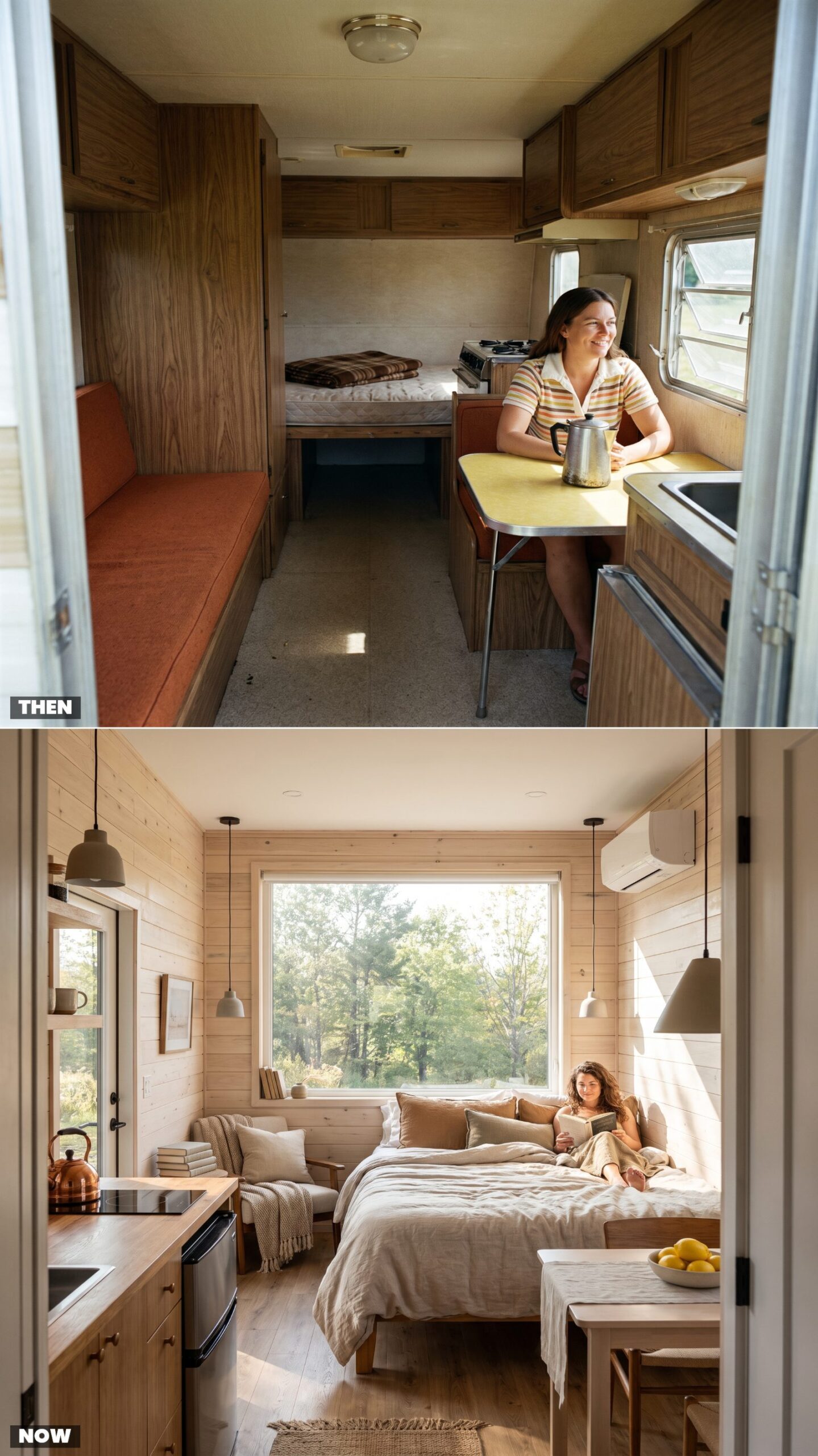
A rental trailer in 1975 was a roof and a mattress and not much argument about it. Wood-grain laminate everywhere, a burnt-orange foam bench, a yellow Formica dinette, a two-burner propane stove, and a metal percolator that made coffee taste like the campground smelled. You weren’t there for luxury. You were there for a dry place to sleep.
The glamping cabin flipped the whole idea on its head. Shiplap walls, a real queen bed with a linen duvet, a kitchenette with an induction cooktop, a mini split keeping it cool, and a picture window framing the pines. Camping-adjacent, with none of the parts that left you sore in the morning.
10. The Unmarked Back-Lot Storage Row vs. Today’s Secured RV Storage Facility
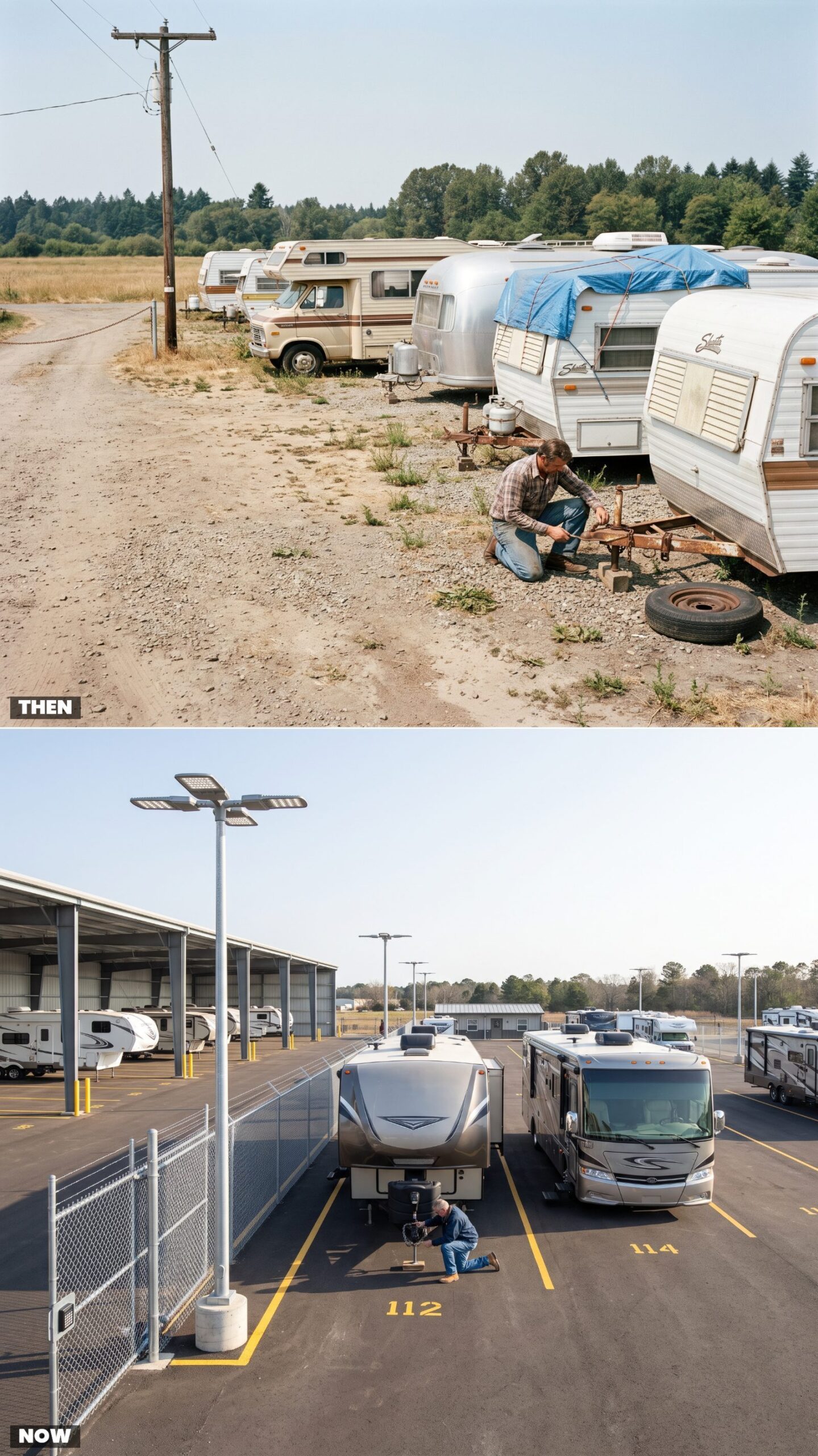
Where you stashed the rig off-season in 1975 was wherever the campground had a back lot. Bare ground, weeds coming up through the gravel, a chain across the entrance, and a sagging tarp bungeed over somebody’s vent. Security was the fact that the lot was hard to find.
Modern storage is its own business now. Paved and striped bays, a keypad gate, chain-link all the way around, LED poles, and covered canopies for the folks who don’t want sun baking their roof. It costs real money. But nobody’s walking off with your spare battery in the night.
9. The Watchful Camp Host vs. Today’s Camera-Monitored Security Station
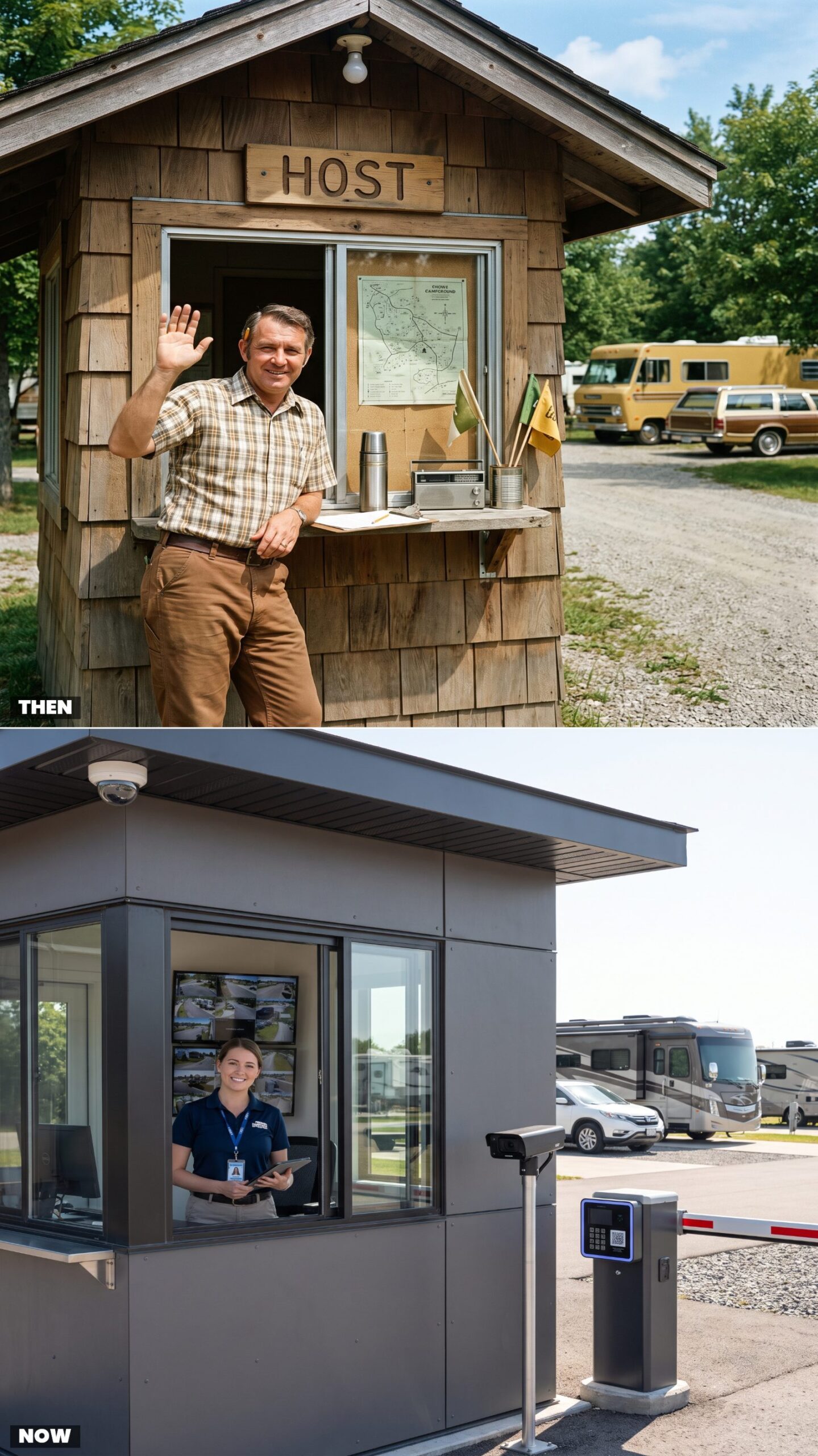
In 1975 your security system had a name, and it was usually Dale. The camp host knew which site you were in, which dog belonged to whom, and exactly when the quiet-hours rule-breakers rolled in. He patrolled on foot with a flashlight and a good memory.
Now a license-plate reader clocks you at the gate while a wall of monitors watches the loops all night. Safer, probably. But nobody waves you in anymore, and nobody remembers your name by Thursday.
8. The Payphone Booth vs. Today’s Device-Charging Lounge
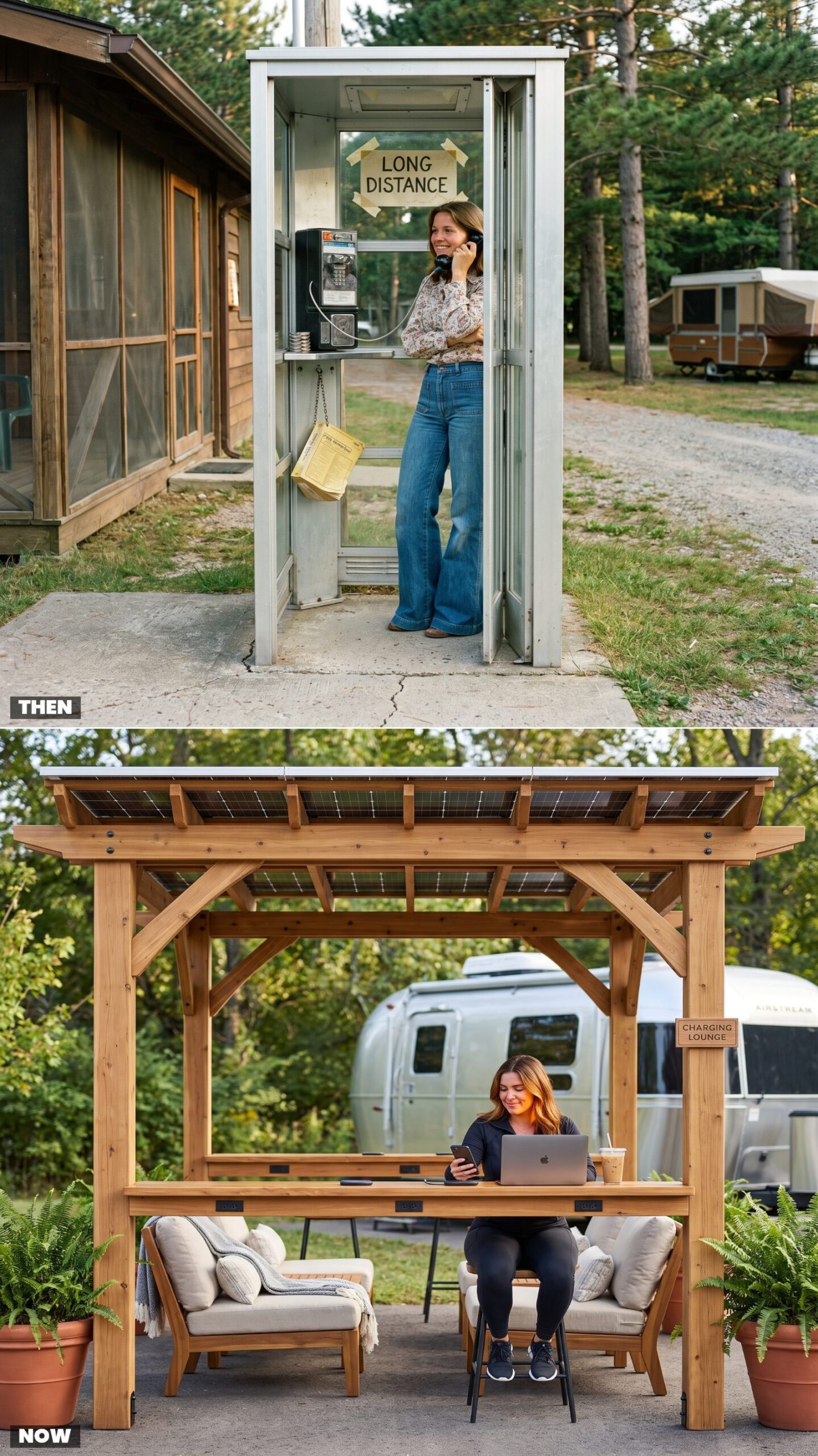
The phone booth was the only lifeline off the loop, and it ran on dimes. You’d ration your quarters, fold yourself into that hot glass box, and shout over a bad connection to let your mother know you made it. The phone book hung on a chain because somebody, somewhere, kept walking off with it.
The booth is gone. In its place sits a shaded counter of charging pads and comfy stools where everyone tops up three devices at once and nobody shouts into anything. Quieter. Cooler. Zero dimes required.
7. The Rooftop Antenna and Portable Radio vs. Today’s Wi-Fi and Streaming Setup
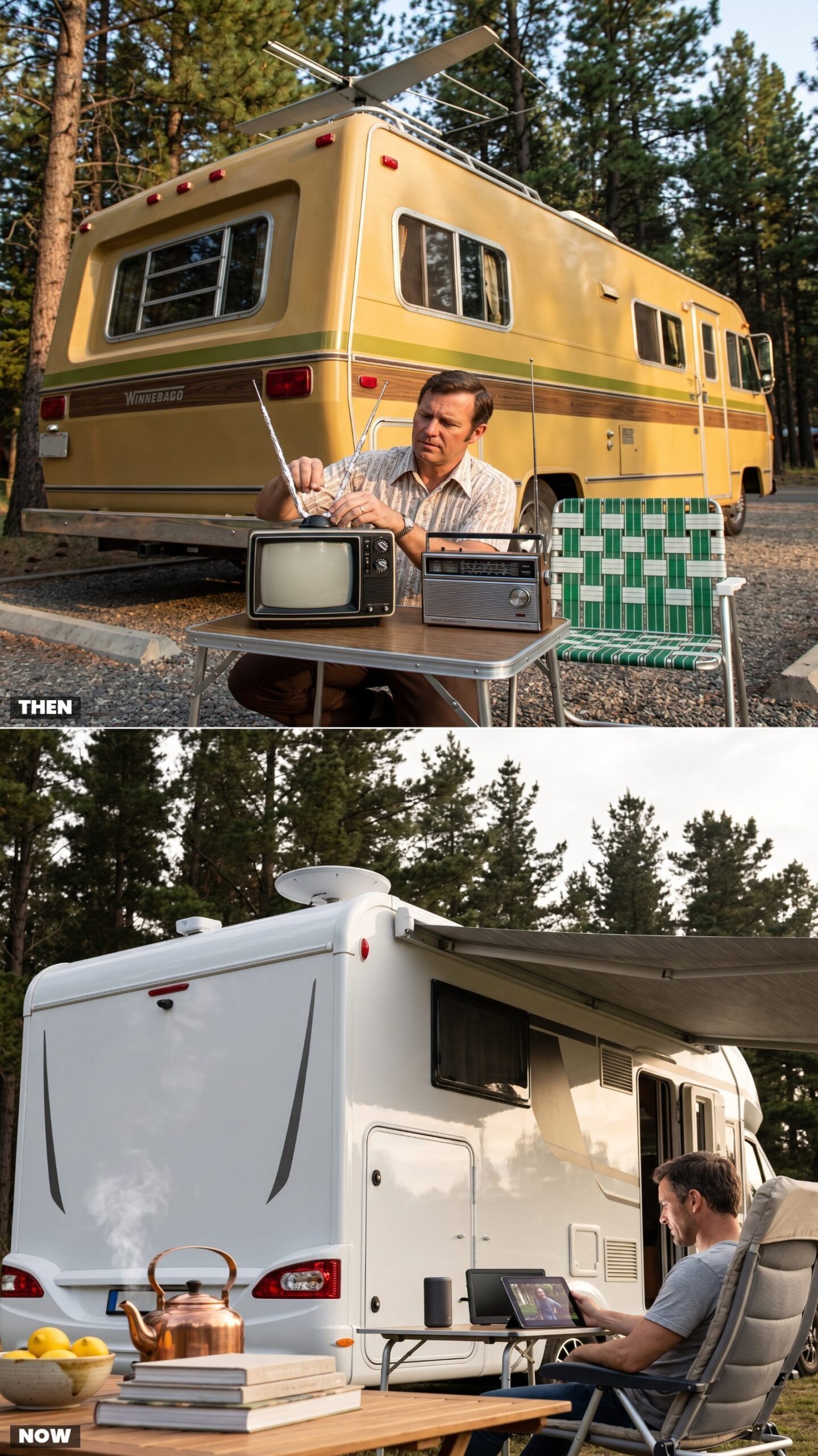
Reception was a contact sport. You cranked the rooftop batwing, wrapped the rabbit ears in foil, and held your breath while a fuzzy ballgame drifted in and out between the pines. The transistor radio did the real work, pulling in some distant AM station playing exactly the kind of thing your kids groaned at.
Now a dome on the roof pulls internet from a satellite and streams a movie to a weatherproof TV under the awning. No foil, no dial-twisting, no standing on a chair at dusk yelling “is it better now?” to whoever’s inside.
6. The General-Delivery Mail Shelf vs. Today’s Secure Package Lockers
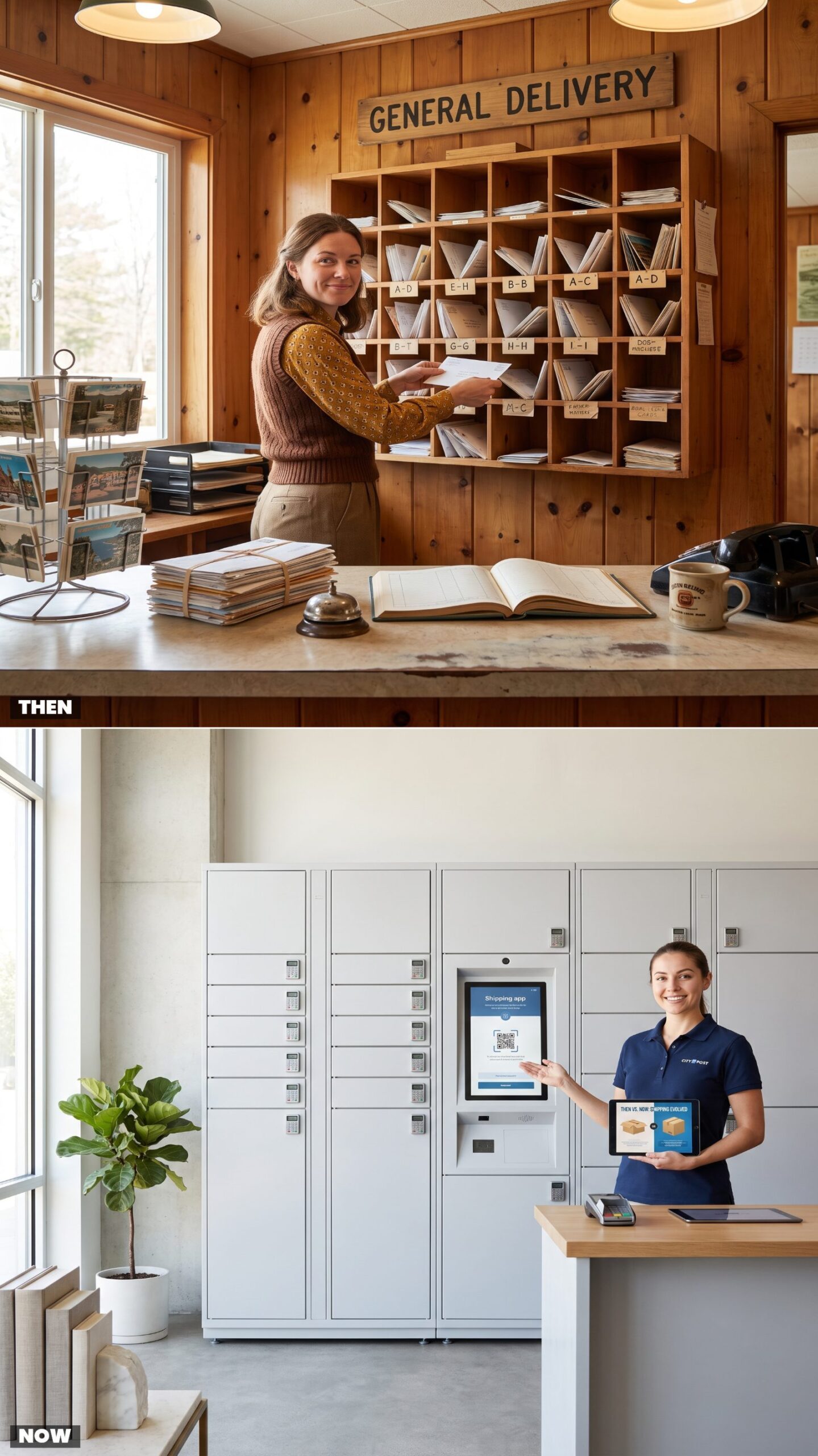
If you were on the road for weeks, general delivery was how the outside world found you. Your mail waited in a wooden cubby under a card with your name, filed by the clerk who knew every regular by sight. You’d ask at the counter, she’d thumb through the bundle, and out came a birthday card two weeks late.
Today a steel bank of smart lockers pings your phone the second your package lands. Scan a code, a door pops open, done. Efficient. A little lonely, too. The clerk who used to say “this came for you yesterday” is now a chime.
5. The Picnic-Table Workspace vs. Today’s Dedicated Coworking Lounge
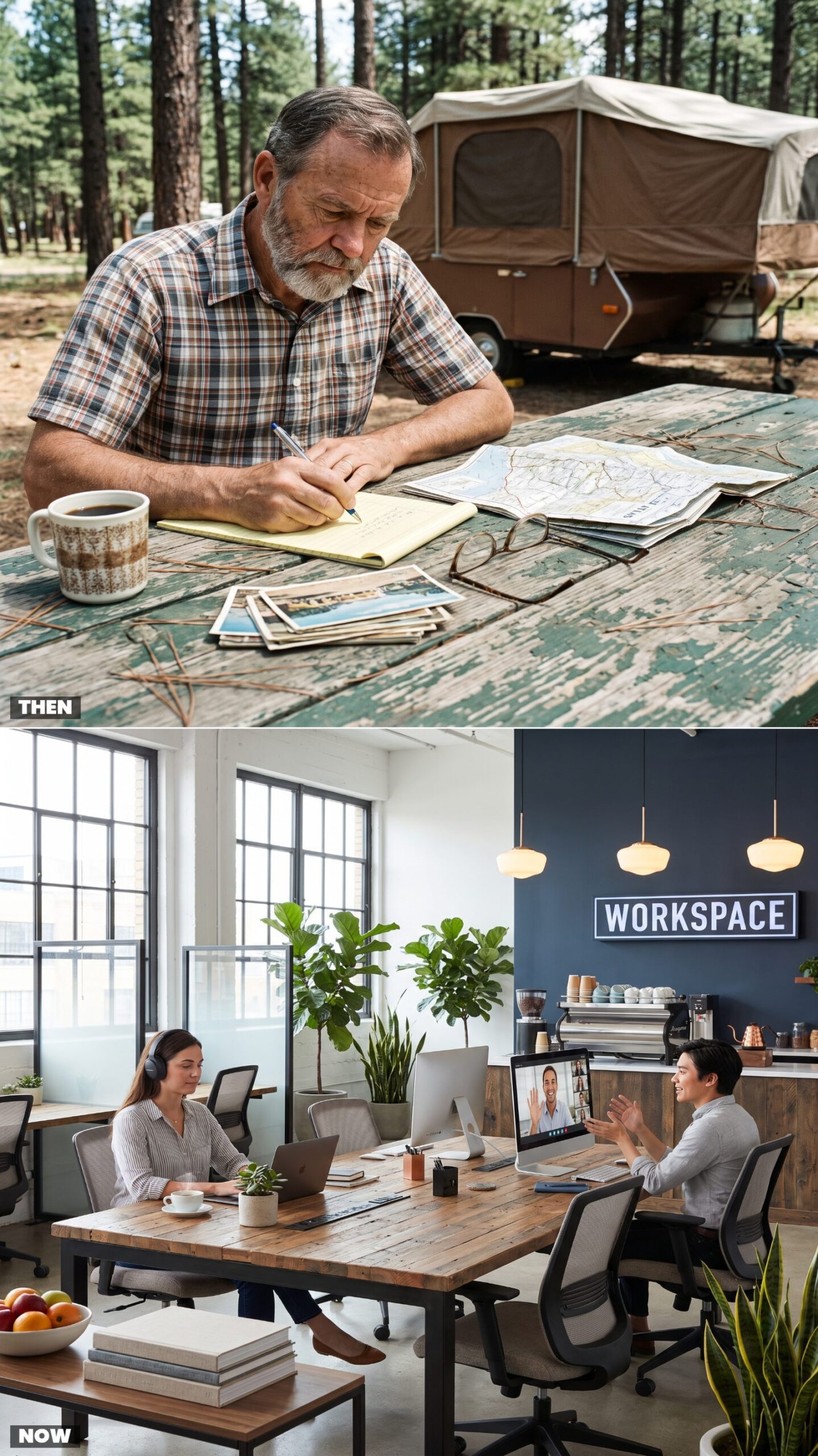
The office was wherever the picnic table happened to be. You squinted at a legal pad in the sun, swatted a bug off your coffee, and wrote postcards or tallied the trip budget by hand. Wind picks up, and there goes your paperwork skittering across the gravel.
Full-timers changed the math. Campgrounds now build coworking lounges with real chairs, strong outlets, an espresso machine, and quiet booths for video calls. You can run a business from the pines without your receipts blowing into the fire ring.
4. The Utility Outlet by the Office vs. Today’s EV Charging Row
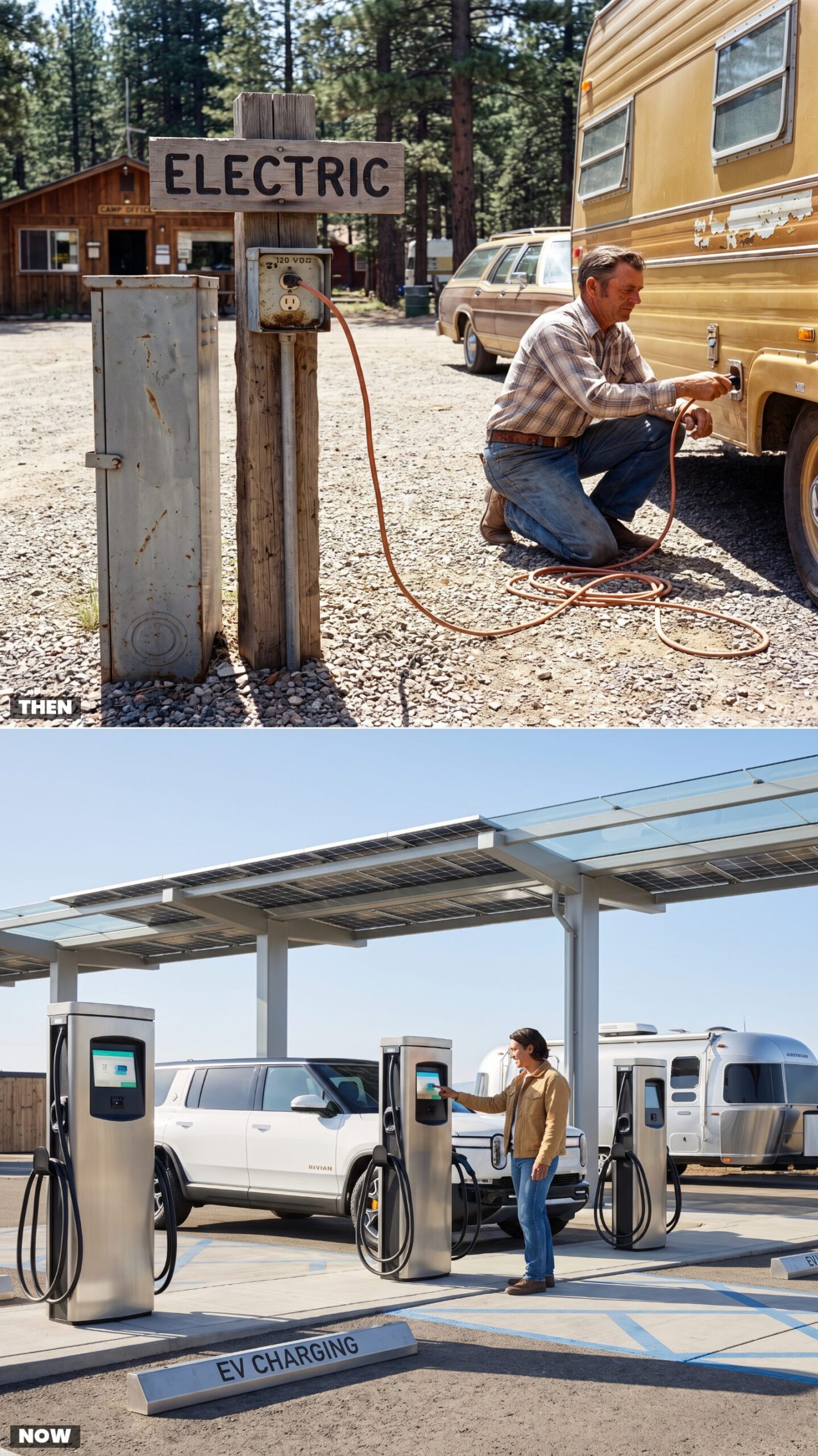
Power in 1975 meant one tired outlet on a post and a prayer. You’d run a long orange cord across the gravel, hope the trailer didn’t trip the breaker, and learn the hard way not to run the coffee pot and the heater at the same time.
Fast forward, and parks are wiring up charging rows for the cars themselves. Sleek pedestals under a canopy, a screen telling you the charge, maybe a solar roof overhead. The tow vehicle sips electrons while you set up camp. That humble power post never saw this coming.
3. The Wooden Fishing Dock vs. Today’s Accessible Waterfront Boardwalk
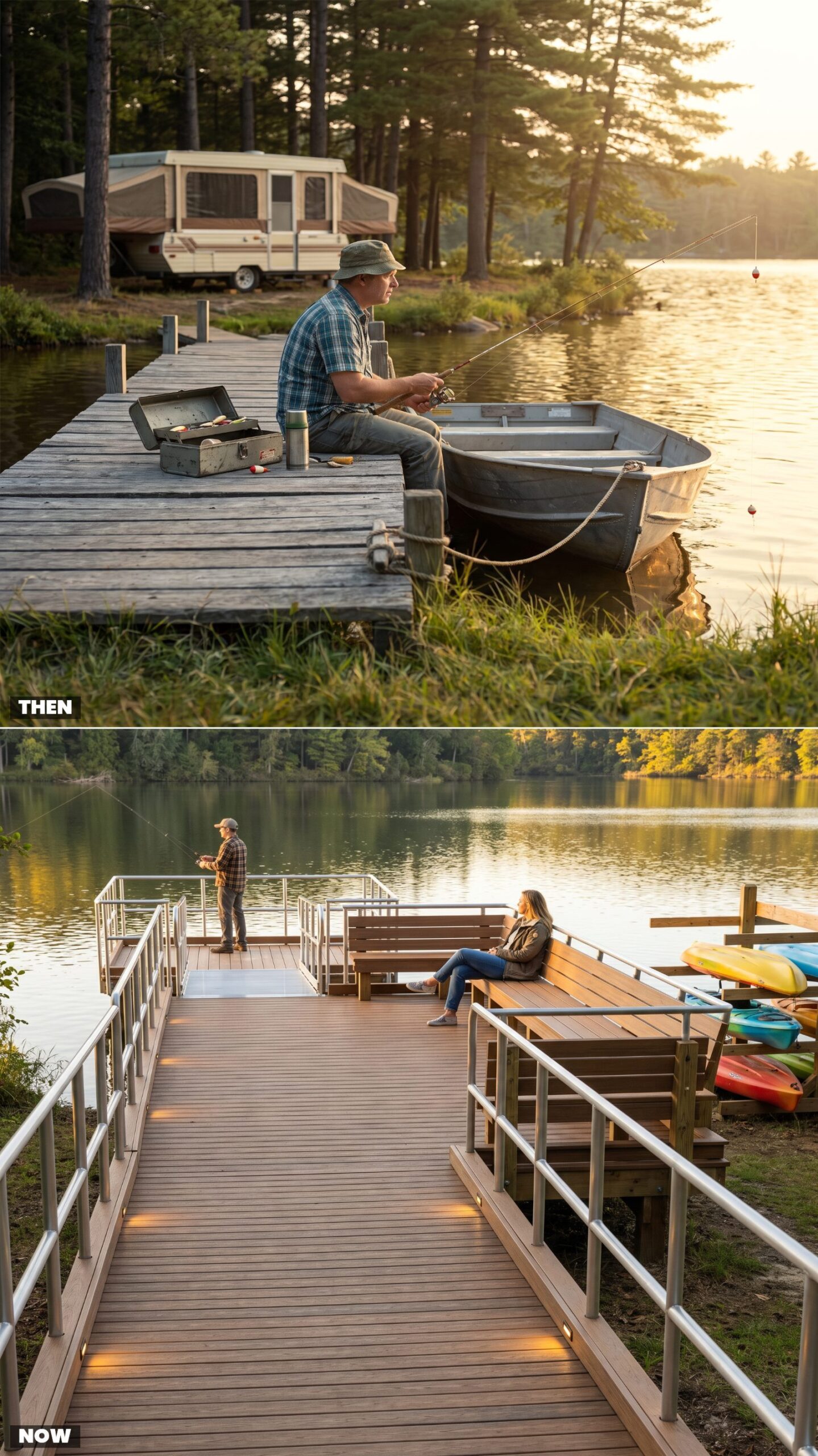
The old dock was three boards wide, silver with age, and one plank always wobbled. You’d sit on the edge with your feet near the water, a bobber out, and nobody fretted much about railings. Perfect until the day it wasn’t.
Modern waterfronts get built so everyone reaches the water. Wide composite decking, handrails the whole way, a gentle ramp, and a fishing platform with a cutout so a wheelchair can pull right up to the edge.
2. The Hand-Rung Emergency Bell vs. Today’s Severe-Weather Alert System
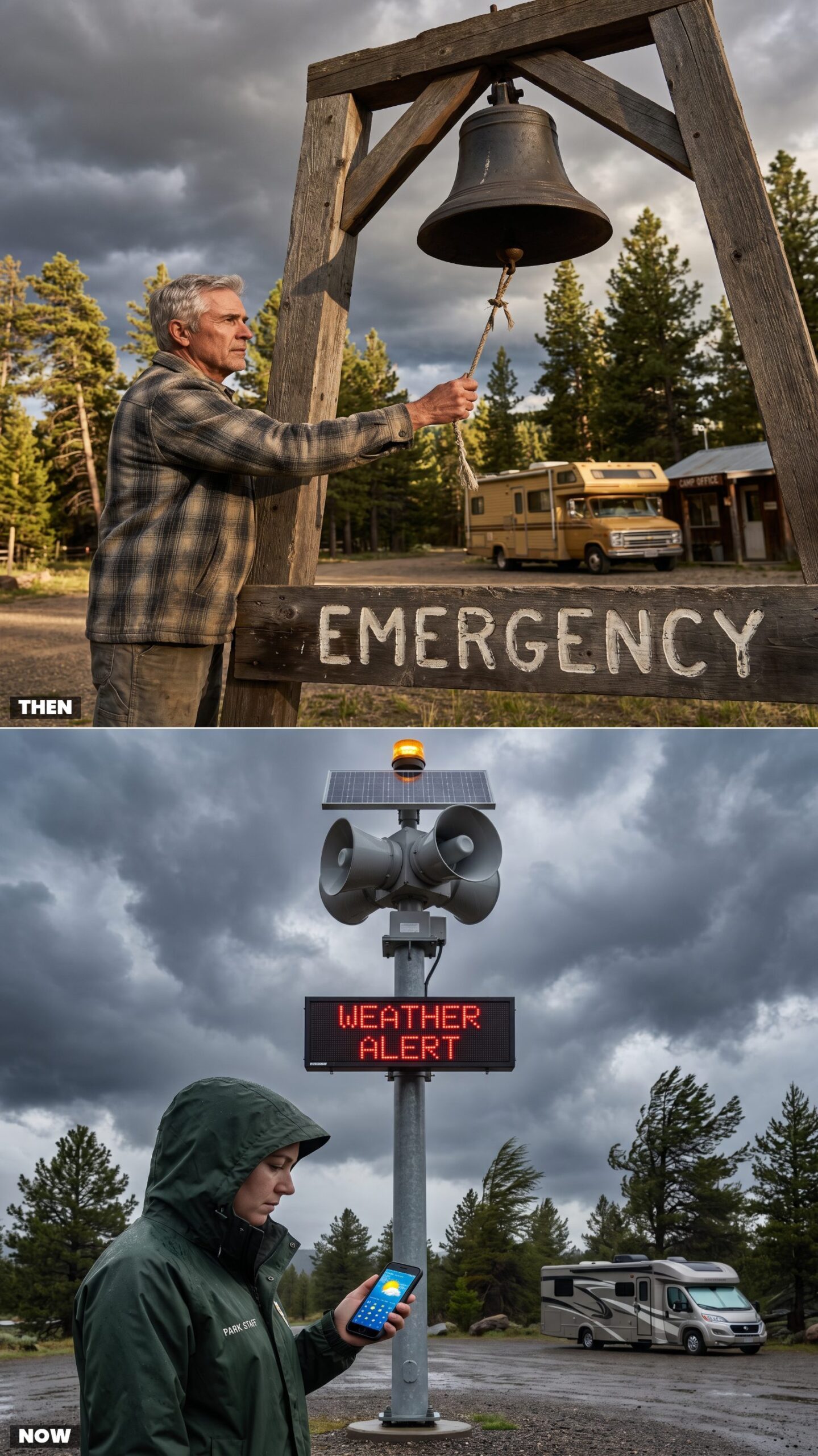
When the sky went green, somebody ran for the bell. That iron clang was the whole warning system: drop what you’re doing, grab the kids, get low. It worked because the sound carried and everybody knew exactly what it meant.
Now the alert hits your phone before the host even looks up. Pole-mounted sirens, strobes, a digital board flashing the warning, a push notification with the storm’s exact track. Faster, smarter, and a little clinical. There was something about that bell, though — it put the fear in you the way no buzzing phone ever will.
1. The Folding Lawn Chairs and Lantern vs. Today’s Rugs, TVs, and Outdoor Kitchens
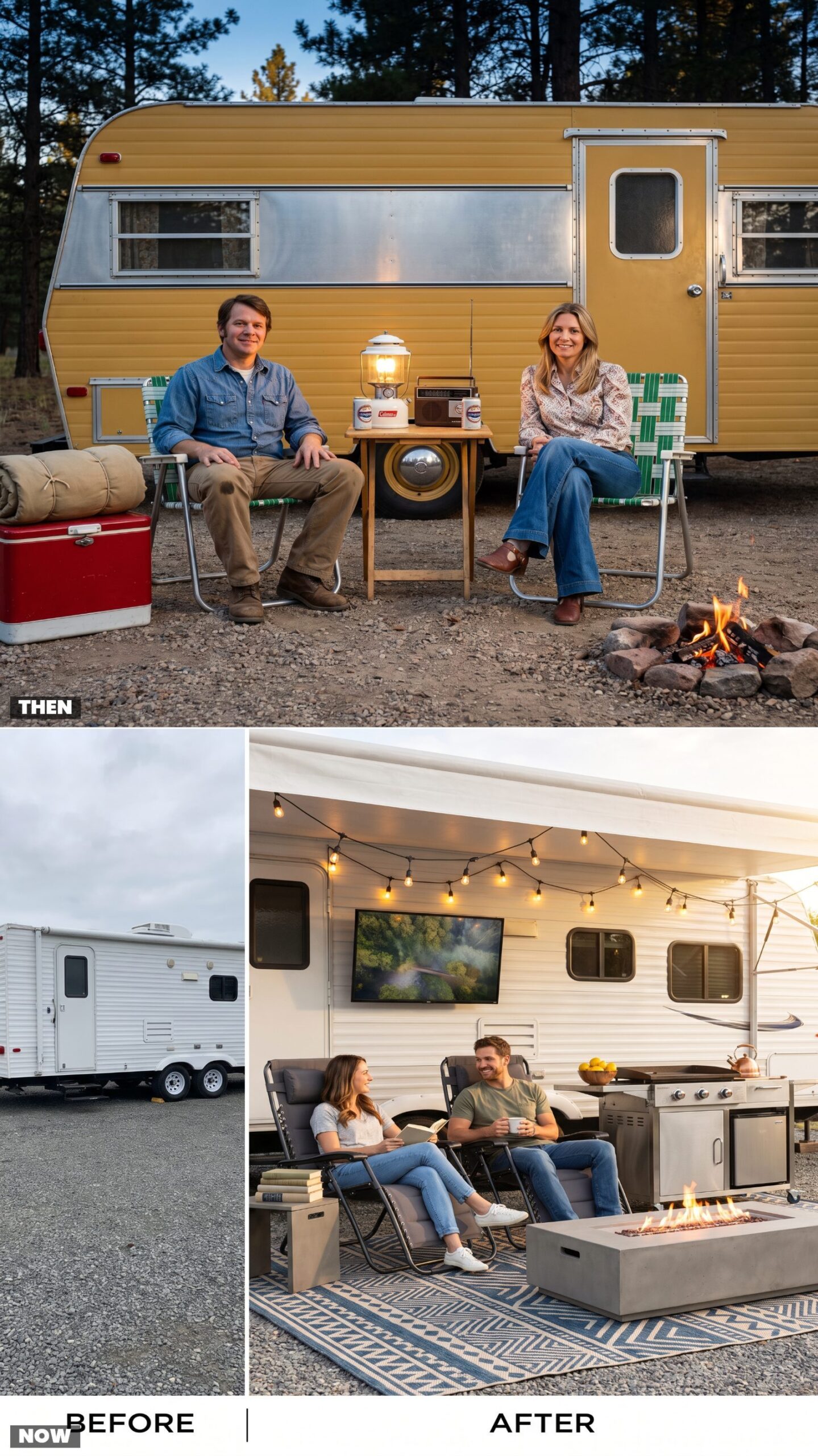
Outdoor living in 1975 came down to two webbed aluminum chairs, a hissing Coleman lantern, and a transistor radio pulling in a ballgame. You sat on gravel and watched the fire. That was the whole setup, and nobody needed more because nobody had more.
The modern site is a full outdoor living room. A big patterned rug thrown over the dirt, zero-gravity recliners, string lights, a weatherproof TV in the awning, an outdoor kitchen with a griddle and a mini fridge. A propane fire table now stands in for the woodsmoke you used to chase around the circle.