
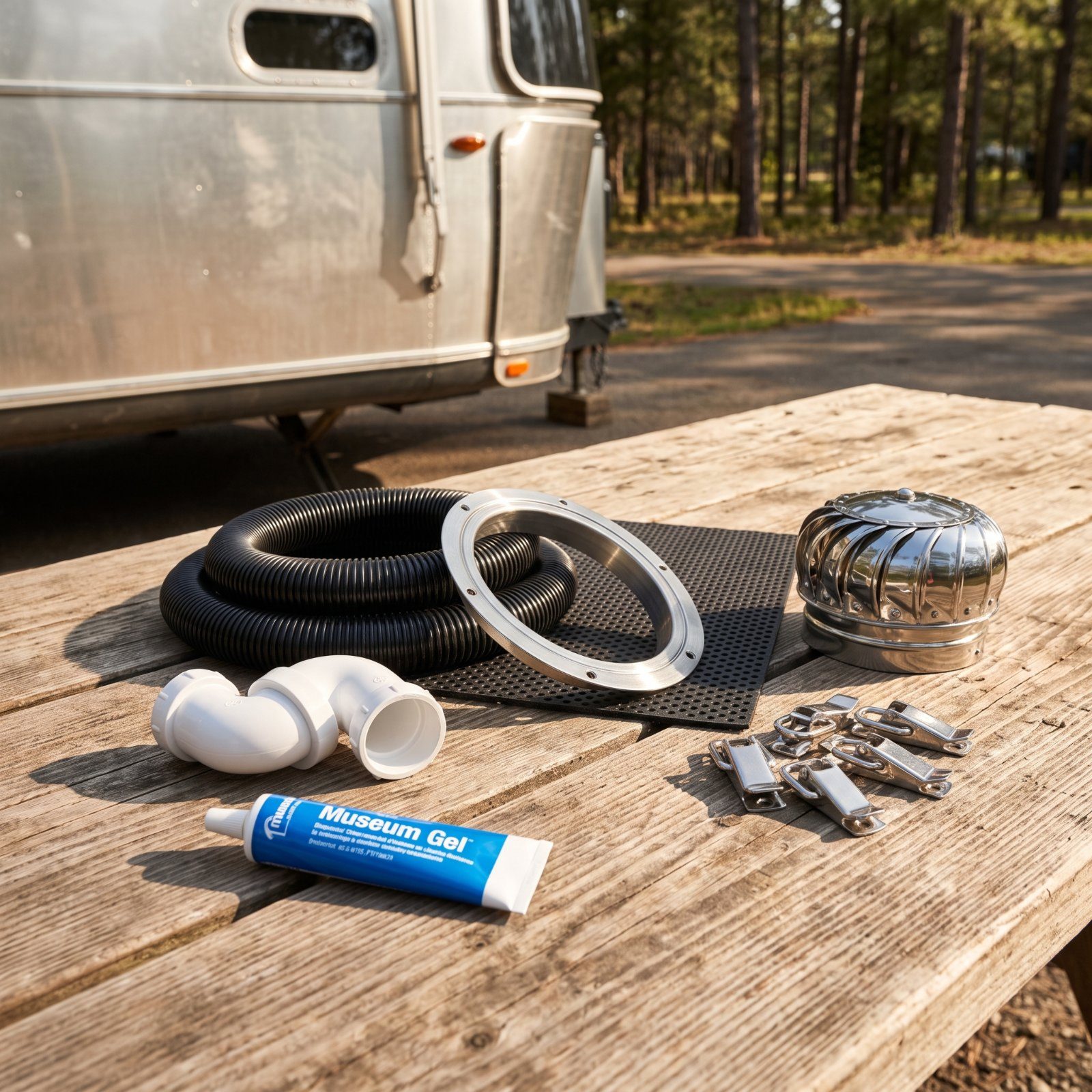
Nobody tells you about the P-trap. You find out somewhere around mile 180, when a cattle-ranch smell drifts up from the bathroom and your passenger quietly rolls down a window. The manuals cover the big systems and skip the stuff that actually drives you nuts — the rattle, the sweating mattress, the shower that scalds and then freezes. None of the modifications below will win any trade-show awards, and a few look faintly ridiculous. But every one solves a real, repeatable headache, most cost less than a tank of diesel, and all are odd enough that your neighbors will wander over to ask what on earth you’re doing.
Please note that some of the images in this article were created with the assistance of AI.
41. Museum Gel That Secures Countertop Items Without Glue

Museum conservators use this stuff to keep priceless vases upright during earthquakes. You’re going to use it to stop your coffee canister from taking a header off the counter on a gravel road.
A clear, tacky dab pressed under the bottom edge of anything that slides or topples, then set down firmly on the counter, holds through the kind of washboard dirt that rattles your fillings, then peels off clean when you want to move things — no mark on laminate or wood. One small jar lasts years. Cheaper and tidier than non-slip drawer liner, which just migrates and bunches anyway.
40. A Waterless P-Trap That Prevents Drain Odors on Bumpy Roads
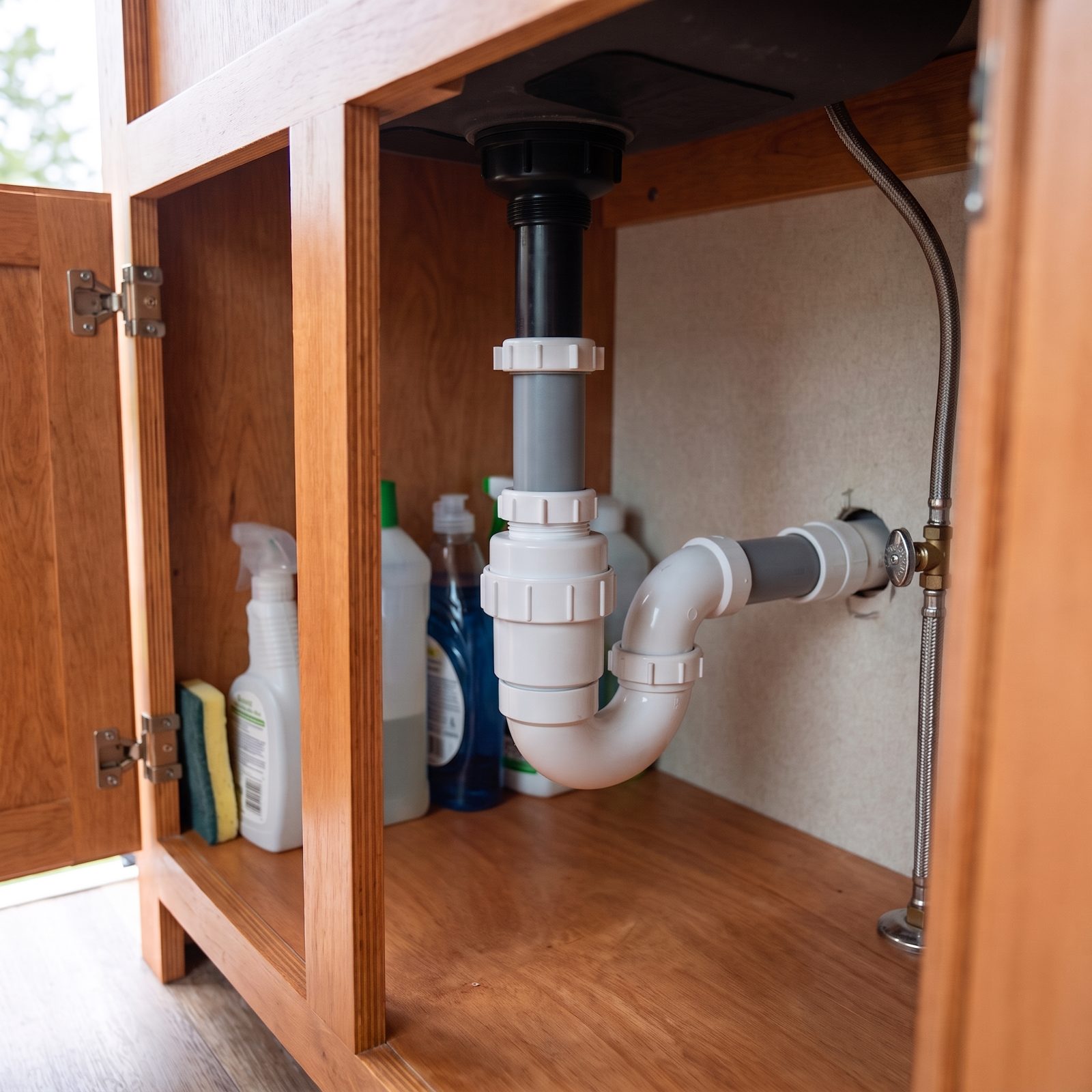
A standard P-trap, like the white one pictured under this sink, relies on a little pool of water sitting in its curved J-bend, forming a seal against sewer gas. Works great in a house that doesn’t move. In an RV, that water sloshes out going over passes and down ruts, and suddenly there’s nothing left to block the smell.
A waterless trap adds a straight inline unit, pictured here fitted above the curved bend, holding a soft silicone membrane that opens when water drains and snaps shut the rest of the time. Even when the bend sloshes dry, the membrane still holds the seal. The kitchen quits greeting you with that faint tank reek after a day of driving. Runs about twenty to thirty dollars and fits into the existing line with basic fittings.
39. A Marine Access Hatch Cut Into Wasted Dinette Space
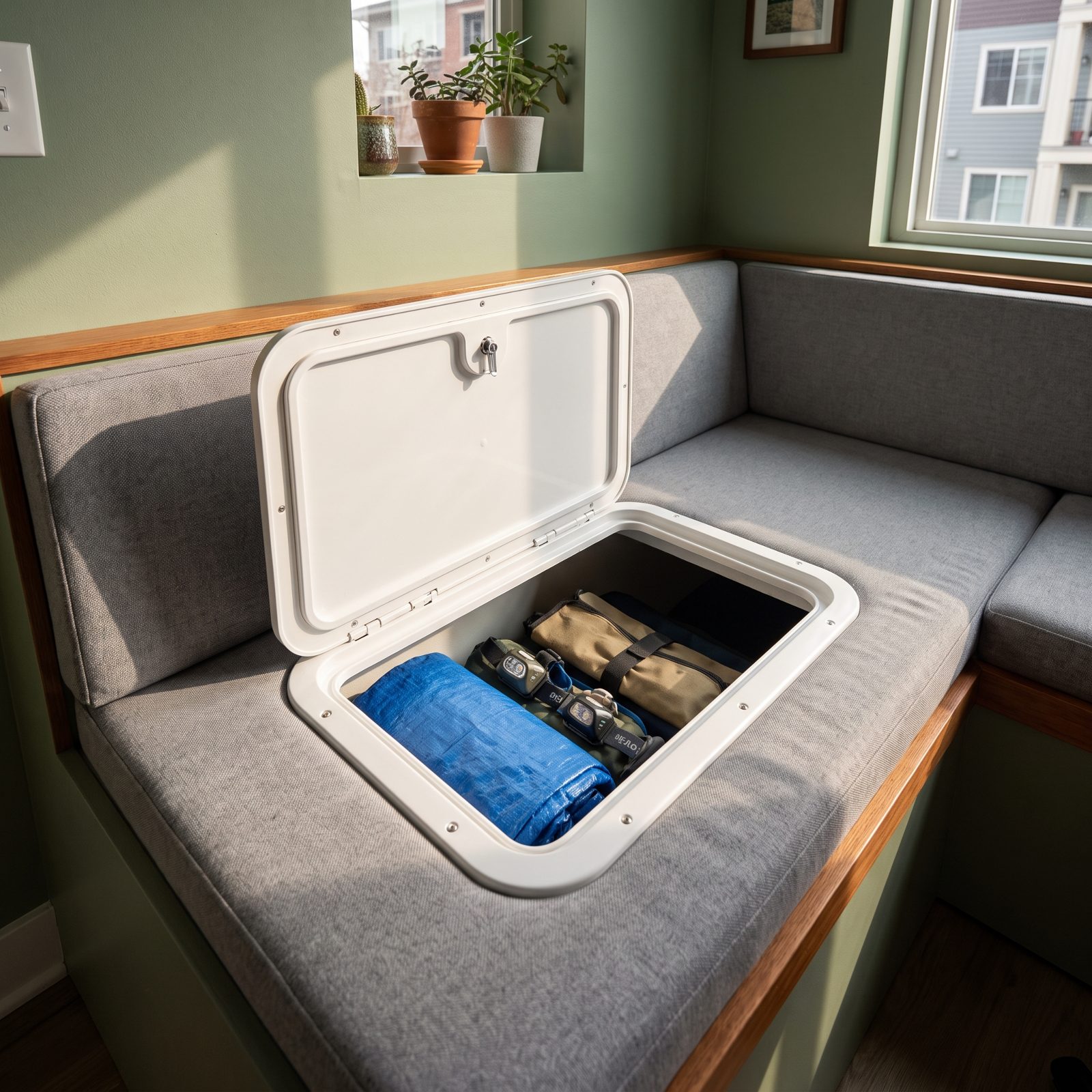
Every dinette hides a cave. Under that bench seat sits a hollow you can only reach by lifting the whole cushion and whatever’s piled on top, which means you never actually use it.
Cut a marine deck hatch straight through the seat cushion and the bench top below it — the kind built for boat decks to shrug off spray and foot traffic — and that dead space becomes a dry, sealed locker you open one-handed. The white ring sits nearly flush with the cushion fabric, so nobody snags a shin. Figure thirty to sixty dollars for the hatch, a jigsaw, and an afternoon. Measure three times before you commit the blade. There’s no un-cutting a bench — or its cushion.
38. An Under-Mattress Airflow Mat That Stops Condensation

Lift your RV mattress on a cold morning and you might find it wet underneath. Not spilled-water wet. Body-heat-meets-cold-platform wet, the kind that turns into black mildew on the mattress base before you ever catch a whiff of it.
An airflow mat is a loose tangle of plastic filament that creates a roughly three-quarter-inch gap under the mattress, so moisture ventilates instead of pooling against a cold surface. Cut it to fit with scissors. Costs maybe forty to seventy dollars. People fight this for years with desiccant packs and dehumidifiers when the real culprit is air that can’t move.
37. A Wind-Powered Roof Vent Cap That Pulls Tank Fumes Out
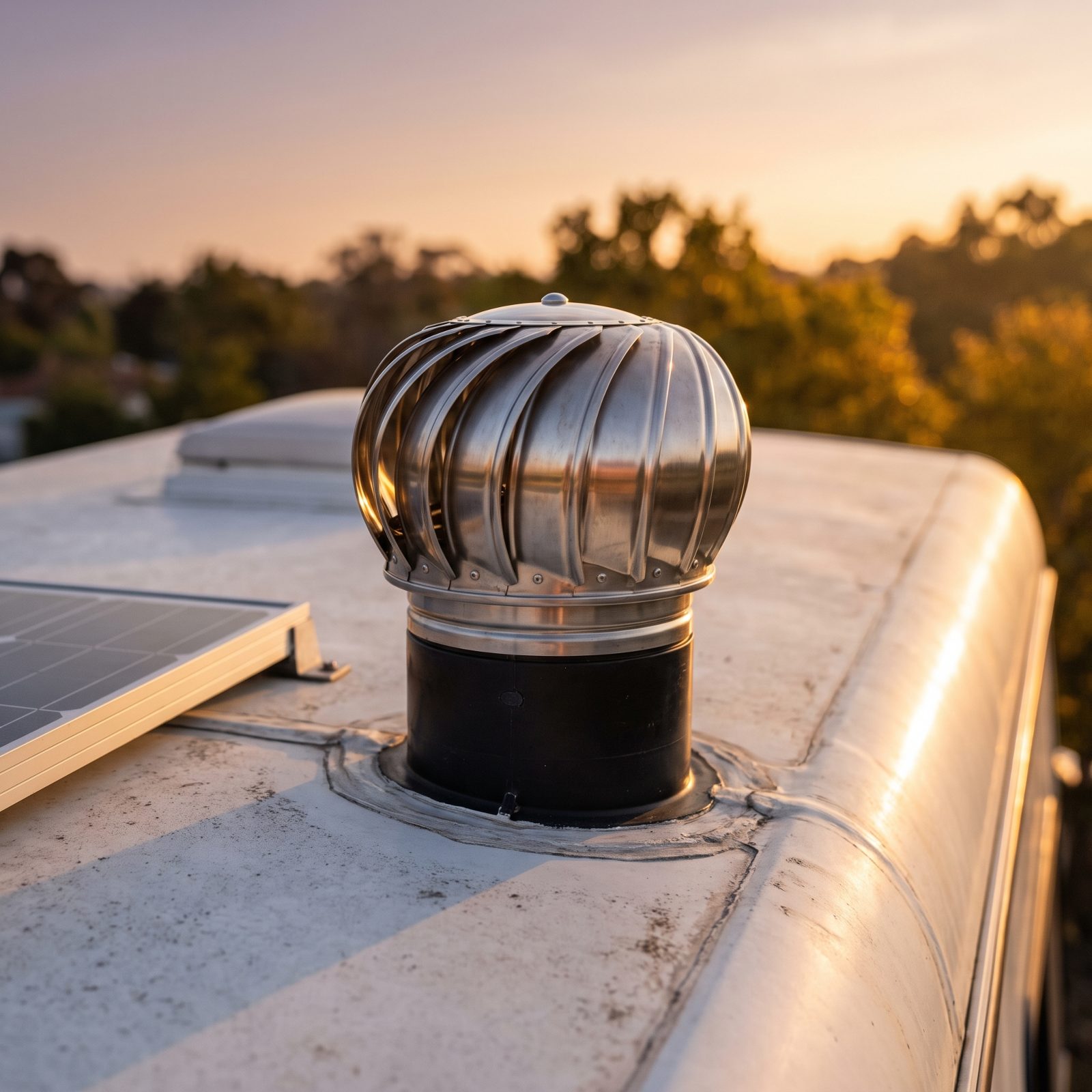
That little mushroom cap over your black tank vent does almost nothing. On a still, hot day, sewer gas just sits in the pipe and backs up into the bathroom.
Swap it for a wind-driven turbine cap, the sort you see spinning on barn roofs and boat cabins. Even a light breeze spins the vanes and draws air up and out of the tank, keeping odors moving the right direction. Stainless versions run twenty to forty dollars and mount on the standard vent pipe. One caution: a few parks with low clearances or strict roof rules may frown on anything that adds height, so eyeball your overall measurement first.
36. A Shower Recirculation Valve That Saves the Cold Water
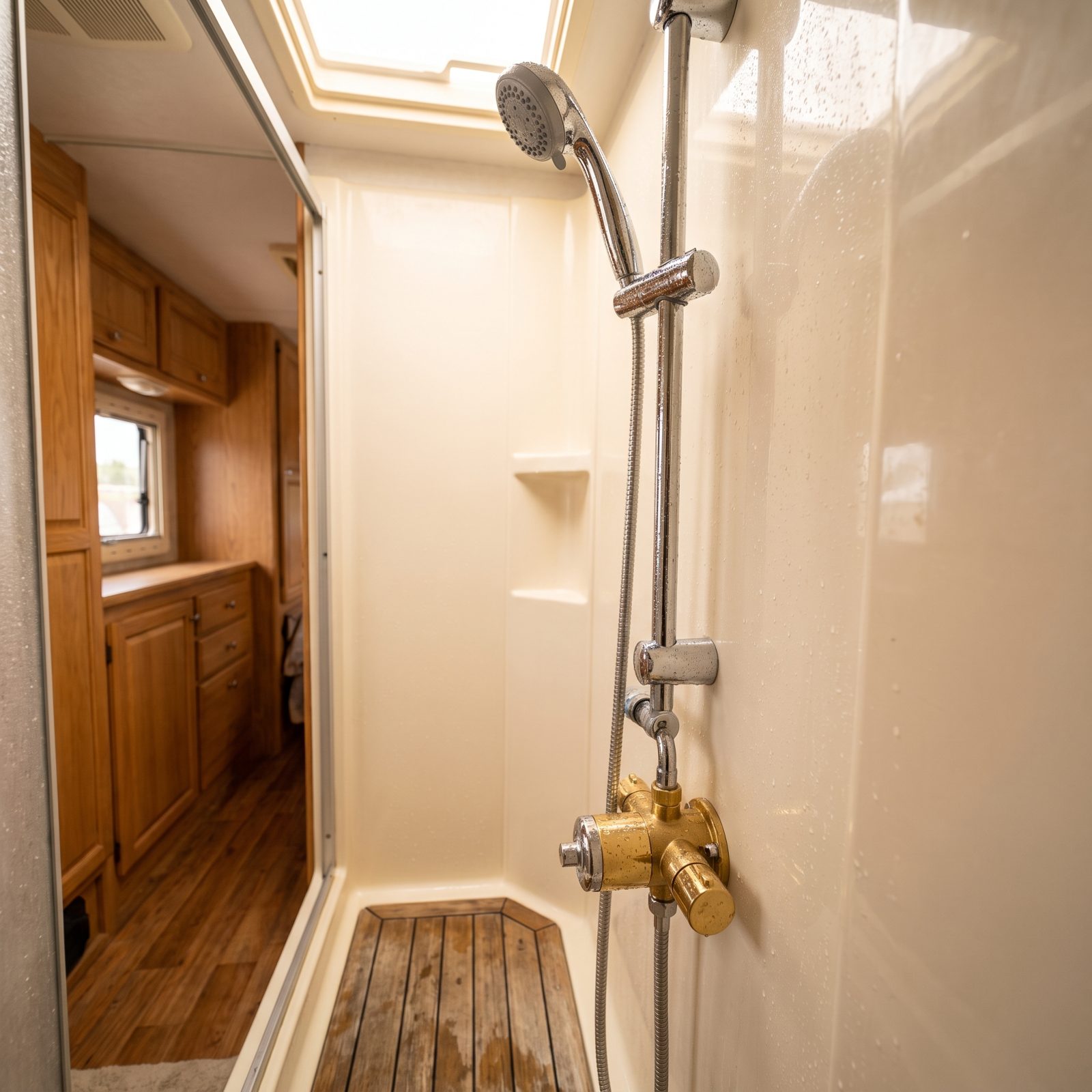
You run the shower waiting for hot, and all that cold water pours straight down the drain and fills your gray tank for nothing. On a full-timer’s math, that’s gallons a day and a tank you’re dumping too often.
A thermostatic recirculation valve sits at the shower and loops the cold water back toward the heater instead of down the drain, then opens for you once the line warms up. You stop wasting fresh water. You stop filling gray. Modest cost, meaningful payoff if you boondock, where every gallon in and every gallon out is a planning decision.
35. A Dehumidifier Drain Routed Straight Through the Floor

A dehumidifier is the fix for RV damp. The catch nobody mentions: the bucket fills overnight, shuts the unit off, and now you’re hauling a sloshing tray to the bathroom every morning like some chore nobody signed up for.
Route the drain line through a small, sealed penetration in the floor and the water just leaves. The unit runs continuous, the bucket never fills, and you forget the thing exists. Use a proper grommet and seal it well — an unsealed hole in the floor is how you trade a damp cabin for a mouse problem.
34. A Thermostatic Fan Behind the Refrigerator Cooling Unit
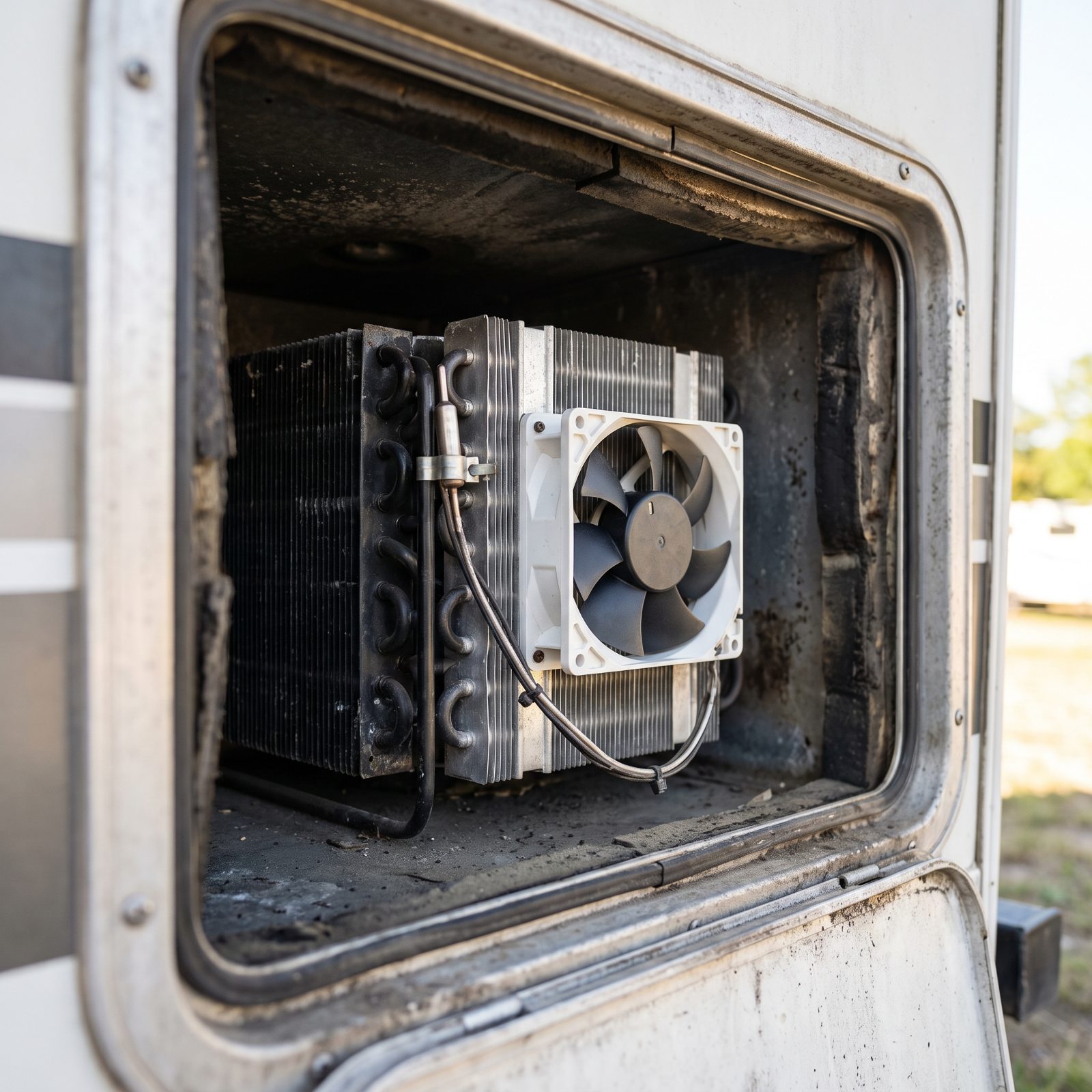
Absorption fridges — the propane-electric kind in most RVs — cool by moving heat away from the back of the unit. Park in the sun on a hot day and that heat has nowhere to go, so the fridge basically gives up and your milk goes warm while you’re at the beach.
A small 12-volt fan with a thermostatic switch clips behind the cooling fins and kicks on only when things heat up. It pulls hot air out of the chimney cavity so the cooling cycle keeps working. Cheap, draws almost no power, and can drop interior temp several degrees on a scorcher.
33. An Accumulator Tank That Smooths Pulsing Water Pressure
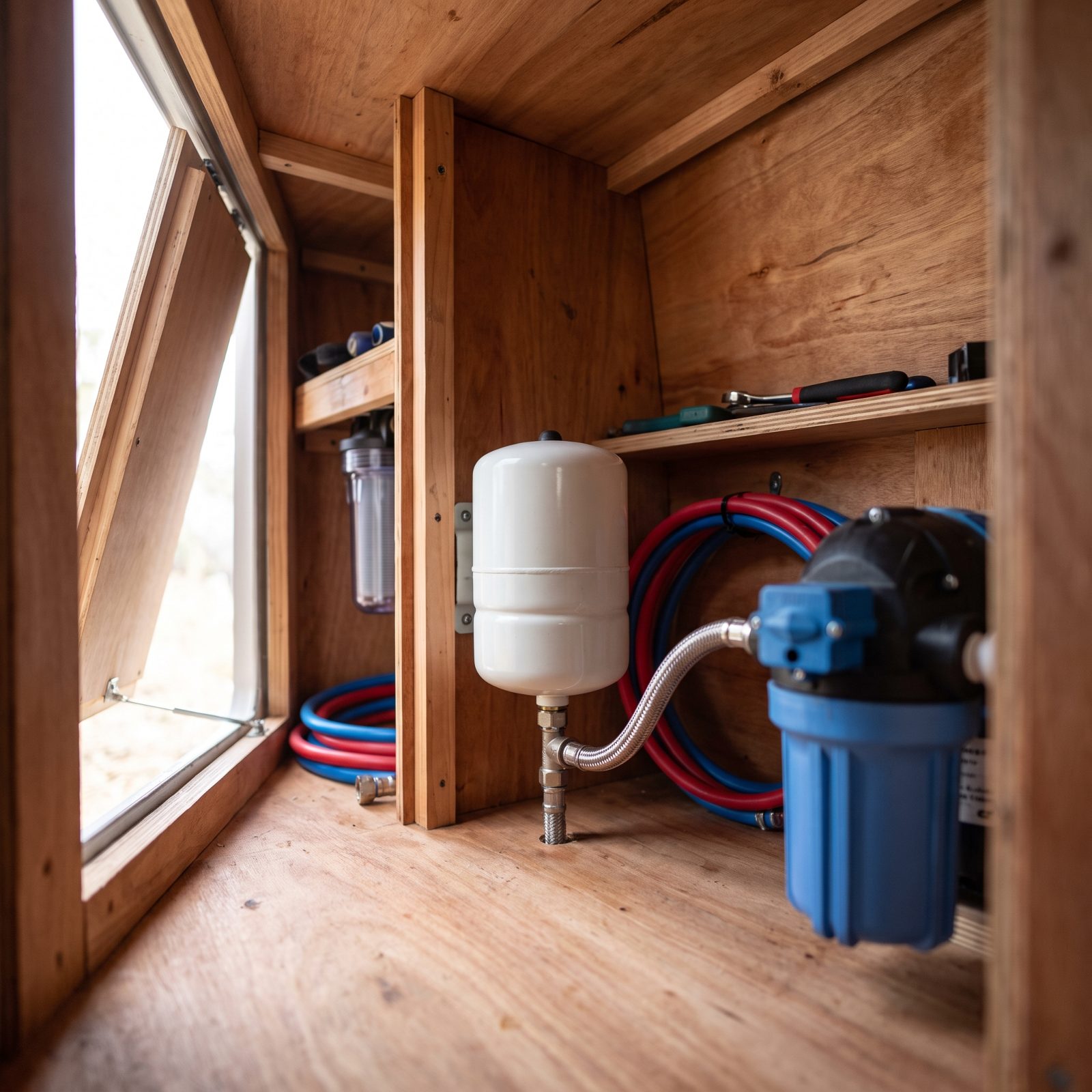
Turn on an RV tap off the pump and the water comes out in pulses — surge and pause, surge and pause — while the pump cycles on and off trying to keep up. It’s loud at 2 a.m. And it makes a simple sink rinse feel like an argument.
An accumulator tank is a small pressure vessel with an air cushion inside. It stores a bit of pressurized water so the pump runs less and the flow comes out smooth. The faucet quits stuttering, the pump quits short-cycling, and the whole water system gets noticeably happier. Forty to sixty dollars, installs right after the pump.
32. Positive-Locking Boat Latches That Keep Cabinets Closed

The magnetic catches that come stock are a joke. One sharp brake, one rough on-ramp, and your overhead cabinet flings open and rains canned goods on the dog. The magnet works fine in a showroom and fails the second the rig moves.
Boat builders solved this decades ago with positive-locking latches — push-button flush catches that physically grab and hold until you release them. Spray won’t pop a locker open at sea, and a pothole won’t pop one open on the interstate. They cost a few dollars each and look sharp set into the wood. Do the ones over your head first. Those are the ones that draw blood.
31. A Laundry Chute Dropping Into an Exterior Storage Bay
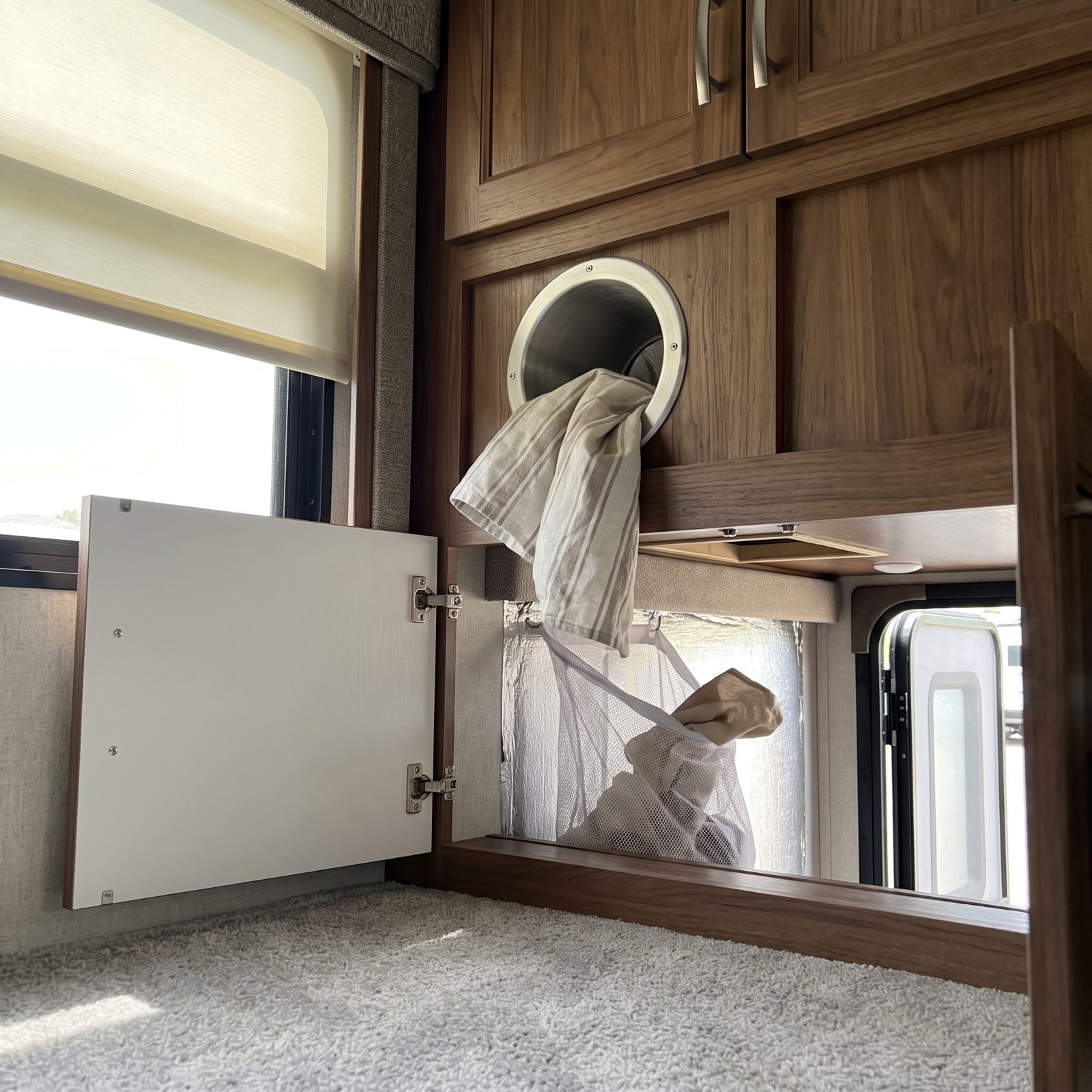
Most people hauling a hamper through a motorhome have done the dance: sideways shuffle, bump a hip on the dinette, drop a sock, back up, try again. A stainless laundry chute set into a bedroom cabinet, paired with a mesh bag in the exterior bay just below, kills that whole routine. Dirty clothes go into the porthole at cabinet height, drop into a mesh bag, and wait there for you to grab from outside on laundry day.
Nobody mentions the sealing. An unconditioned bay holding your laundry is a draft highway come January and a bug door come July. Gasket the bay door, keep the mesh bag cinched, and both problems go away.
30. Toe-Kick Drawers Hidden Beneath the Kitchen Cabinets
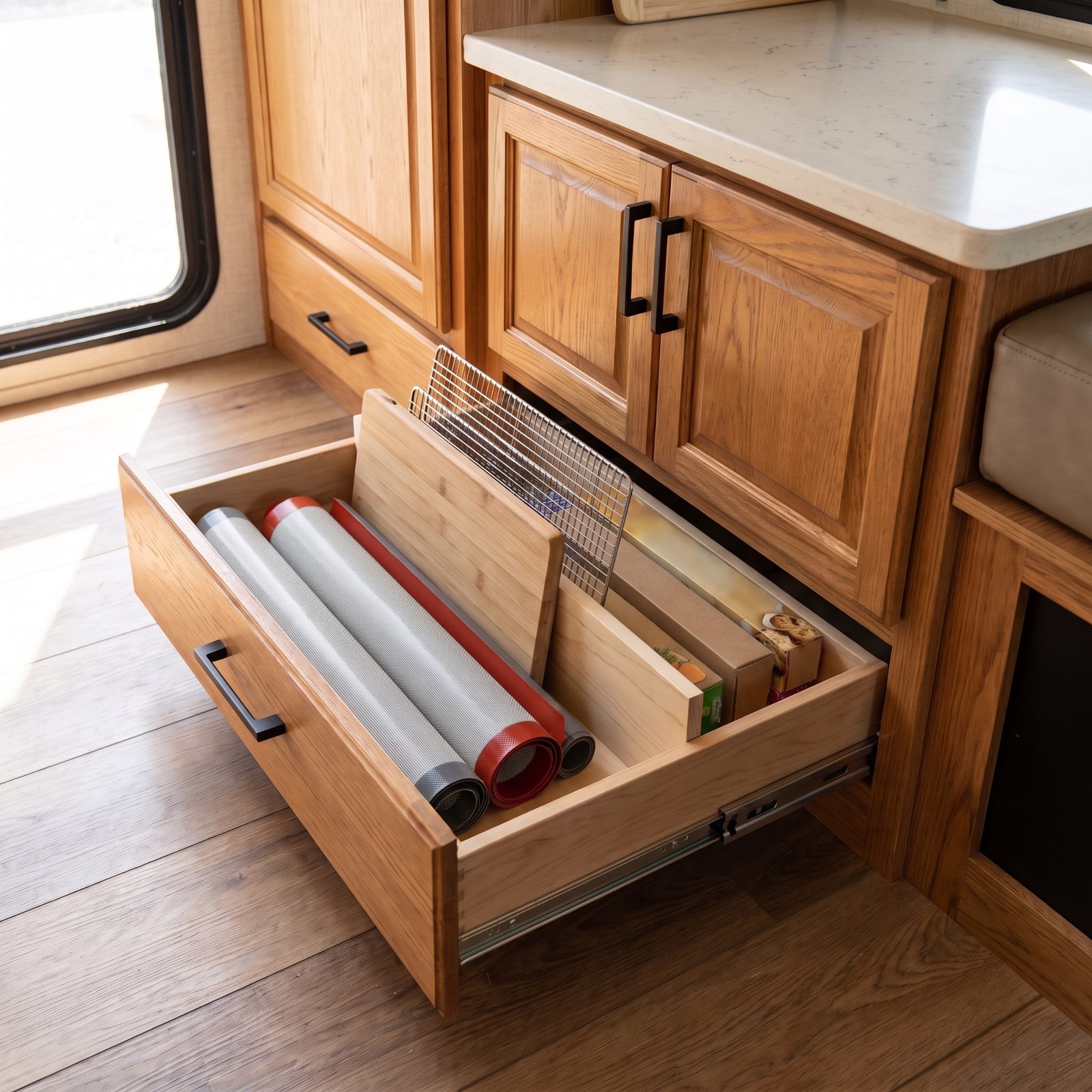
The space beneath your base cabinets is dead space. Every RV has it — that low gap below the cabinet doors, down by the floor, where nothing ever goes — and almost every RV wastes it. Build a deep pull-out drawer with its own handle into that opening, separate from the doors above, and it becomes a home for all the flat stuff that never fits anywhere: cutting boards and cooling racks filed upright, those silicone mats rolled up and laid flat instead of curling in every other drawer, and a divided side compartment for boxes of foil, parchment and wrap.
It holds surprisingly little weight, and that’s deliberate. Nothing heavy down there, nothing you grab mid-recipe. This is where the things you need twice a month live, the things you resent storing the other twenty-eight days.
29. A Hollow Entry Step Converted Into a Storage Compartment
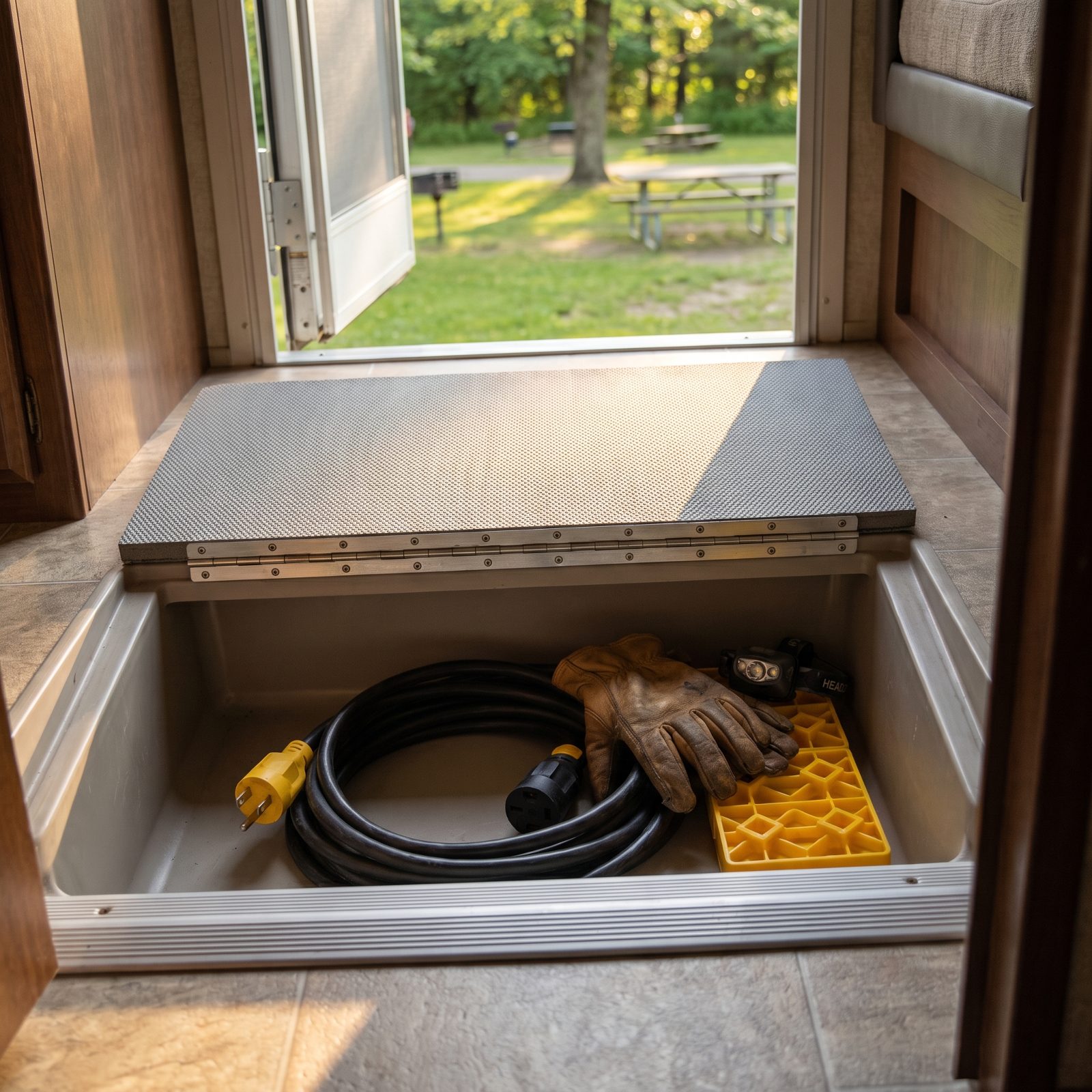
Your entry step is a lie. It looks solid, but underneath it’s almost always a molded plastic shell bolted over empty air — air that could be holding your power cord instead of nothing.
Hinge the tread, line the cavity, and suddenly the grabby, greasy stuff you hate dragging inside lives right at the door: shore cord, work gloves, leveling blocks, the headlamp that vanishes every single night. First thing you open on arrival, last thing you close on the way out.
One caution, learned the hard way. Keep it light and keep it dry. Water tracks in on that step, and anything that rusts or molds has no business sitting in a box right under your feet.
28. A Shower-Door Drip Rail That Sends Water Back Into the Pan
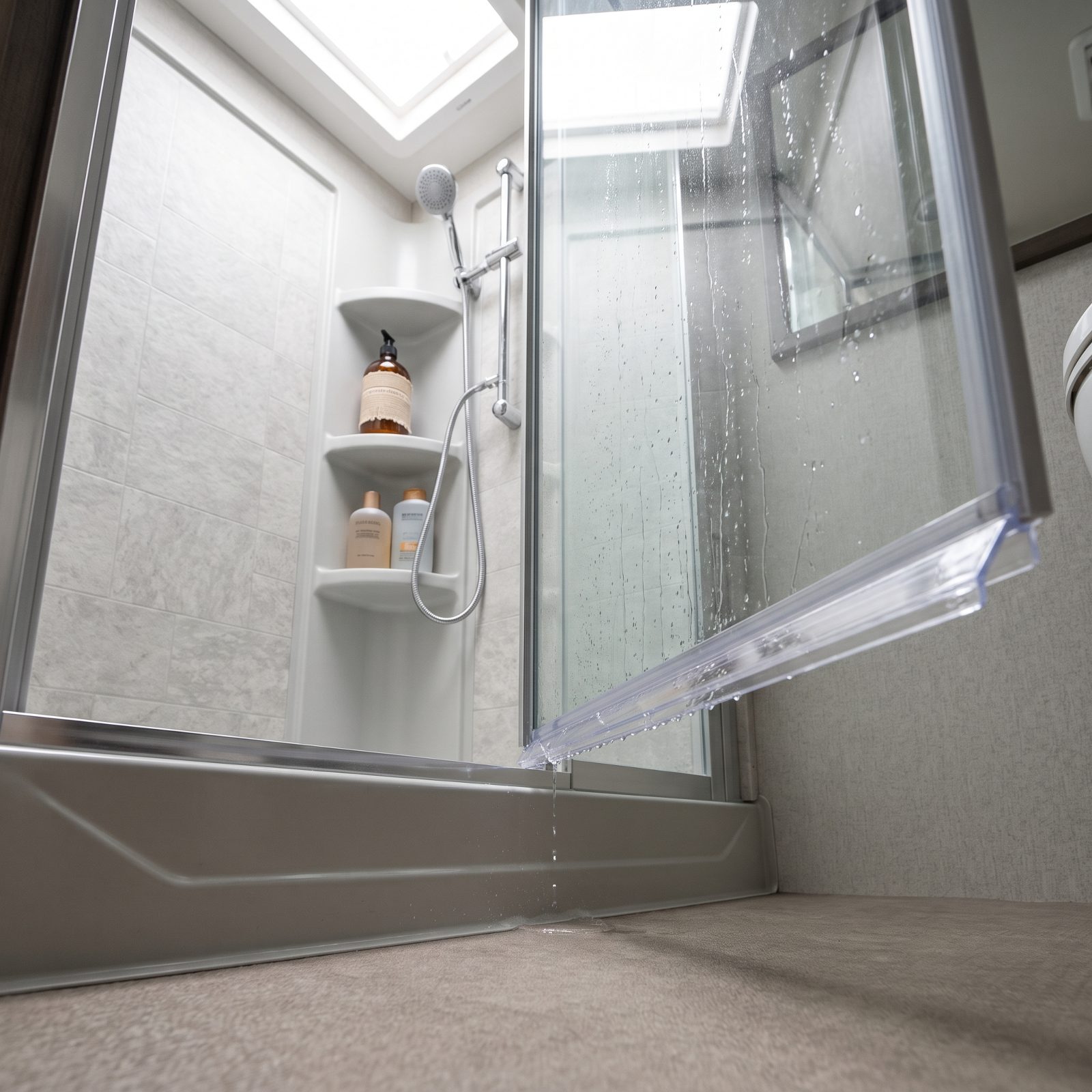
Small fix, daily payoff: that puddle outside the shower you step in every single time. Most RV shower doors leak at the bottom seam, and the half-cup of water that escapes hits the bathroom floor, waits patiently, and finds your socks an hour later.
A drip rail here is a full-length clear sweep fitted along the entire bottom edge of the glass panel. It catches the runoff and pours it back into the pan instead of onto the floor. Cheap, five minutes with adhesive, no tools. You install it once and never think about it again.
27. External Tank Sensors That Read Through the Tank Wall
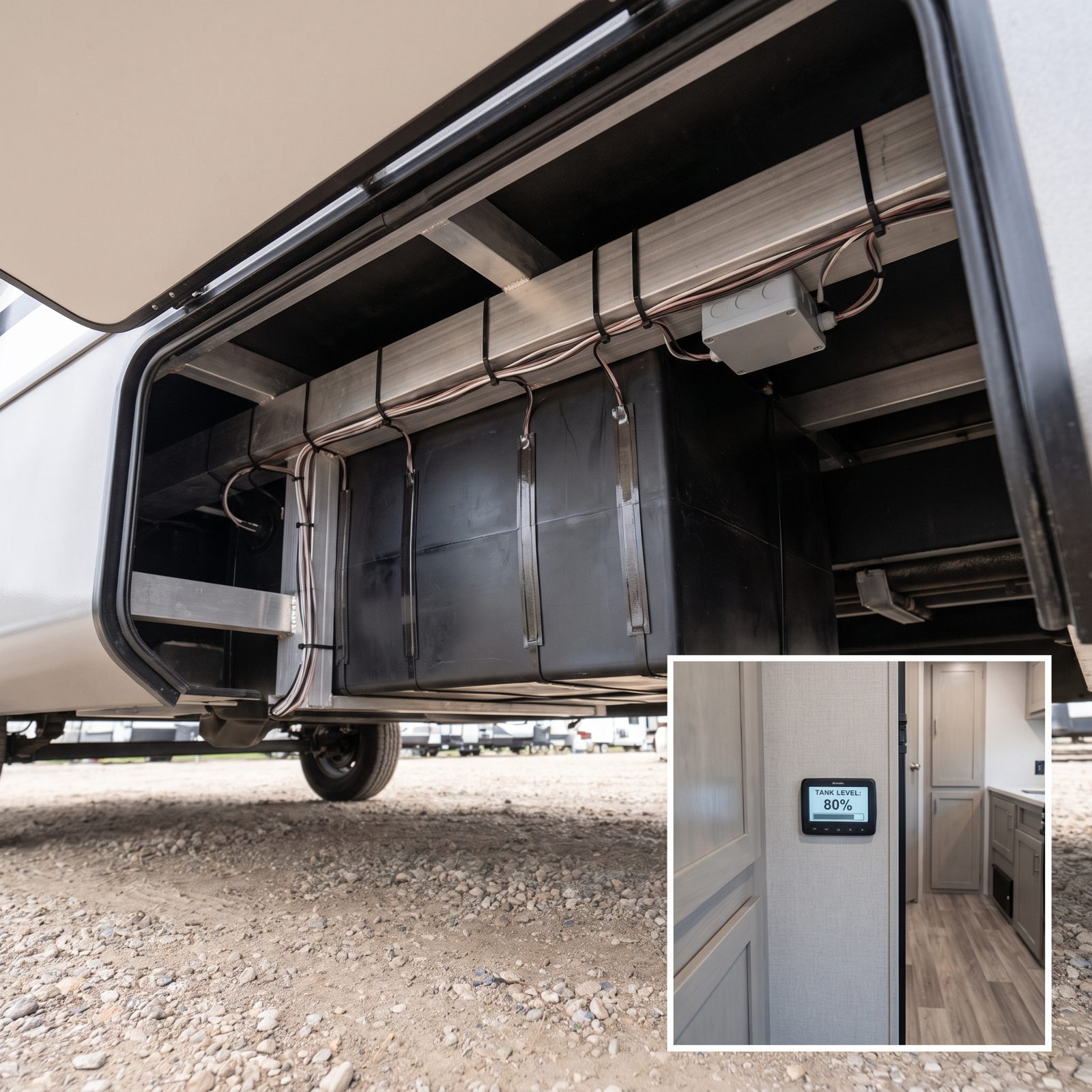
Factory tank sensors lie. The old probes poke through the tank wall, and the moment a wad of toilet paper drapes across one, it insists the tank is “two-thirds full” for the next three weeks no matter what. Everyone with a trailer has sworn at that readout.
External sensors sidestep the whole mess. They stick to the outside of the tank and read the level through the wall, so nothing floating around in there can ever gunk them up. No probes to foul. No cleaning rituals. No guessing at the dump station.
26. A Propane Detector That Automatically Closes the Gas Valve
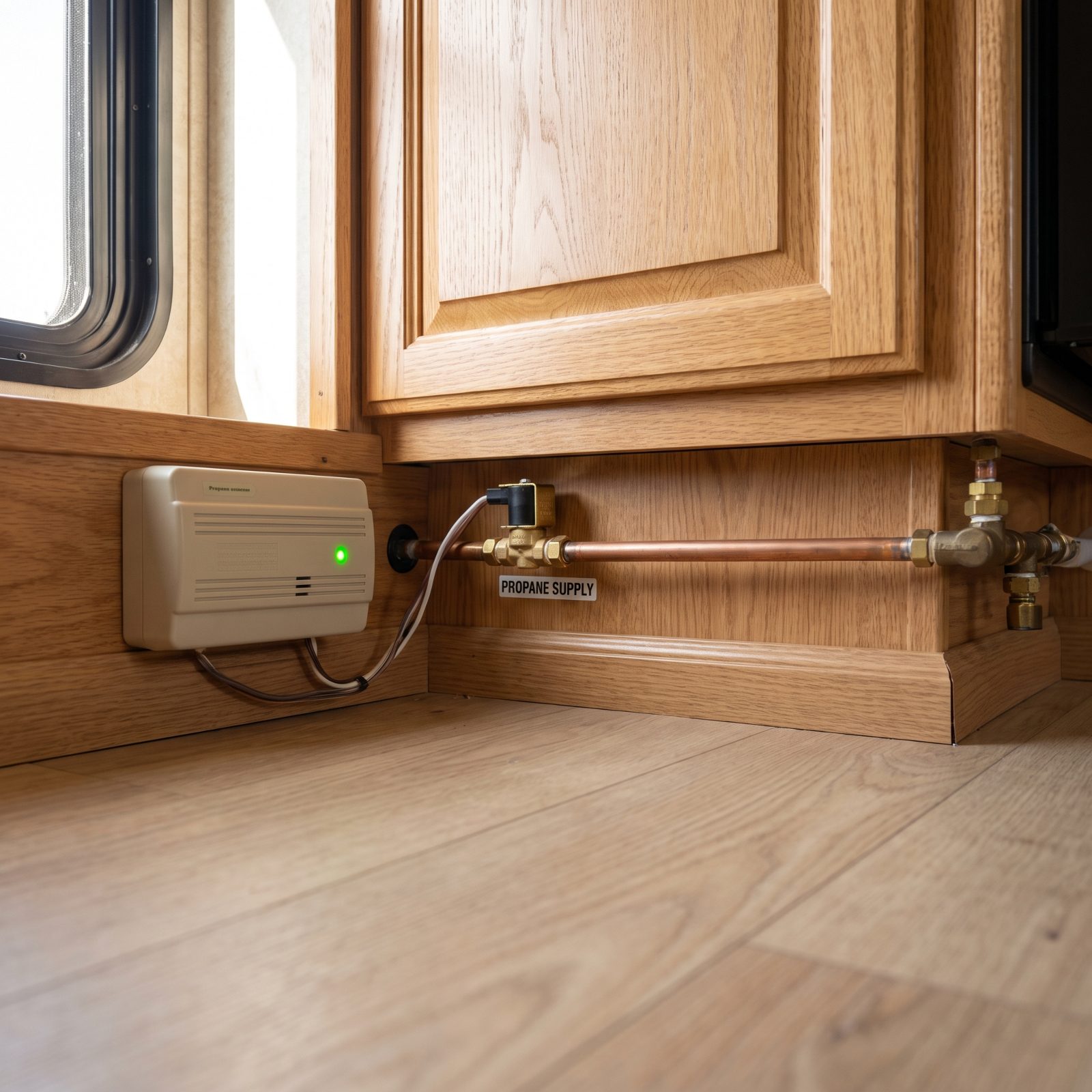
A standard propane alarm does exactly one thing: it screams. Handy at 3 a.m. when you’re lying three feet from it. Useless when the rig is parked and empty and a slow leak spends the whole afternoon filling the cabin.
Pair the detector with an automatic shutoff solenoid on the gas line, though, and the alarm becomes more than noise. Sensor trips, valve slams shut, leak ends — whether you’re standing right there or four hours into a hike. For a rig that spends most of its life stored or boondocking, that’s the whole difference.
25. An Automatic Fire-Suppression Canister Above the RV Refrigerator
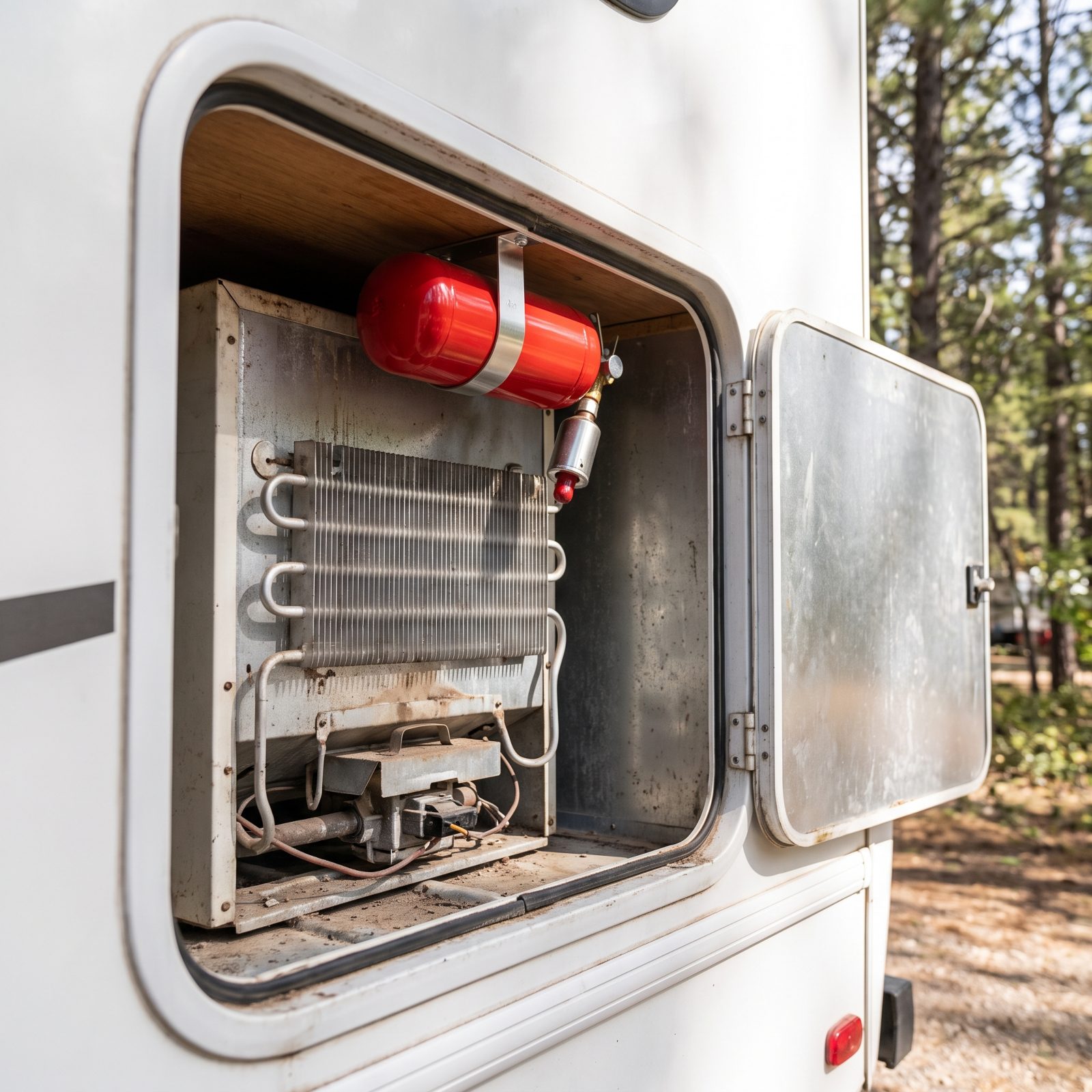
Here’s what nobody tells new owners: a large share of RV fires start at the absorption refrigerator. It runs on a propane flame tucked inside an outside compartment you almost never open, so a fault can smolder back there a good long while before anyone smells smoke.
An automatic suppression canister mounts in that compartment and discharges the instant it hits a trigger temperature. No wiring. No button. No human required. It sits there doing nothing for years, then earns its entire cost in the four seconds that matter.
24. A Self-Heating Lithium Battery for Freezing Conditions
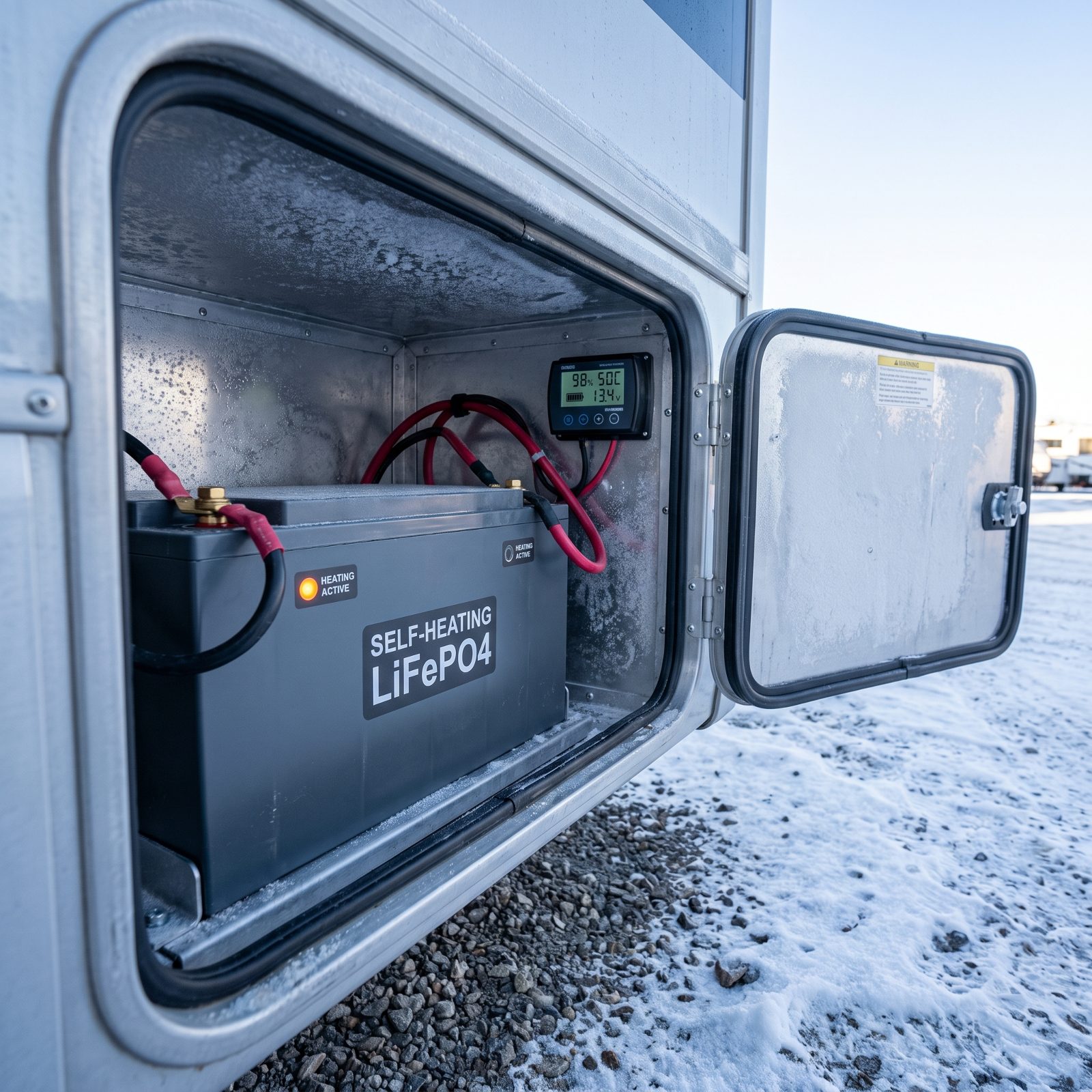
Lithium batteries have one genuine weakness, and it bites the people who chase their RV north in winter. You cannot charge most of them below freezing without doing permanent damage. Pull into a cold campsite, plug in, and that expensive battery pack can wreck itself trying to accept the charge.
A self-heating model builds a warming pad right into the cells. Temperature drops, the battery warms itself up to a safe charging range first, then takes power. No external heat mats to wire in, no babysitting a thermometer, no dead battery in April when you learn all this the hard way.
23. A DC-to-DC Charger That Protects the Alternator
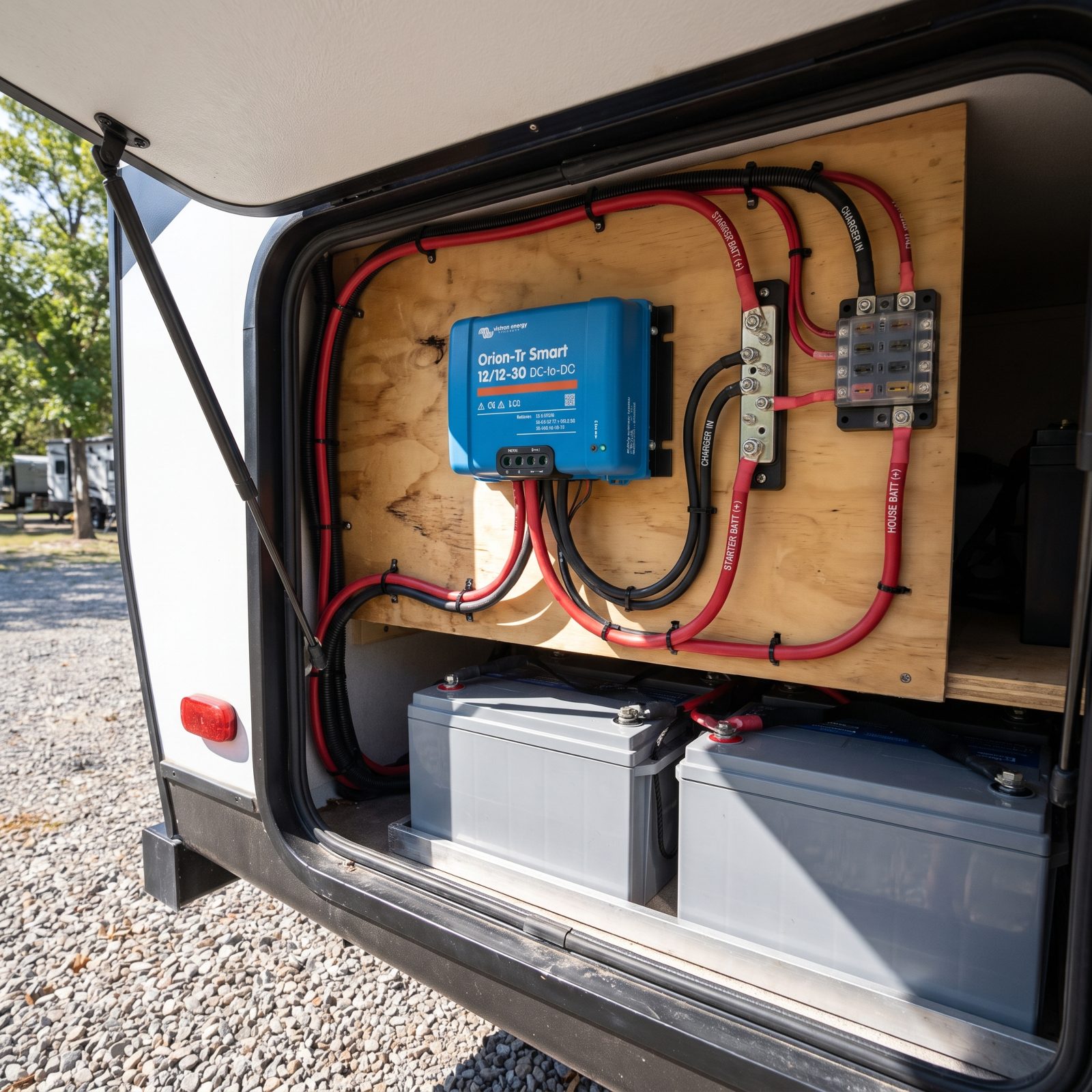
Add lithium house batteries, wire them straight to your alternator the old way, and you’ve handed the factory a problem it never planned for. Lithium drinks current so hard it can run a stock alternator flat out for hours, cooking it until it fails on some lonely stretch of highway.
A DC-to-DC charger sits between the engine and the house batteries and meters the flow. It feeds the lithium a controlled, safe rate and keeps your alternator well clear of the danger zone. This is the upgrade that makes a lithium conversion actually safe to drive, not just nice to park.
22. An Air-Conditioner Soft Starter for Limited Campground Power
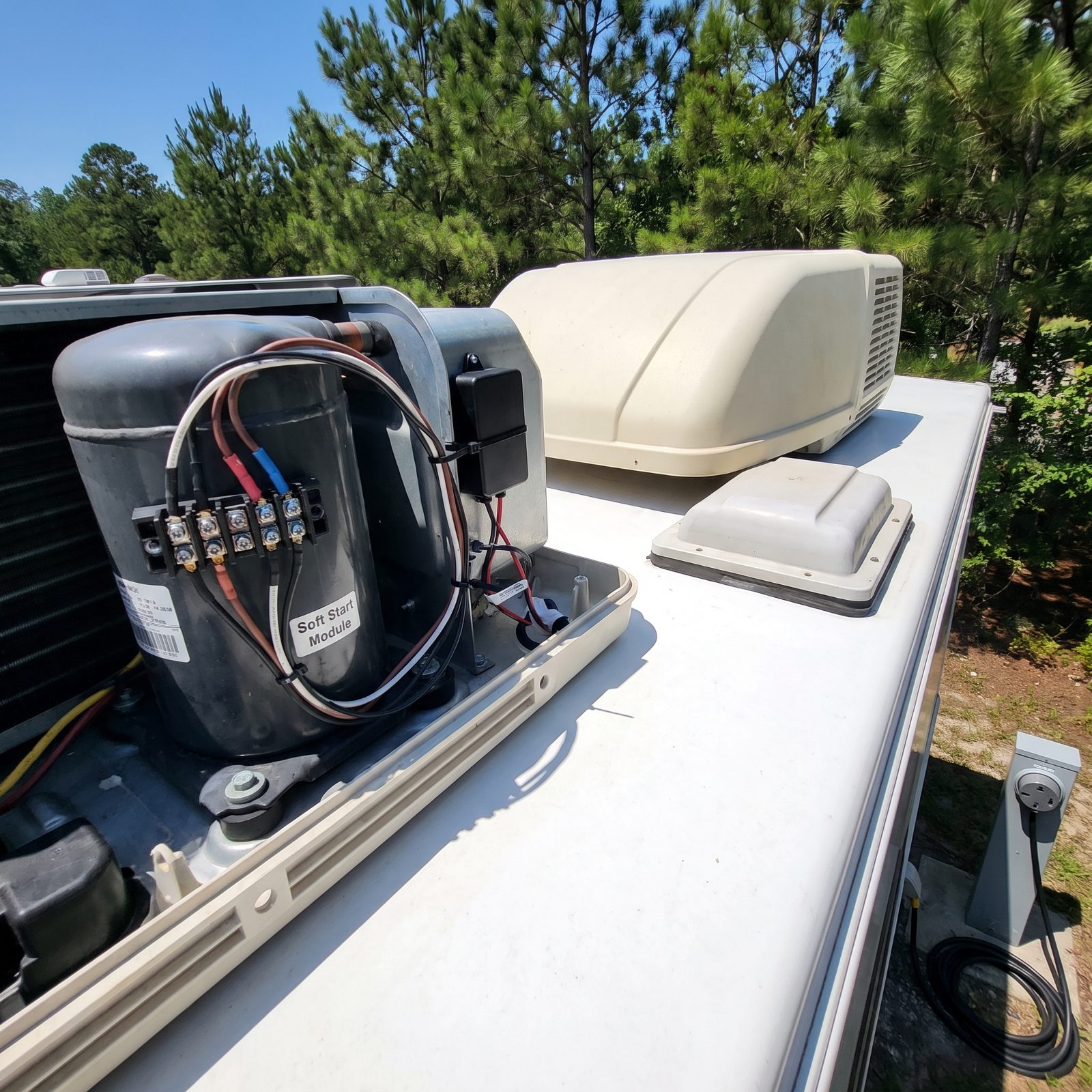
An RV air conditioner draws a brutal spike the instant its compressor kicks on, far more than it sips once it’s running. On a weak 30-amp pedestal, or a generator, or when the neighbor’s rig is hammering the same circuit, that spike is what trips the breaker or stalls the gen.
A soft starter smooths the launch. Instead of slamming the compressor on, it ramps it up, flattening the startup surge. And here’s what owners actually care about: you can often run the AC off a single generator that could never start it before, or on a park pedestal that tripped all summer long.
21. Red Floor-Level Lights That Preserve Night Vision
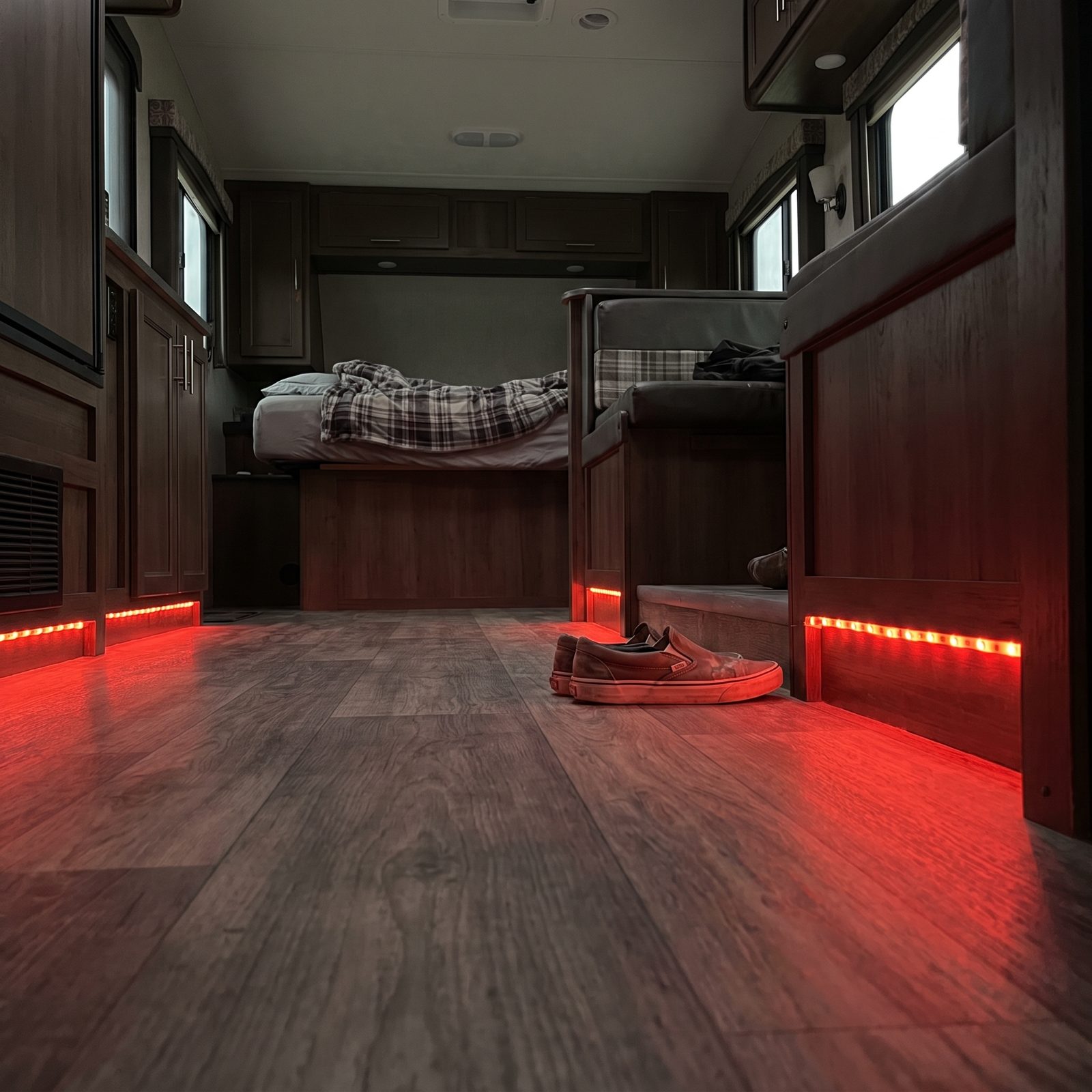
White overhead lights at 2 a.m. are a small act of violence against everyone still asleep. Flip one on for a glass of water and you’ve blown out your night vision for twenty minutes and woken whoever’s in the back.
Red light fixes it. Your eyes hold their dark adaptation under red wavelengths, so the step, the fridge handle, the dog — all visible, none of the full-brightness slap. A short strip of red LED tape wired to the cabinet kick runs maybe twenty dollars and an afternoon.
20. Gas Struts That Lift and Hold the Bed Platform

Most under-bed storage is technically storage. In practice it’s a trap — the platform wants to crash down on your wrist the second you reach in with both hands.
Two gas struts sized to the mattress weight change that completely. The lid floats open and stays open. You can dig through winter gear with both hands free, no chin-holding-the-mattress nonsense, no slammed fingers.
Get the weight rating right or you’ll hate it. Struts that are too strong launch an empty platform at the ceiling, while too-weak ones sag shut on their own. Weigh your platform, check the manufacturer’s chart, and round sensibly.
19. A Narrow Pull-Out Pantry Installed in a Filler Panel

Look at the dead space beside your fridge. There’s often one — a narrow column of nothing, finished off with a plain panel that does no work at all.
Swap that panel for a tall, full-width pull-out and you’ve found a whole pantry hiding in plain sight. Spices, oils, cans, all upright and visible instead of buried in a deep cabinet where the taco seasoning goes to die.
The retaining rails matter more than the shelves. Without them, every jar becomes a projectile on the first hard brake. Rails on each shelf keep the contents put while you drive.
18. A Locking Magnetic Knife Strip Made for Moving Vehicles
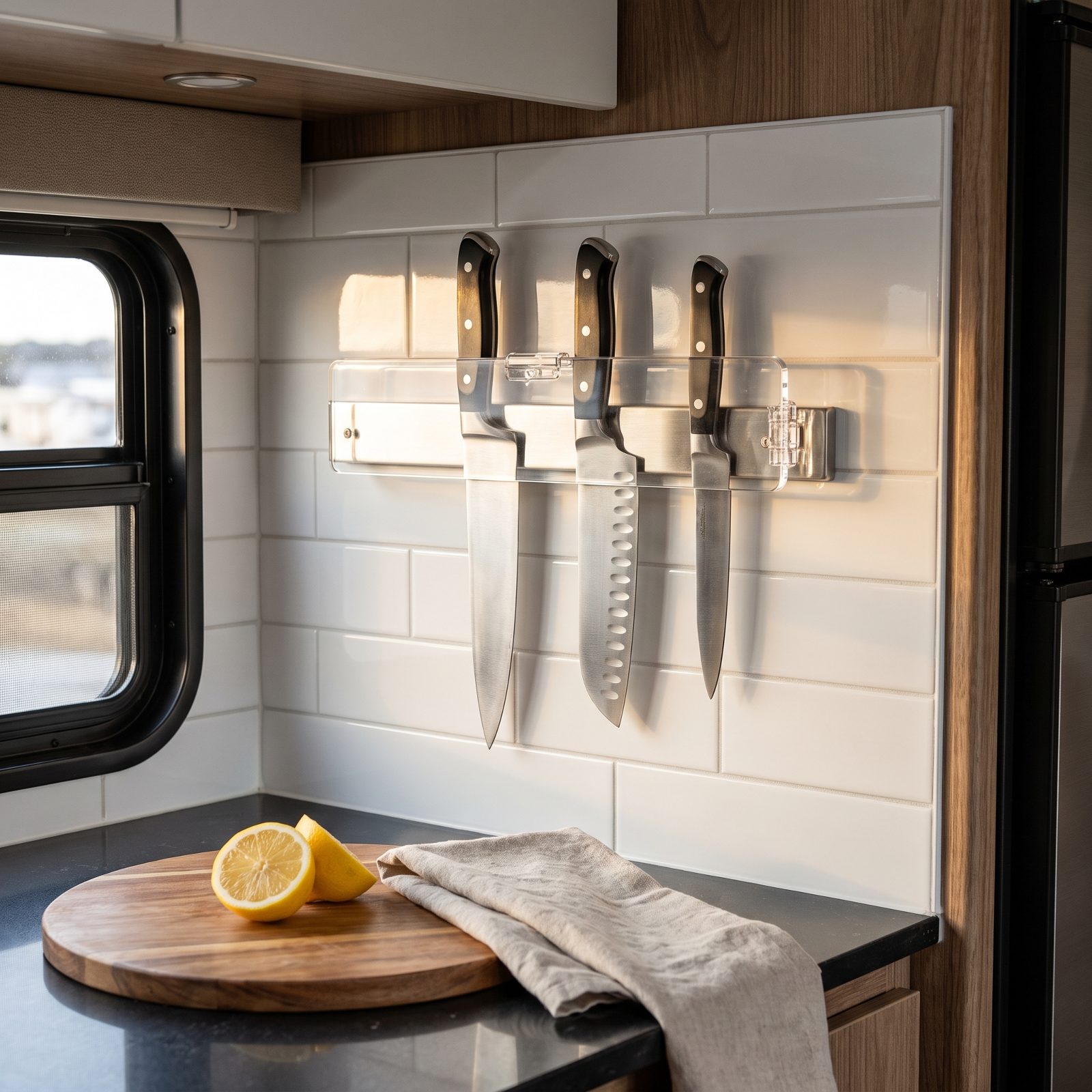
A regular magnetic knife strip is a fine idea right up until the first mountain pass, when the magnet loses its argument with gravity and your chef’s knife ends up on the floor.
Strips built for RVs and boats add a locking bar that clamps over the handles. The magnet holds them for daily use; the bar holds them when the whole rig is bouncing down a washboard road. Nobody opens a cabinet to a loose knife, which is exactly how people get stitches on vacation.
17. A Retractable Clothesline Mounted Inside the Shower

Wet swimsuits and dishrags have to go somewhere. In a small coach that somewhere is usually a damp pile on the floor that smells like a lake by morning.
A spring-loaded clothesline screwed into the shower wall solves it. Pull the cord across, clip it to the opposite hook, hang the wet stuff where water already belongs. Push a button and it retracts out of the way when you actually need to shower.
Why the shower? Drips land in the drain instead of on your floor. Mount both anchors into something solid, not just the fiberglass skin, or it’ll pull loose the first time you overload it with beach towels.
16. A Separating Composting Toilet for Remote Camping
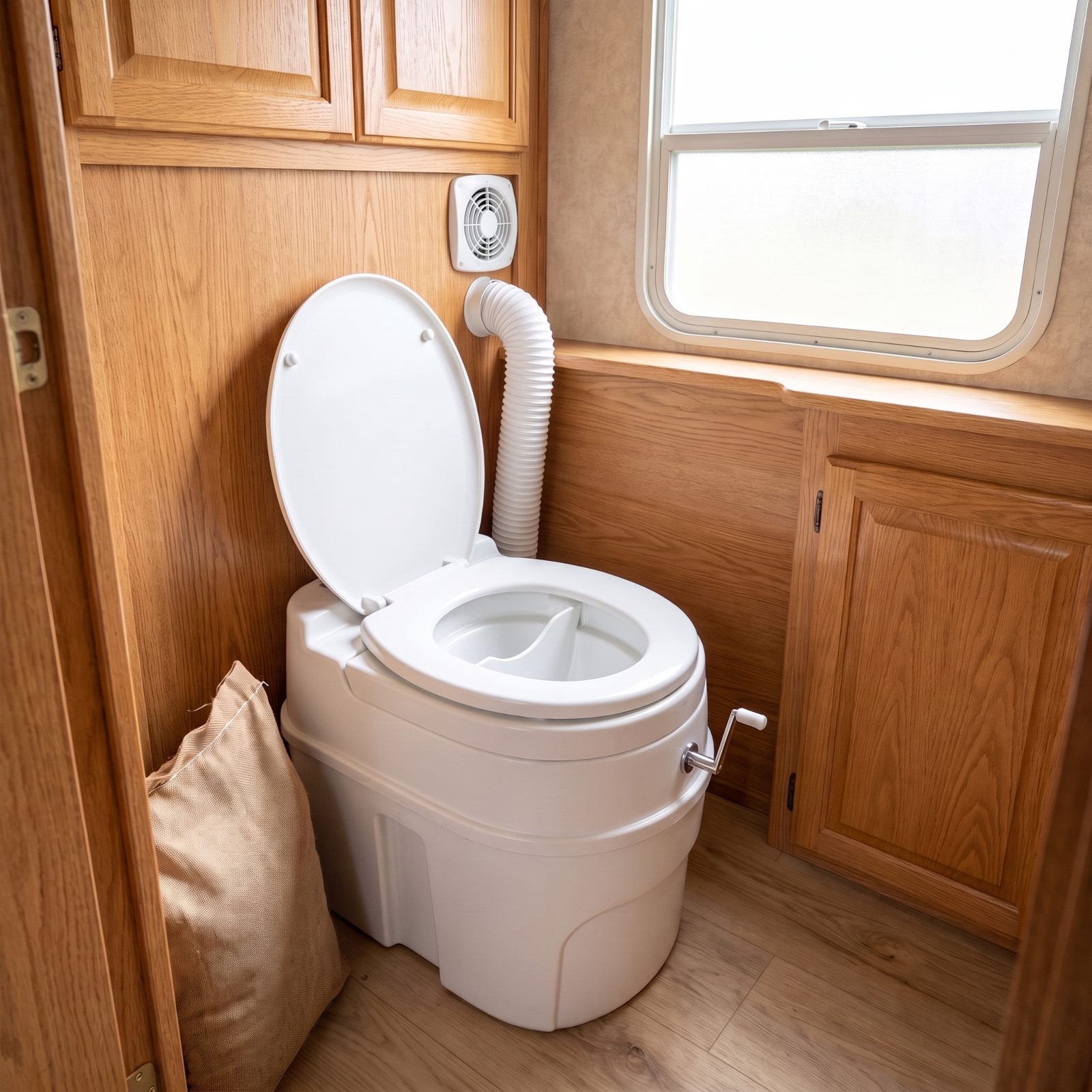
People hear “composting toilet” and picture something grim. The reality is less dramatic and genuinely useful for anyone who camps where there’s no dump station for fifty miles.
The whole thing works by keeping waste dry and aerated. Dry it out and you kill the smell, because the odor everyone dreads comes from soggy, airless waste. Everything drops into a chamber with coconut coir, a side hand crank mixes it, a small fan vents the box through a flexible hose, and you’re not hauling a black tank full of sloshing waste down a dirt road.
It’s not maintenance-free. You add coir and turn the crank every couple of days and empty the chamber every few weeks. But off-grid and dry camping, it buys real freedom.
15. A Portable Sewer Macerator Pump for Distant Dump Connections
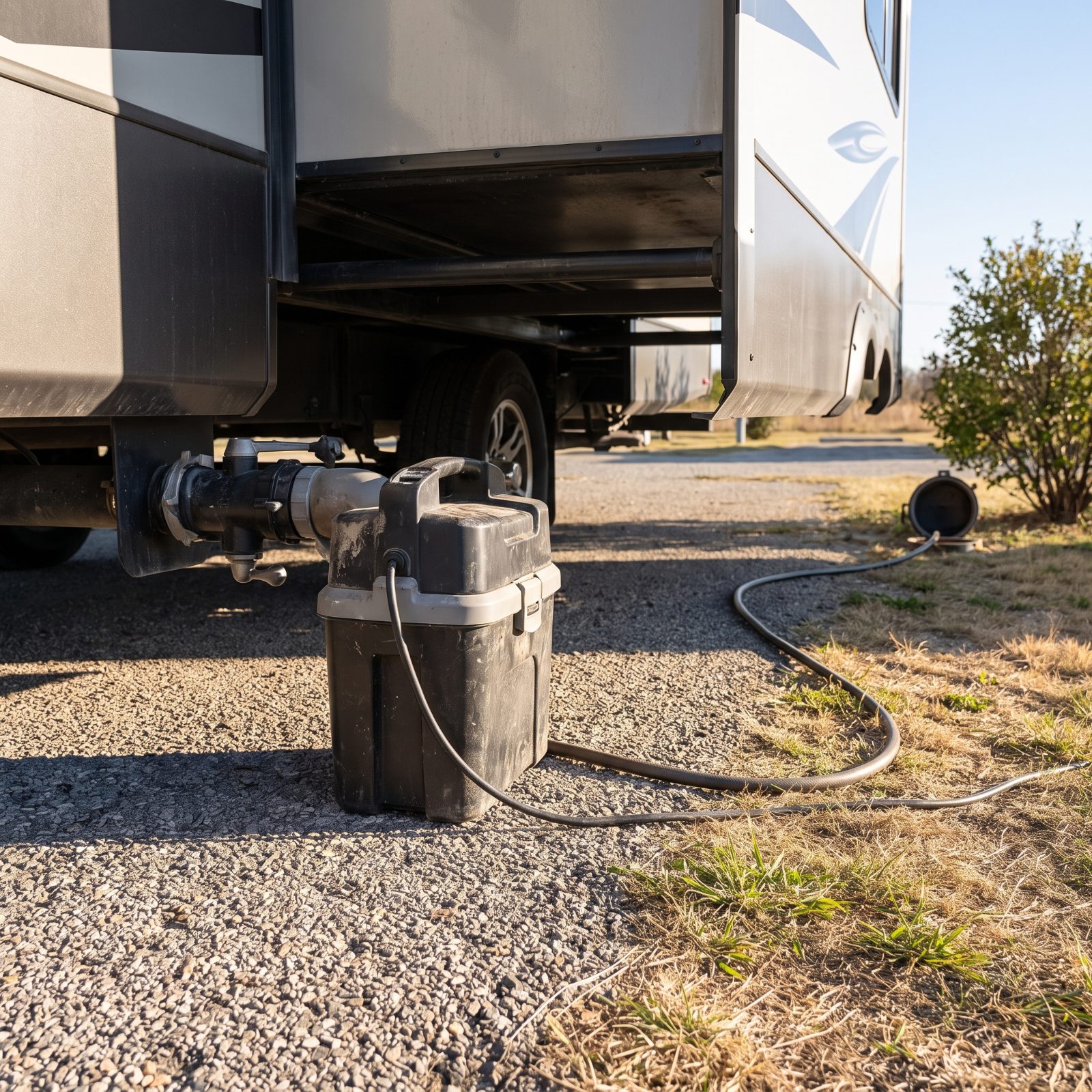
Some sites put the sewer connection in a spot that makes no sense — uphill, around a tree, way across the pad from where your rig actually fits.
A macerator pump grinds waste into slurry and pushes it through a line no thicker than a garden hose, which means it can run uphill and across distances a standard 3-inch sewer hose simply can’t. The thin line coils small and stores easy, too.
14. A Fence-Post Sewer-Hose Carrier Mounted Under the Chassis
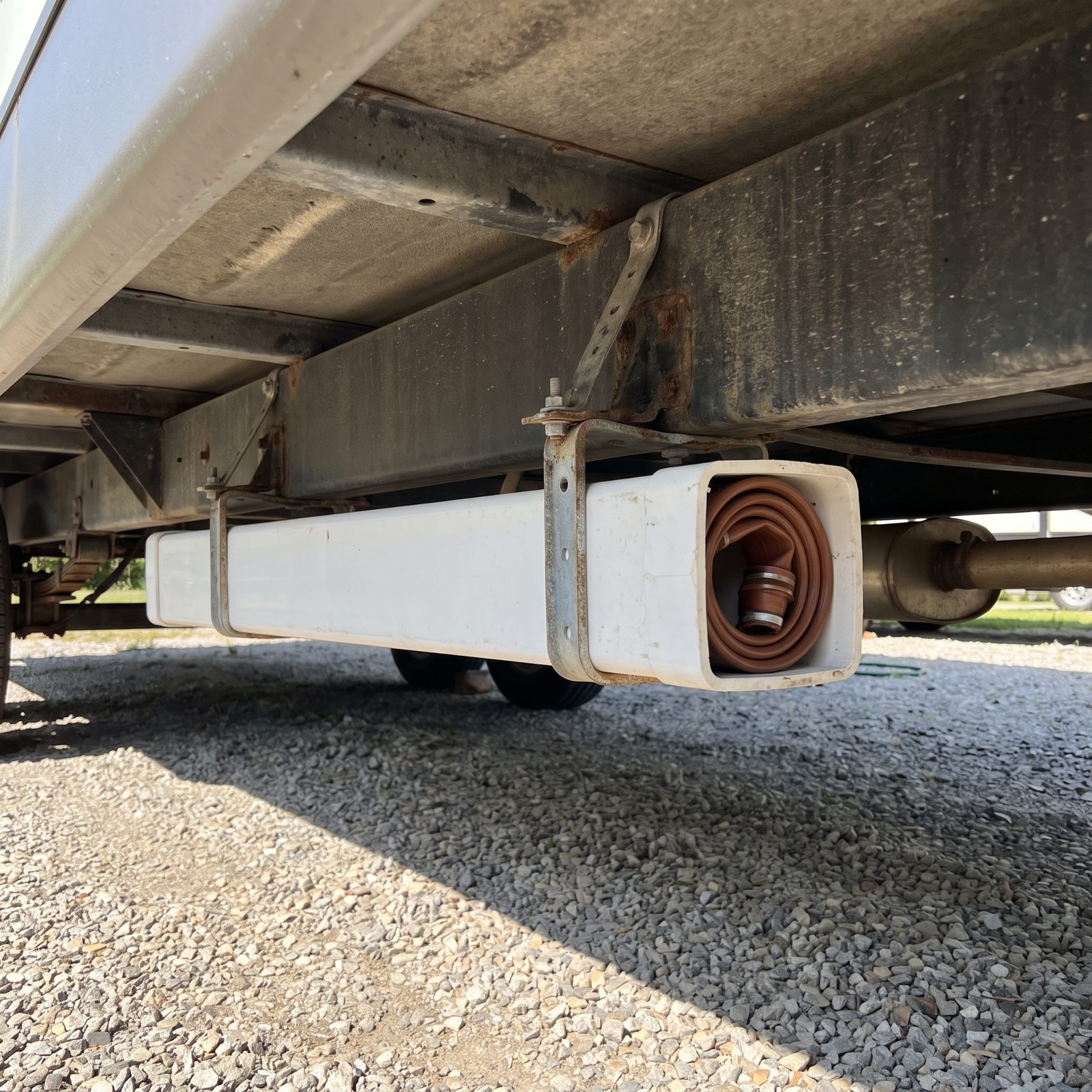
The sewer hose is the one piece of gear nobody wants sharing space with anything else. Store it in a bumper that’s too short or a basement bay next to the camp chairs, and your clean gear stops being clean.
A length of square PVC fence post — the heavy vinyl kind from a home store — bolted under the chassis with brackets becomes a dedicated hose tube that costs almost nothing. Leave the end open, slide the hose in, done. It lives outside, away from everything you touch with bare hands.
Buy the thick-walled post, not the flimsy railing stock. Road debris and curb strikes find the cheap stuff fast.
13. Electric Waste Valves Operated From Inside the RV
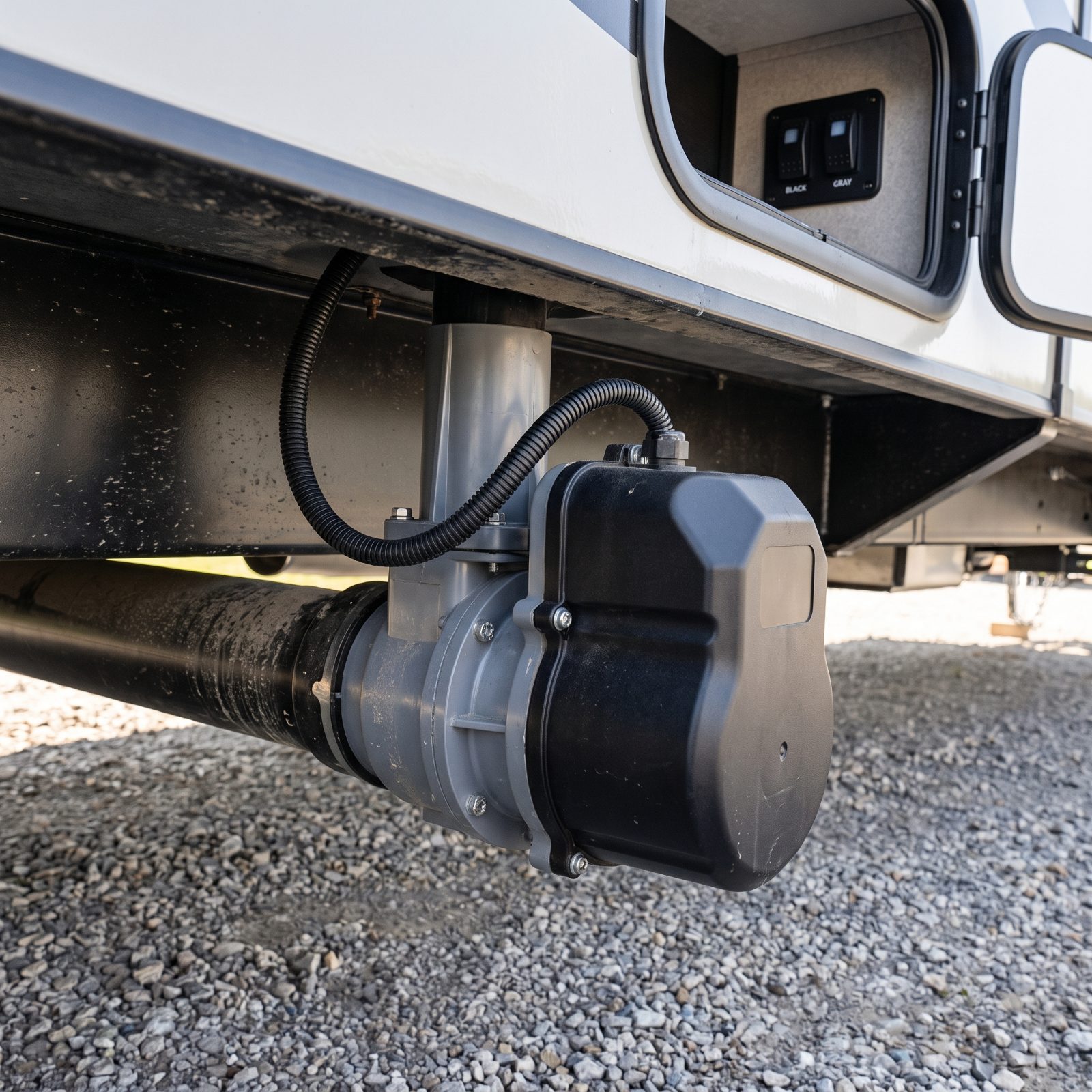
Pulling waste valves by hand means crouching at the back of the rig, grabbing a handle that lives in the least pleasant neighborhood of your whole setup. Twice. In the dark. In the rain, usually.
Electric actuators replace those manual pull handles with motors wired to a switch panel inside, so you run the dump sequence from a dry spot with clean hands, watching the tank monitors instead of guessing. For anyone with a bad back or knees that have earned their complaints, it’s the difference between dreading the dump station and barely thinking about it.
12. A Leak Sensor That Automatically Shuts Off Incoming Water
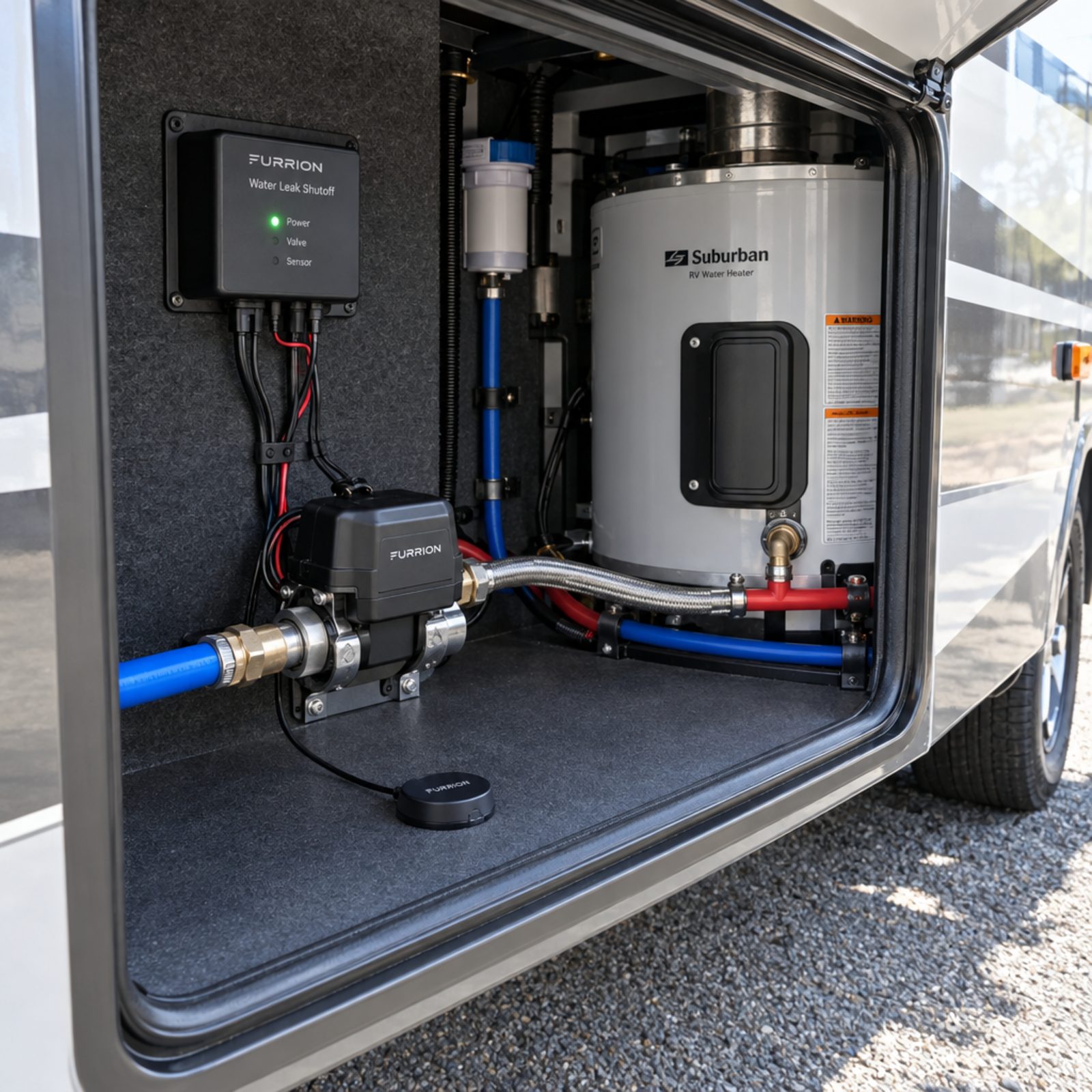
Hooked up to city water, your RV plumbing stays under constant pressure whether you’re inside or miles away at a trailhead. A fitting lets go, a line cracks, and the hose just keeps feeding water into your floor all day.
A leak sensor paired with an automatic shutoff valve kills the supply the instant a puck on the floor goes wet. No soaked subfloor, no returning to a swamp where your kitchen used to be.
Water damage is the slow leak that totals an RV long before the engine ever does.
Put the sensor at the low point where water would pool first, usually under the kitchen or the water heater. That’s where a leak announces itself.
11. A Permanent Winterizing Valve Beside the Water Pump
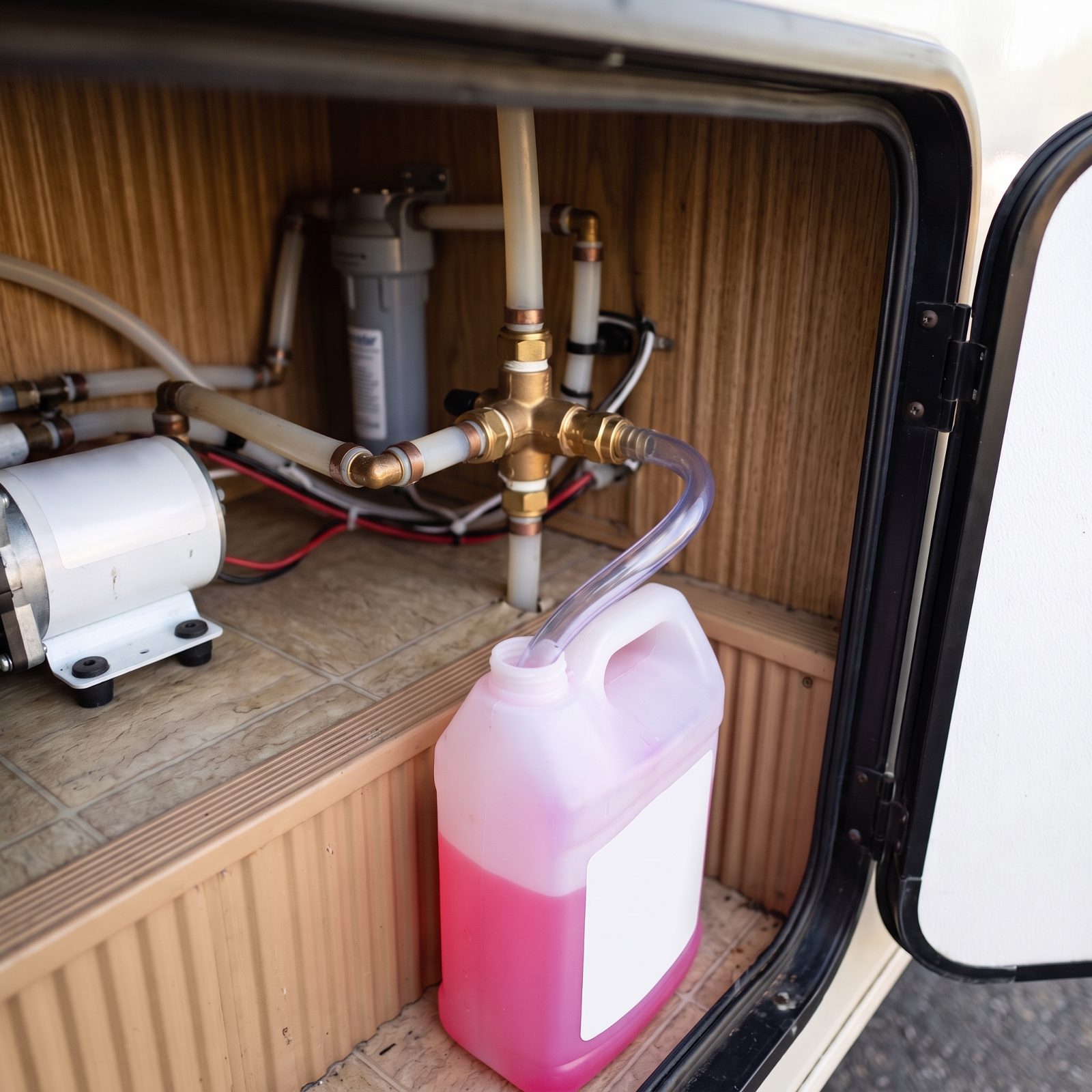
Most people winterize by crawling under the rig with a wrench and a flashlight, hoping they remembered which line to open first. A permanent brass cross fitting plumbed in next to the pump, with a clear suction hose on one port, ends that ritual. You drop that hose into a jug of pink antifreeze, and the pump pulls it straight through the system.
The install runs maybe forty dollars in brass fittings and an afternoon if your plumbing is reachable, and the payoff shows up every October when the job that used to eat a Saturday takes fifteen minutes. People skip it because it feels like overkill — right up until the first freeze cracks a line. Then it feels like genius.
10. A Booster Fan Added to the Weakest Heat Duct
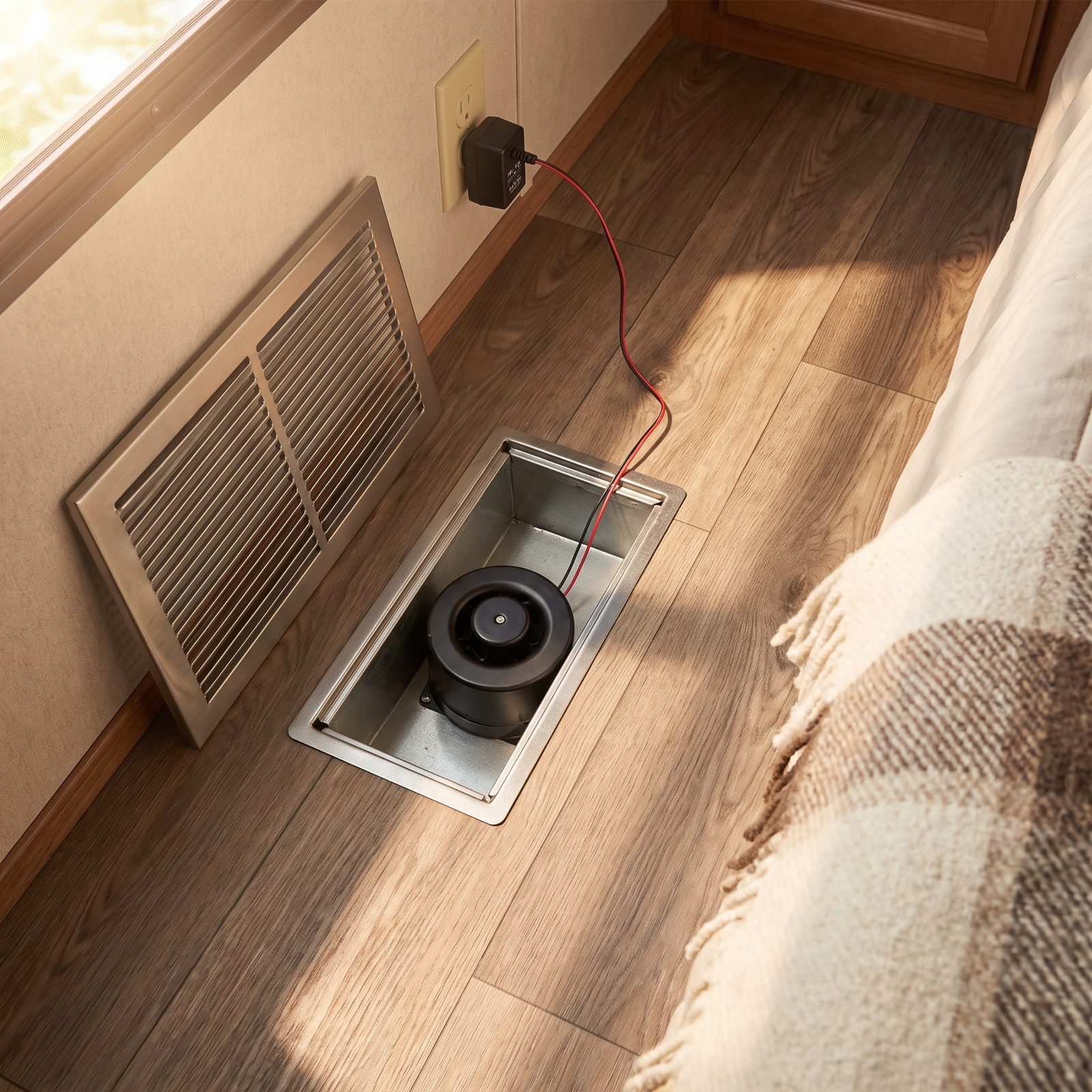
Every furnace in a motorhome has one room it barely reaches. Usually the bedroom at the far end of a long run, where the air limps out of the register lukewarm while the living area roasts.
Drop a small 12-volt duct booster fan into that one weak register and it pulls the warm air the rest of the way instead of letting it stall in the ductwork. They cost around twenty-five dollars and wire into a nearby outlet or switched circuit. On a cold morning the difference is the gap between reaching for socks and reaching for a second blanket you never needed. Fix the worst duct only. Fanning a register that already works just shoves the cold somewhere else.
9. A Compact Diesel Air Heater With a Sealed Exterior Exhaust
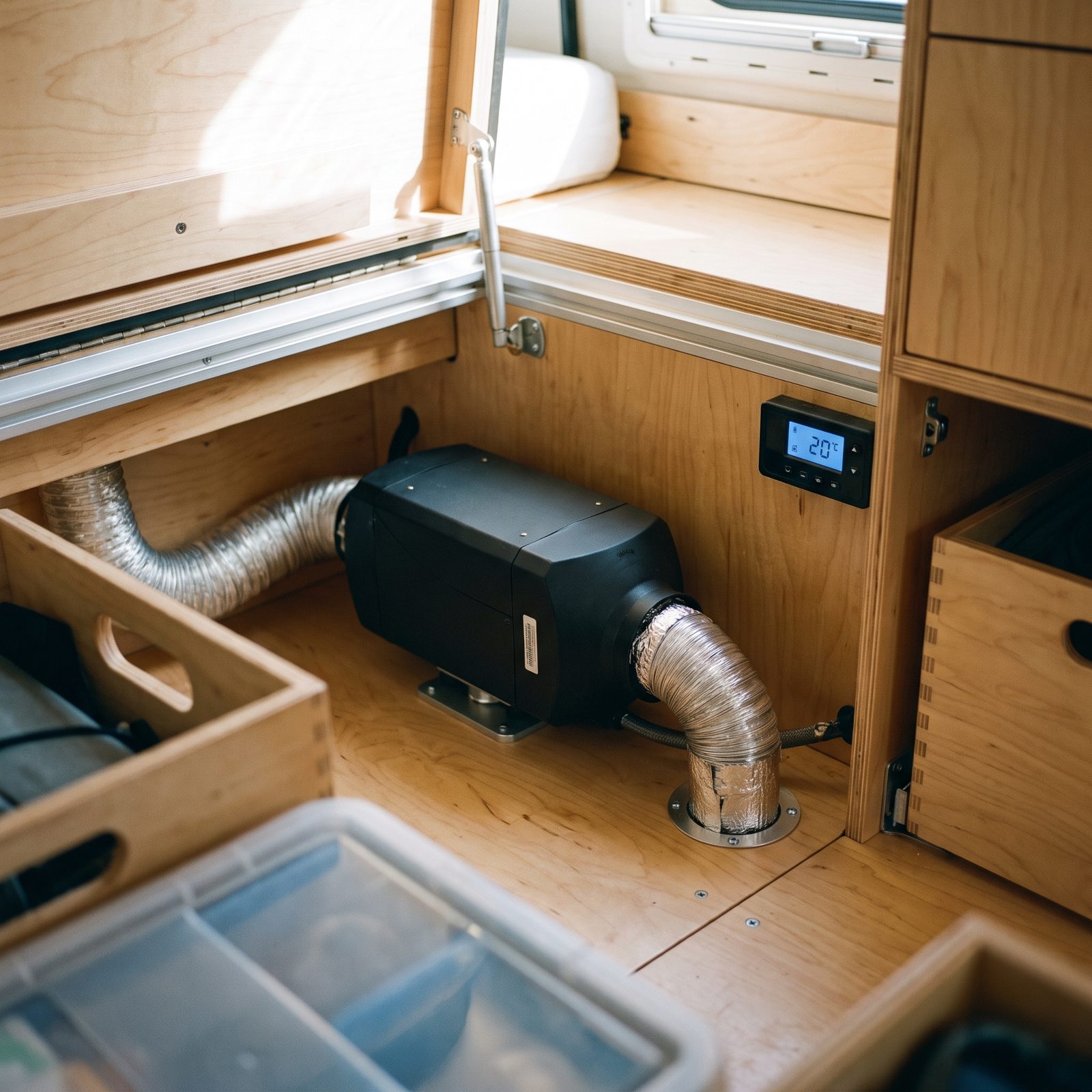
This is the upgrade van-lifers figured out years before the rest of us. A diesel air heater sips a fraction of the fuel a propane furnace burns, and because the combustion happens in a sealed chamber vented straight outside, none of the exhaust ever touches the air you breathe.
The units run a few hundred dollars. They pull warm, dry heat from a box about the size of a shoebox, running on either their own small tank or a tap off a diesel rig’s main tank. What intimidates people is the part where you drill a hole through the floor for the exhaust. Get that sealed exhaust right and you’ve got the whole thing working the way it should — it’s what stands between cozy and carbon monoxide.
8. A Mini-Split Heat Pump Replacing a Rooftop Air Conditioner

Rooftop air conditioners are loud, heavy, and they only do one thing. A mini-split heat pump cools, heats, and dehumidifies, all three at a whisper compared to the jackhammer bolted to your roof.
The catch is honest: it’s a real project. You’re mounting an indoor head unit on a wall, a compressor outside, and running a line set between them, and plenty of people just pay a shop to do it. But the heat pump function alone changes how you camp, pulling warmth from outside air down into the low thirties before it needs help. It also drops your roof weight and your profile — a mercy to anyone who has ever clipped a low branch.
7. Removable Acrylic Storm Panels for Single-Pane Windows

Single-pane RV windows are a heat colander. They sweat on cold mornings, leak warmth all night, and the wet frames below them eventually breed the kind of mold you smell before you see.
Cut-to-fit acrylic panels, held in with turn-button clips, create a trapped air gap that works just like a storm window on a house. The dead air does the insulating. Condensation drops off sharply because the interior pane stays warmer than the glass, and the panels pop out in seconds when summer comes — which beats the shrink-film plastic people tape up and then curse at every time it rips. Cheap, reversible, and the single biggest comfort win per dollar in a cold rig.
6. A Snap-On Insulated Skirt Around the RV Undercarriage

The cold doesn’t just come through the windows. It pours up from under the rig, where wind rakes the exposed tanks and pipes all night long.
A snap-on insulated skirt closes off that gap between the body and the ground, trapping a buffer of still air underneath. Seasonal campers and ice fishermen have leaned on the trick for decades, and it keeps your tanks from freezing while cutting furnace runtime by a noticeable margin. Custom-fit skirts with snap fasteners run several hundred dollars; a roll of foam board and some tape costs far less and works nearly as well for a single winter. Weight the bottom edge with sandbags or the first gust will fold it like a bedsheet.
5. An Awning Wind Sensor That Retracts the Fabric Automatically

You leave for a hike with the awning out. A storm rolls through while you’re gone. You come back to a twisted mess of aluminum and torn fabric, plus a repair bill that could’ve bought a very nice awning.
A wind sensor mounts on the awning arm, reads the gusts, and retracts the fabric on its own before the wind can wreck it. Few accessories pay for themselves in one avoided disaster the way this one does. The honest downside: it only works on powered awnings, and some rigs need an add-on controller to talk to it. Worth every penny for anyone who actually leaves the campsite.
4. Amber Awning Lights That Attract Fewer Flying Insects

Bugs see blue and ultraviolet light far better than they see yellow and orange. Swap your bright white awning strip for amber-toned LEDs and the cloud of moths and gnats that usually circles your dinner thins out fast.
It’s no force field. A warm porch light is still a light. But amber shifts the odds hard in your favor, and the glow reads cozier than the operating-room white most factory strips throw. A roll of warm amber LED strip costs little and runs on 12 volts straight off your existing wiring. The physics was true long before RVs existed — it just took a while for anyone to put it on an awning.
3. A Sliding Cargo Tray for Deep Pass-Through Compartments
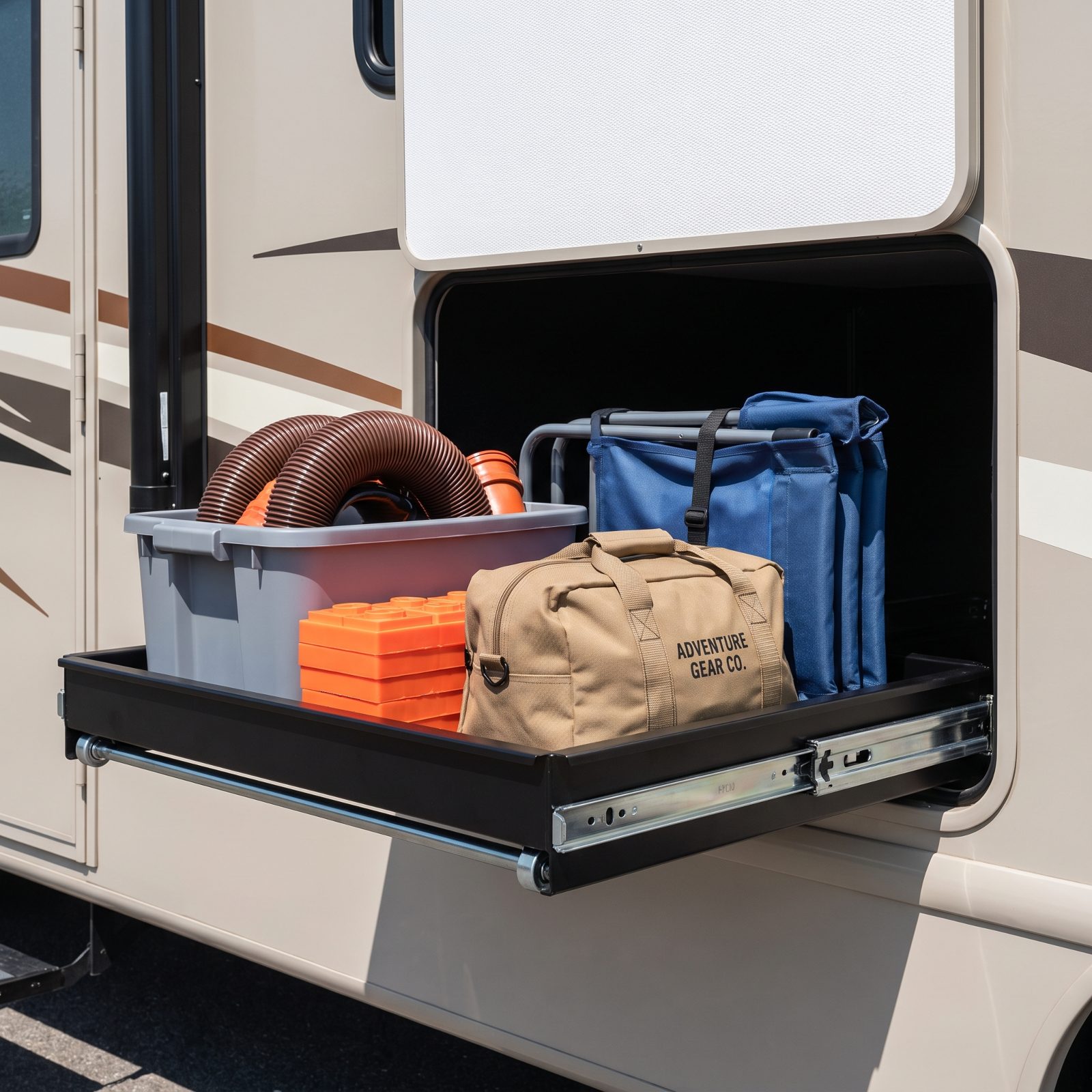
Pass-through compartments are generous and cruel. They swallow enormous amounts of gear and then hide half of it in a dark cavern you can only reach by lying on the gravel and stretching.
A sliding cargo tray on heavy rails pulls the entire load out to you at waist height, so the thing you buried in the back becomes the thing you grab first. Rated trays handle several hundred pounds, which matters because people underestimate how heavy a loaded tray gets. Measure the depth and the weight rating before you buy. A tray that bottoms out on a full load is worse than no tray — now your gear is stuck halfway out in the rain.
2. A Dual-Tire Pressure Equalizer With a Visible Gauge
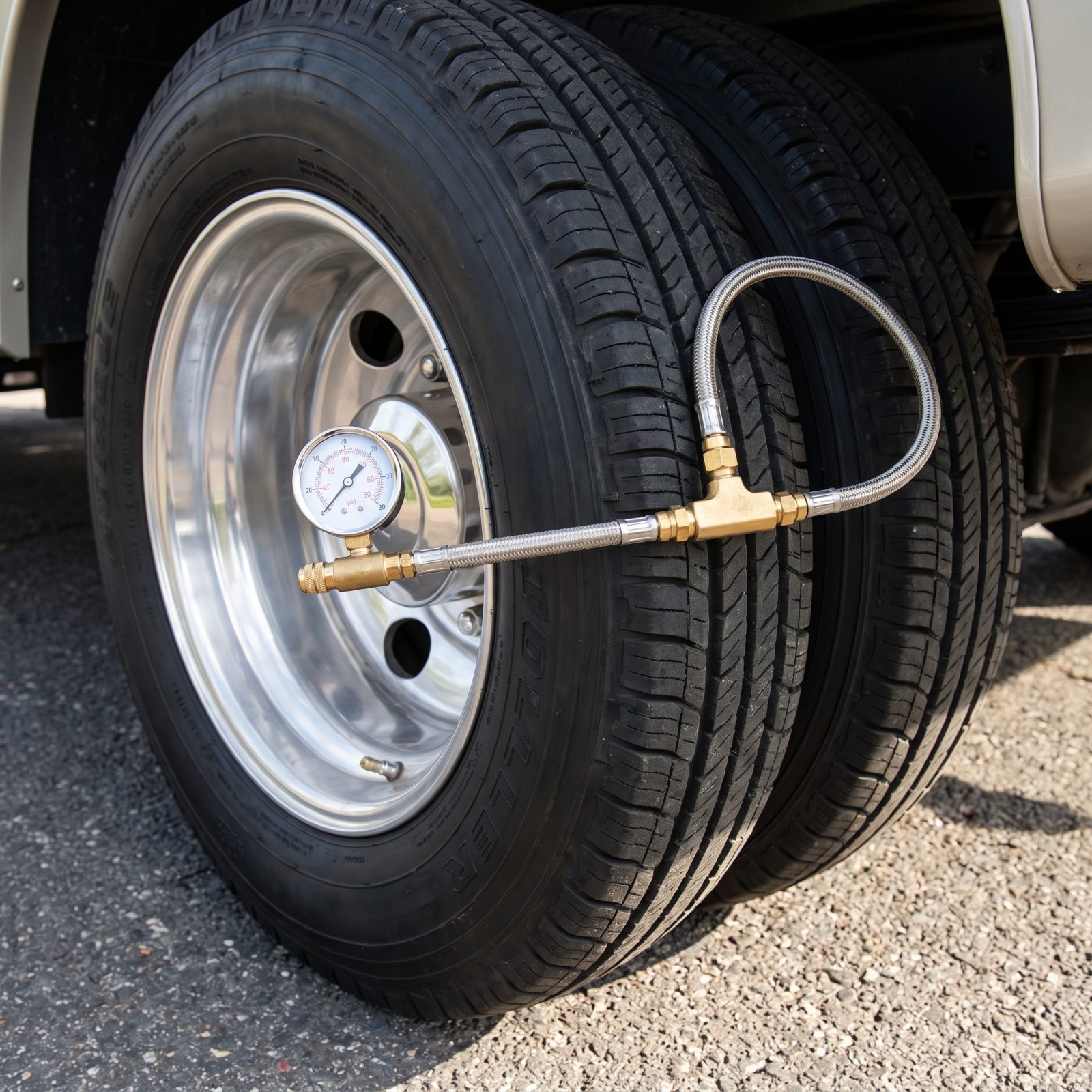
On dual rear wheels, the inner tire is the one you can never reach and never check. So nobody checks it. It quietly loses pressure, the outer tire carries the extra load, and the first sign of trouble is a blowout at highway speed.
An equalizer is meant to link both tires through a crossover hose so they share air and settle to the same pressure. The face gauge lets you read their shared pressure at a glance without crawling or guessing. Inner-dual failures rank among the most common serious road problems out there, and they’re almost entirely preventable. Not glamorous gear, this. It’s the kind of thing you forget about completely until the day it saves you from shredding a tire in the fast lane.
1. Microcellular Suspension Springs That Stop the Harsh Bottoming Jolt
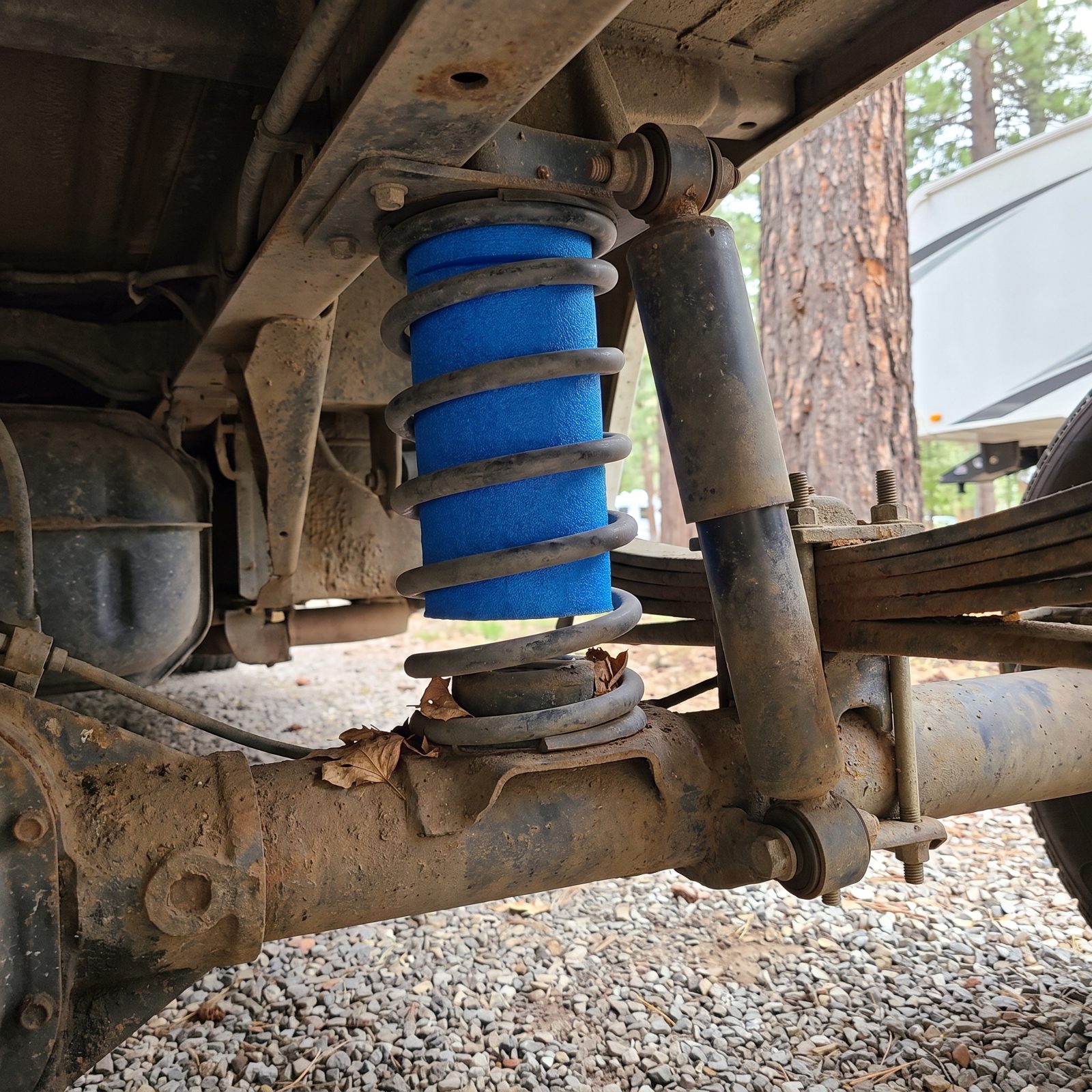
Most people never know these exist until a cattle guard launches the coffee mug clear across the galley. Microcellular springs are dense polyurethane inserts — sometimes called jounce bumpers or hollow spring assists — that tuck inside or alongside your existing coil or leaf setup. In normal driving they do nothing at all. They only wake up at the bottom of a big compression, right when the suspension would otherwise slam metal on metal.
That slam is the jolt you feel through the steering wheel on a dip. It’s also the bang your cabinets hear when you hit a frost heave loaded to the gills. The foam catches that last inch of travel and feeds it back slower, so a sharp hit turns into a firm push instead of a crack.
Budget roughly $100 to $300 a pair depending on your rig, plus a few hours if you’re doing it yourself. Here’s what nobody mentions, though: they also cut the nose-dive wallow when you’re braking hard downhill, and that does more for frayed passenger nerves than any gadget glowing on the dash.