
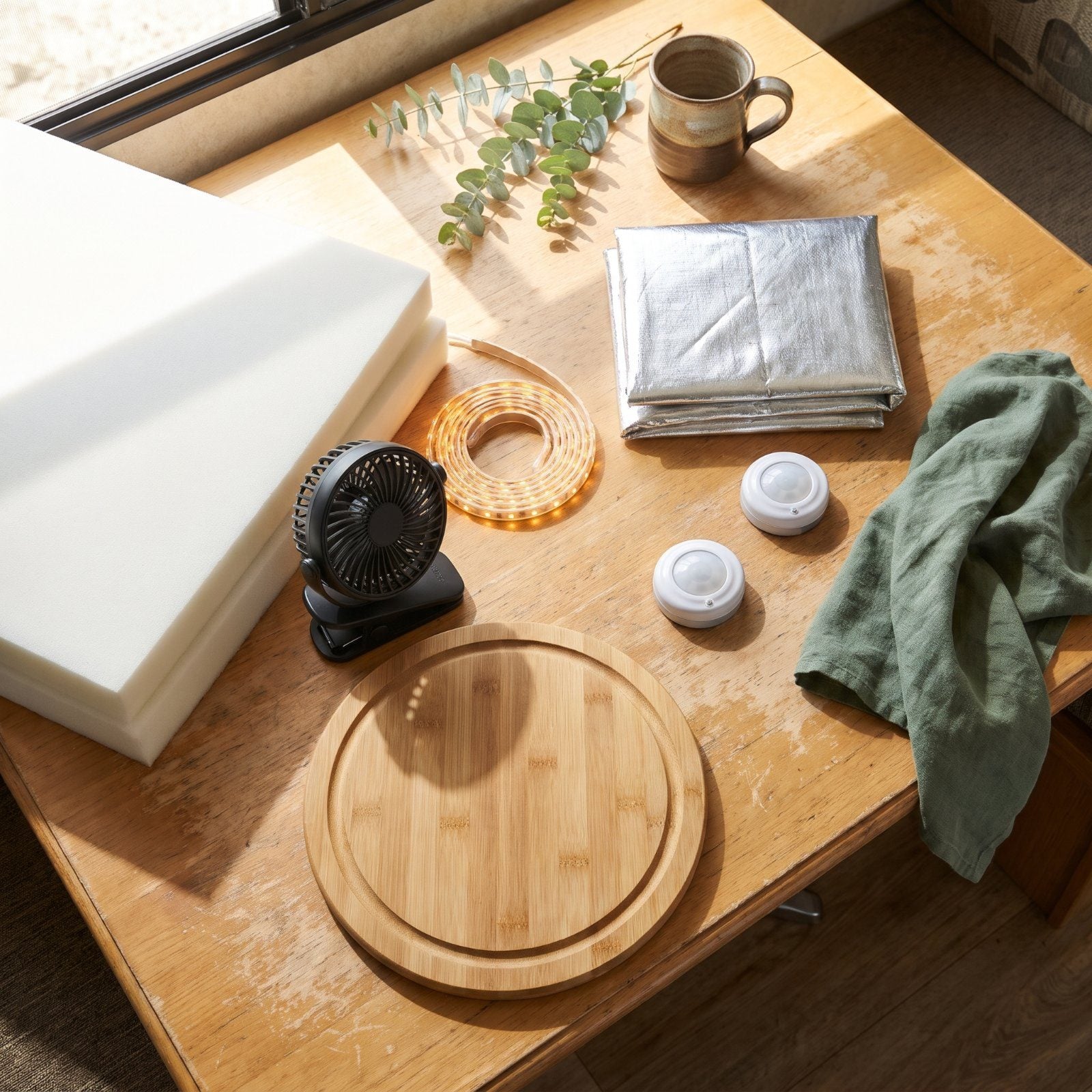
The best thing we ever did to our rig cost less than a night at a nice campground. Not the solar. Not the lithium swap. A little piece of foam that turned a bed we dreaded into one we actually slept in. That’s the funny thing about RVs — the salesman wants you drooling over the big-ticket stuff, but the things that make a trip better are almost always small, dumb, and nearly free. These are the add-ons that earn their keep every single night without wrecking the budget or needing a wiring diagram.
Please note that some of the images in this article were created with the assistance of AI.
34. A Foam Mattress Topper That Fixes the Factory Bed
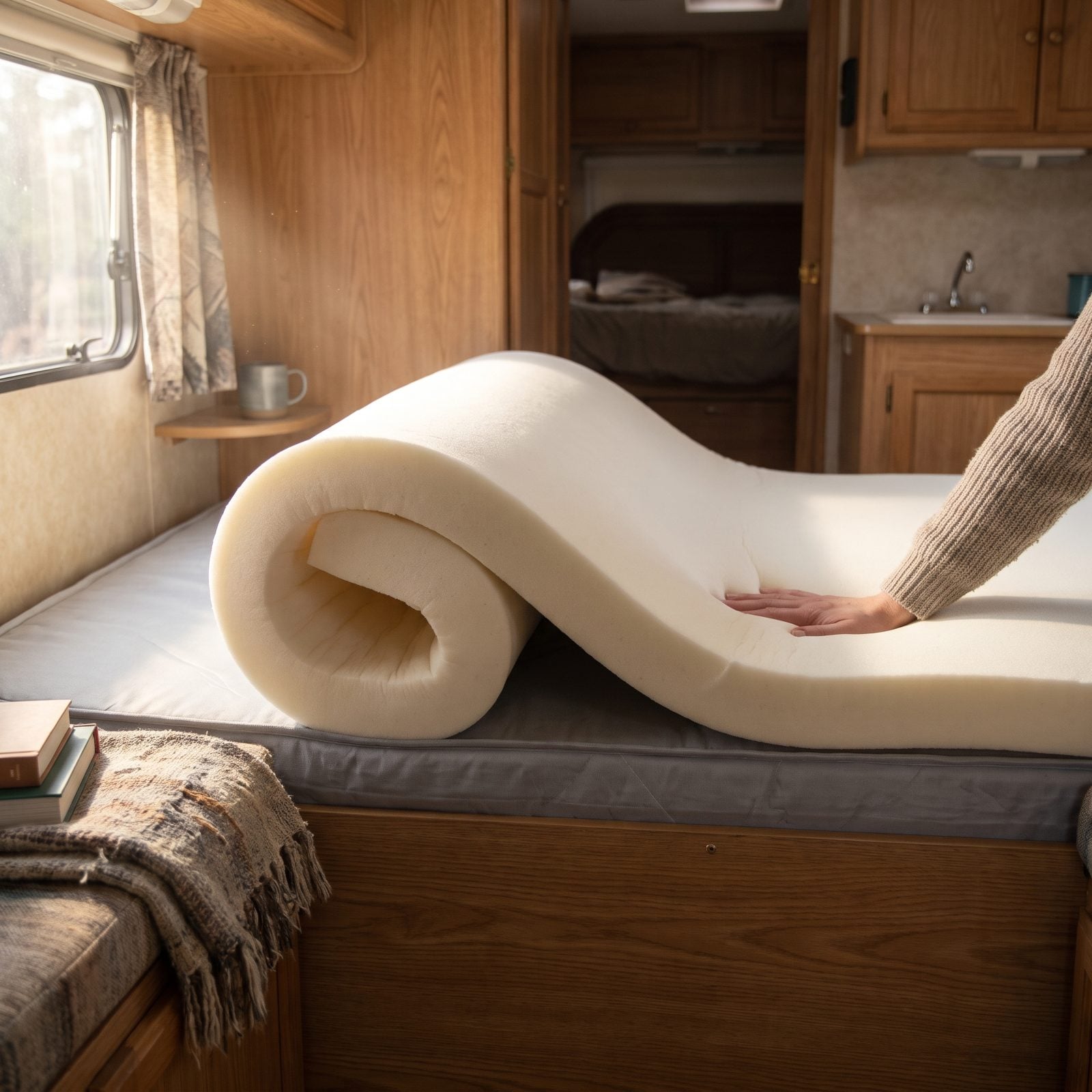
RV mattresses are a crime. Thin, dense, built to a price point that assumes you’ll only sleep on it a handful of nights a year. Plenty of us have found that the fix costs less than one night at a nice campground.
A three-inch foam topper — memory or plain — drops right over the factory slab, and suddenly your back stops filing complaints at 3am. Get the medium density. The cheap one-inch sheet compresses to nothing by morning.
33. A Cutting Board Made to Cover the Sink
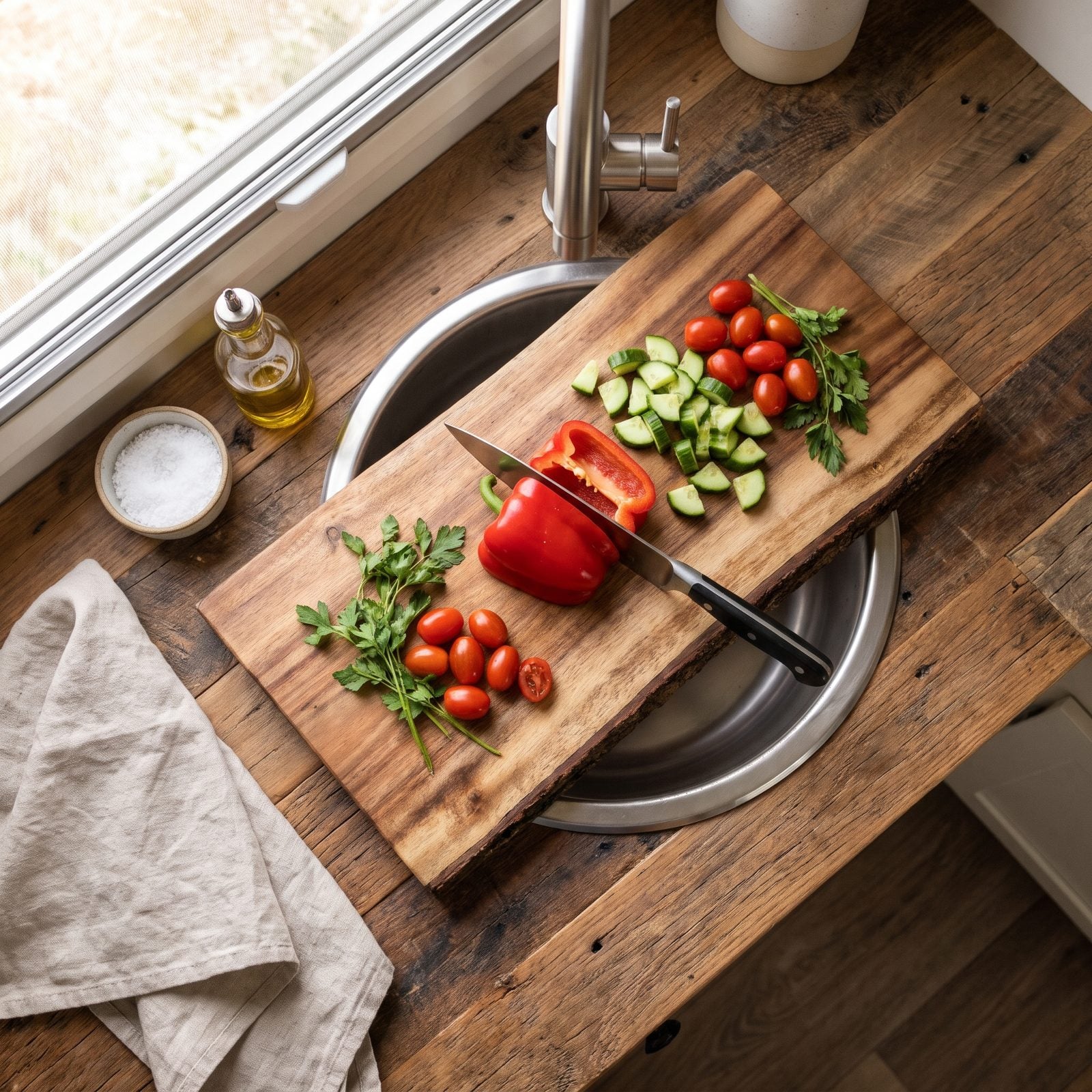
Counter space in an RV is a cruel joke. You get roughly the footprint of a cafeteria tray and you’re expected to make dinner on it.
A cutting board cut to drop over your sink basin doubles your prep surface in two seconds. Chop on top, then lift it off when you need the sink back. Measure your basin before you buy, because “universal” rarely is. Bamboo holds up to RV humidity better than cheap plastic, which warps into a taco shape by season’s end.
32. A Rechargeable Fan That Moves Air Without Shore Power
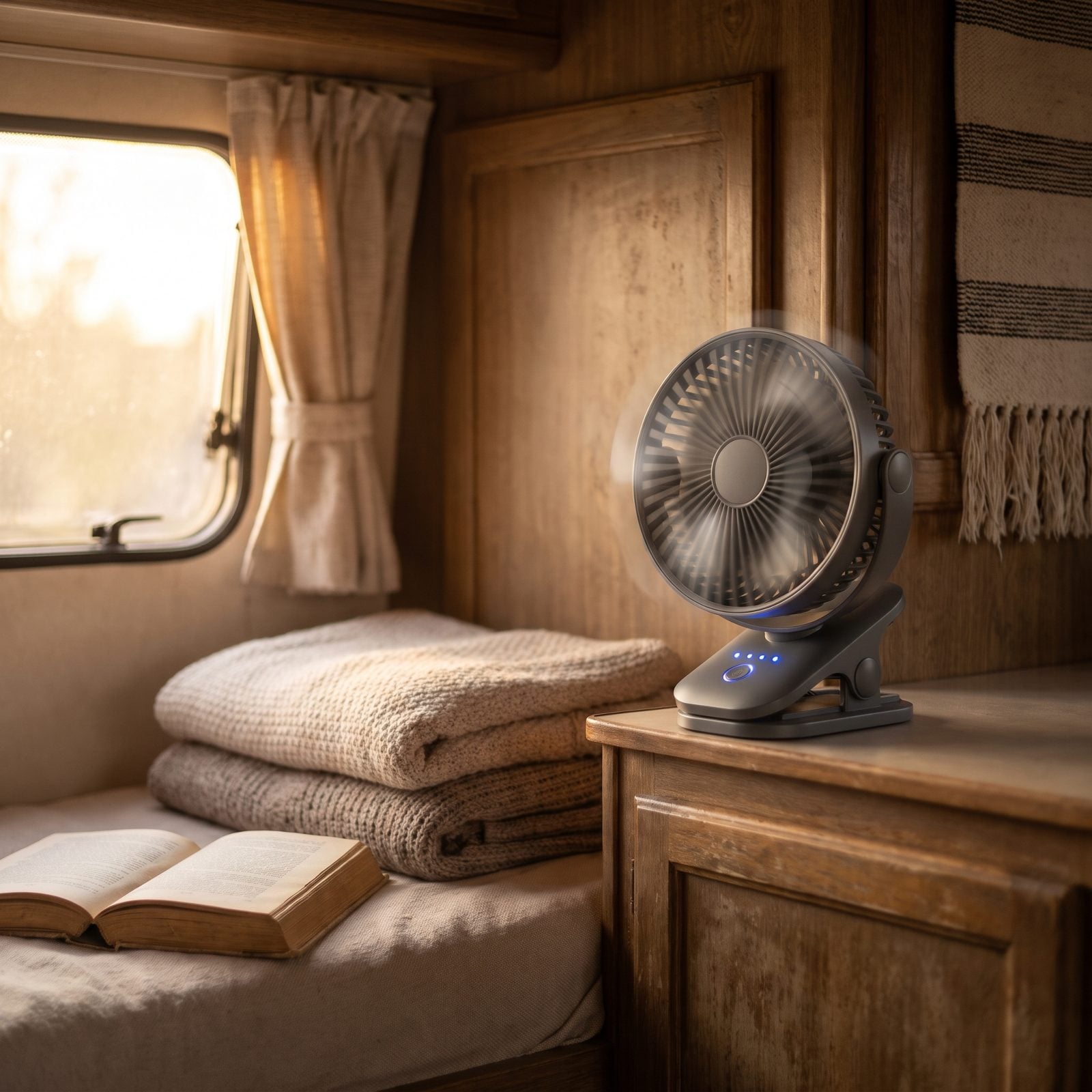
Dry camping turns your air conditioner into a paperweight. No shore power means no AC, and that’s when a stuffy rig goes from annoying to unbearable.
A rechargeable fan sips battery and runs all night off a single charge. Clip it to a cabinet handle, aim it at the bed, and you’ve solved the worst part of boondocking in July. The good ones run quiet on low and hold a charge for days. I keep two, because the first one convinced me I’d been suffering for no reason.
31. A Reversible Outdoor Mat That Keeps Dirt Outside
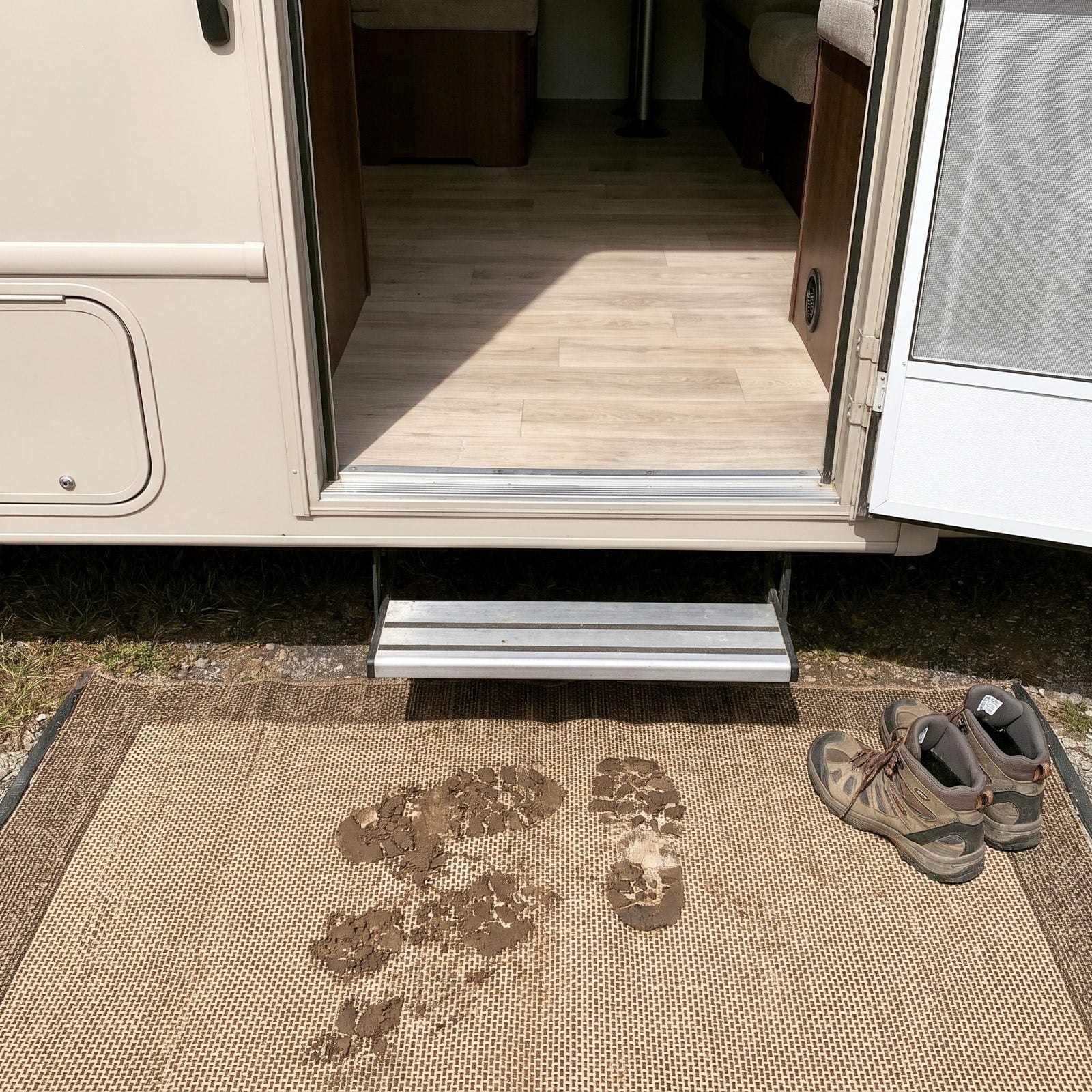
The dirt always wins. You sweep, you wipe, you install a boot tray, and somehow the inside of the rig still feels like a trail by Sunday.
A reversible woven mat under your awning gives shoes somewhere to leave their crud before anyone hits the steps. The weave lets dirt fall through instead of grinding into fabric, and you shake it out in one flick. Reversible means twice the life before it looks beat.
Get one bigger than you think. A mat the size of a bath towel does nothing.
30. A Reflective Windshield Cover for Hot Campsites
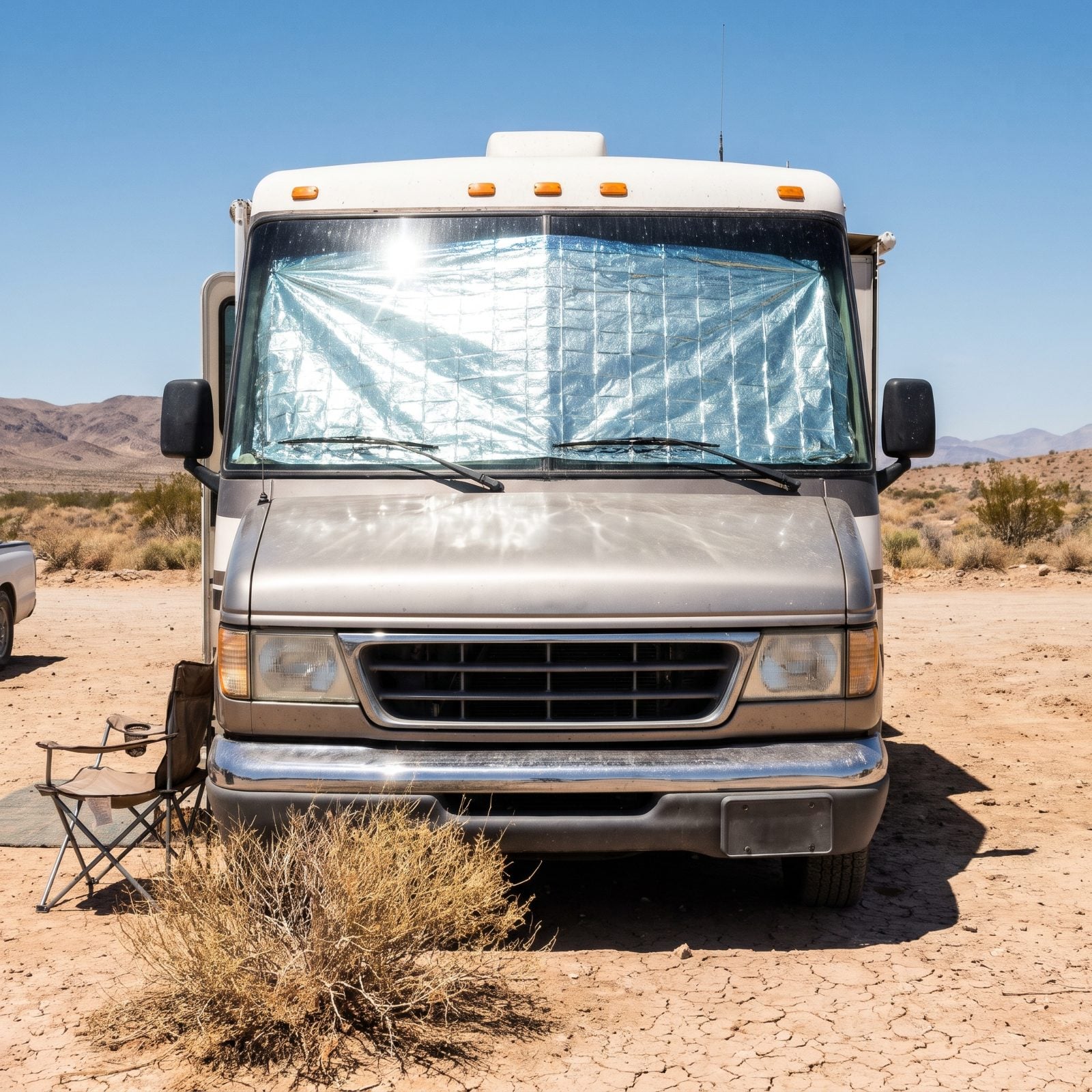
Park a motorhome in the sun and the cab becomes a greenhouse by noon. The dash heats up, the whole front end radiates warmth into the living space, and your AC spends the afternoon fighting a losing battle.
A reflective windshield cover bounces the sun back out before it ever gets in. Custom-fit ones with suction cups stay put and seal the edges. The generic accordion kind from the auto aisle works in a pinch, but it leaves gaps that let the heat sneak through.
29. An Insulated Cushion for the Roof Vent
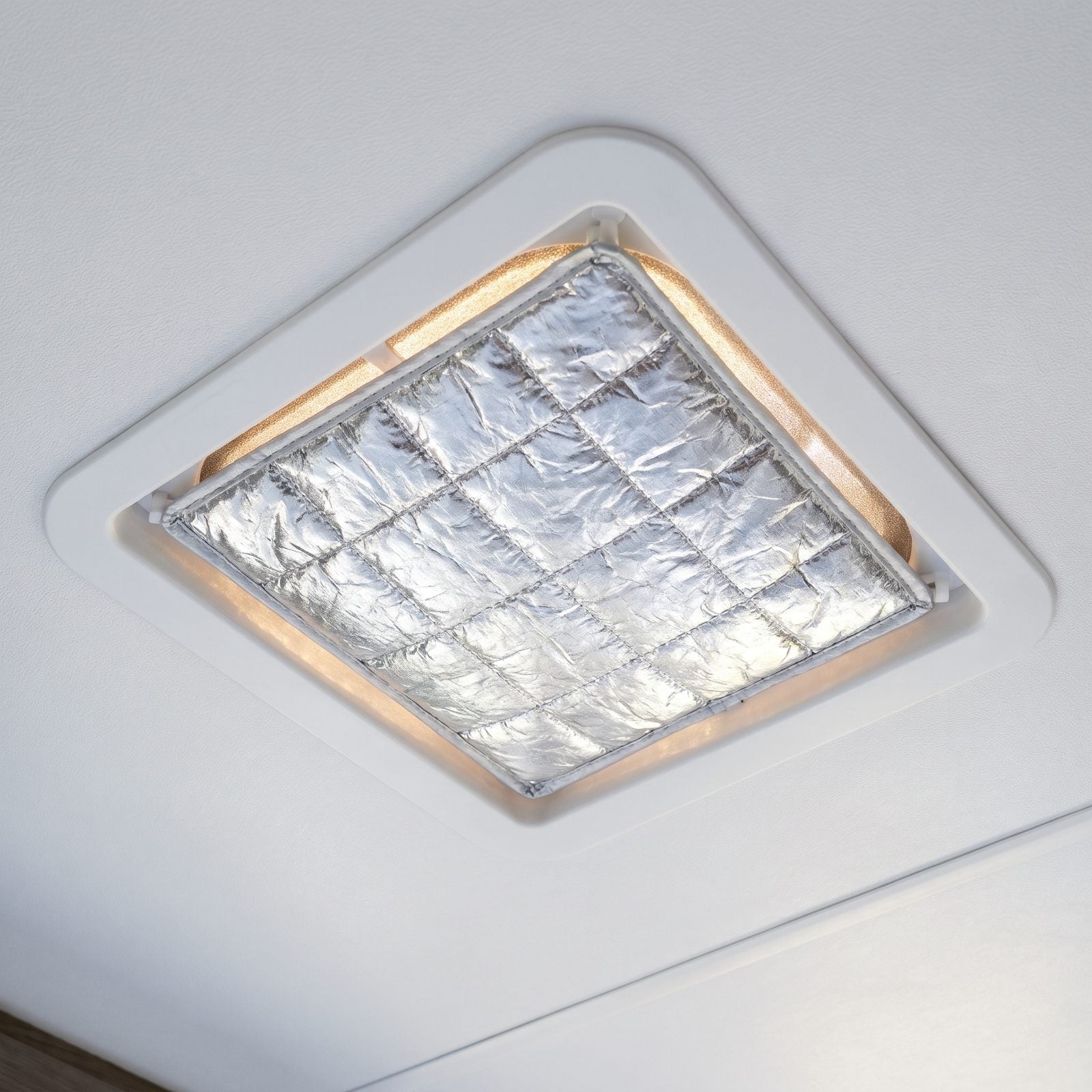
That roof vent is a hole in your ceiling, and holes leak temperature both ways. Hot air pours in on summer afternoons and your hard-won heat escapes through it on cold nights.
A foam vent cushion with a reflective face pops into the opening and plugs the gap. Pull it out when you want airflow, push it back when you want the climate to stay put. It costs about as much as two lattes and does more for your comfort than another AC degree ever will.
Explaining why vent cushions are among the first things he’d buy for a rig, a full-time RVer and blogger writes “When it is too hot or cold outside the vents are a major source of temperature exchange, by blocking them you can better regulate the inside temperature.”
28. Removable Blackout Panels for Bedroom Windows

RV window shades are a suggestion, not a solution. They filter light. They do not stop it. And a campground floodlight thirty feet away will find every gap.
Panels cut from blackout material, held in with suction cups or a snug friction fit, give you actual darkness — you sleep past dawn, you nap after a long drive, you stop waking up at 5am because the sun cleared the treeline.
Cut them slightly oversized so they wedge into the frame. A panel that’s exactly window-sized falls out the first time you roll over.
27. Soft Amber Nightlights Along the Floor
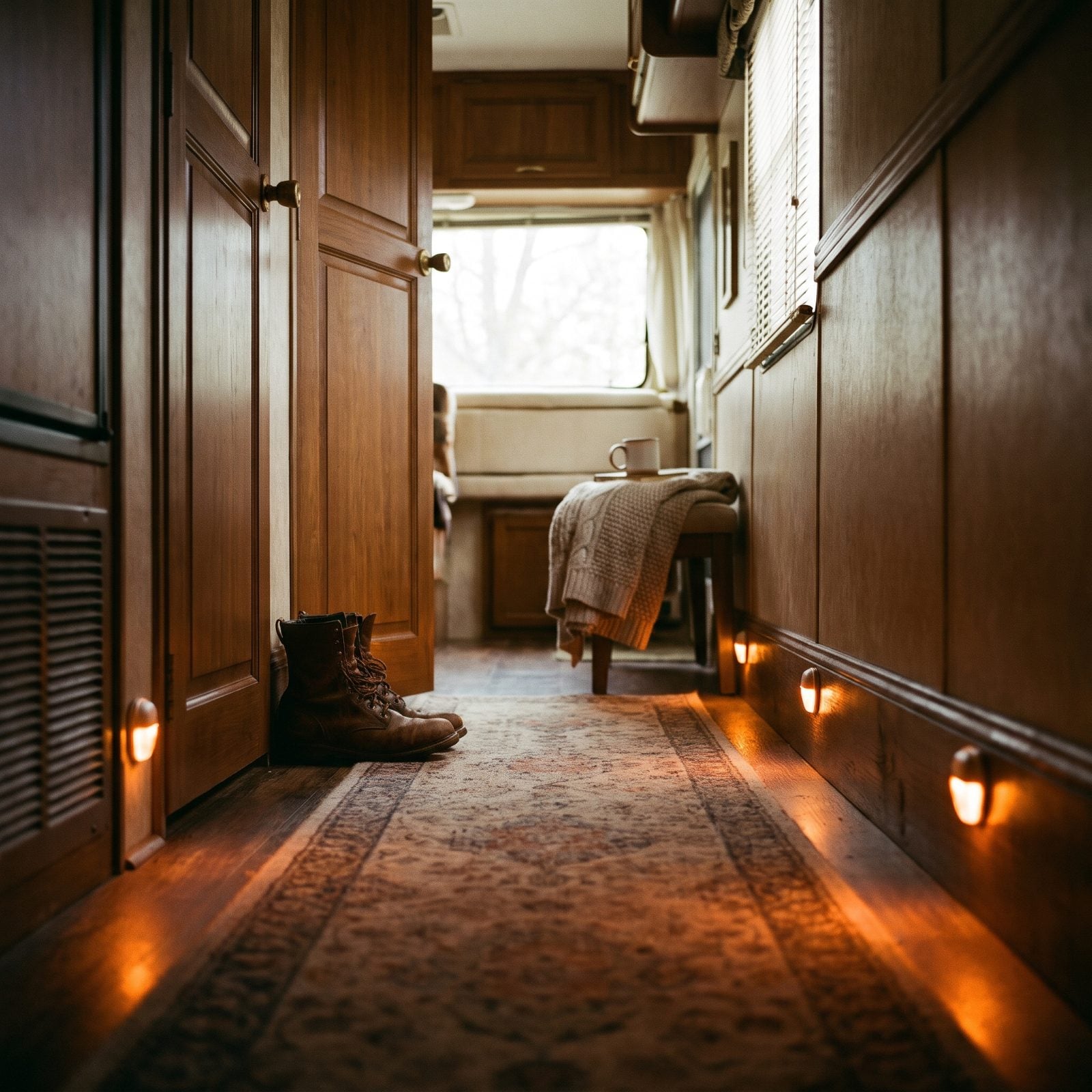
The 2am bathroom trip is where RVs get you. One wrong overhead switch and you’ve blasted your partner awake and torched your own night vision in the same second.
A soft amber nightlight strip along the floor gives you just enough to see the step down without killing the dark. Amber, not white, so your eyes stay adjusted and you can fall back asleep. Stick-on battery pucks work, but a hardwired low-draw strip is nicer if you can manage the splice.
26. Motion-Sensor Puck Lights Inside Dark Cabinets
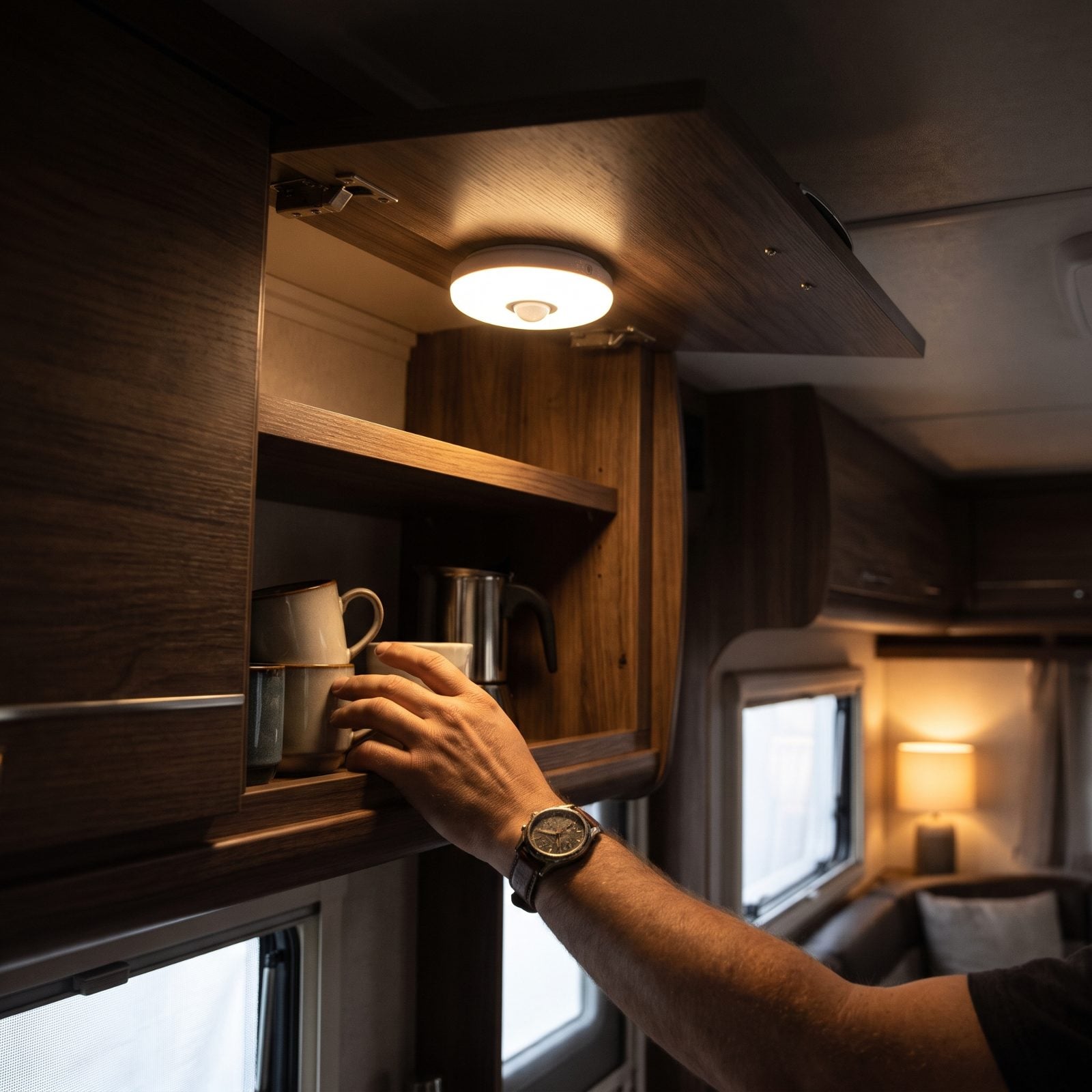
Every RV cabinet is a black hole. You open the door, you can’t see the back, and you end up pulling everything out to find the one thing you wanted.
A stick-on motion puck lights up the instant the door opens and shuts itself off when you’re done. No wiring, no switch to remember. Three batteries last a surprisingly long time, and seeing your pantry for once feels wildly out of proportion to what it costs.
25. A Bedside Caddy That Replaces Missing Nightstands
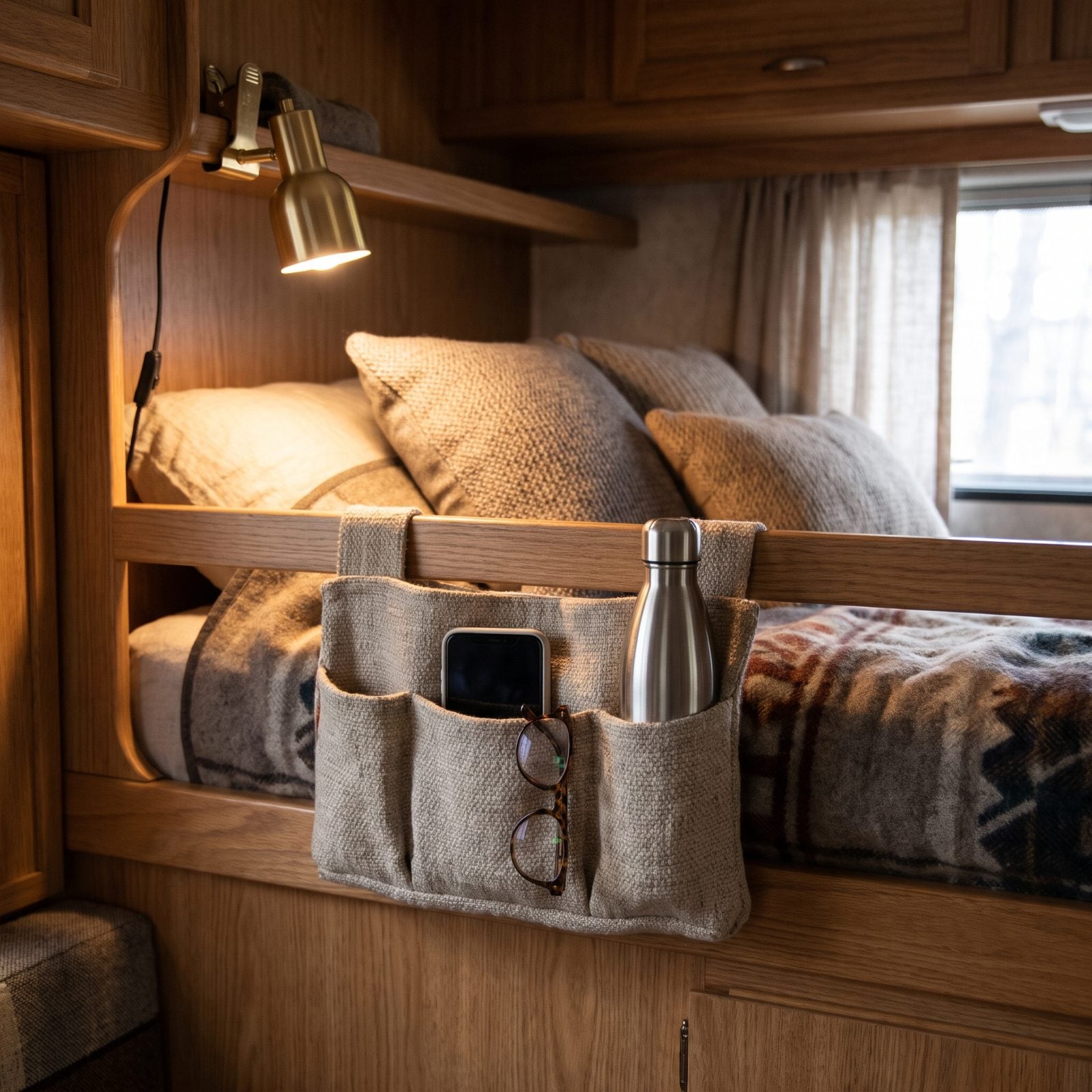
RV beds come with nowhere to set anything. Your phone ends up on the floor, your glasses end up lost, and your water lands wherever gravity decides.
A fabric caddy that slips between the mattress and the wall gives every bedside thing a home. Phone in one pocket, book in another, water bottle where you won’t knock it over reaching in the dark. It weighs nothing, costs about as much as a sandwich, and solves a problem the factory pretended didn’t exist. I ignored this one for two seasons and I still don’t know why.
24. A Shallow Shoe Tray That Keeps the Entry Clean
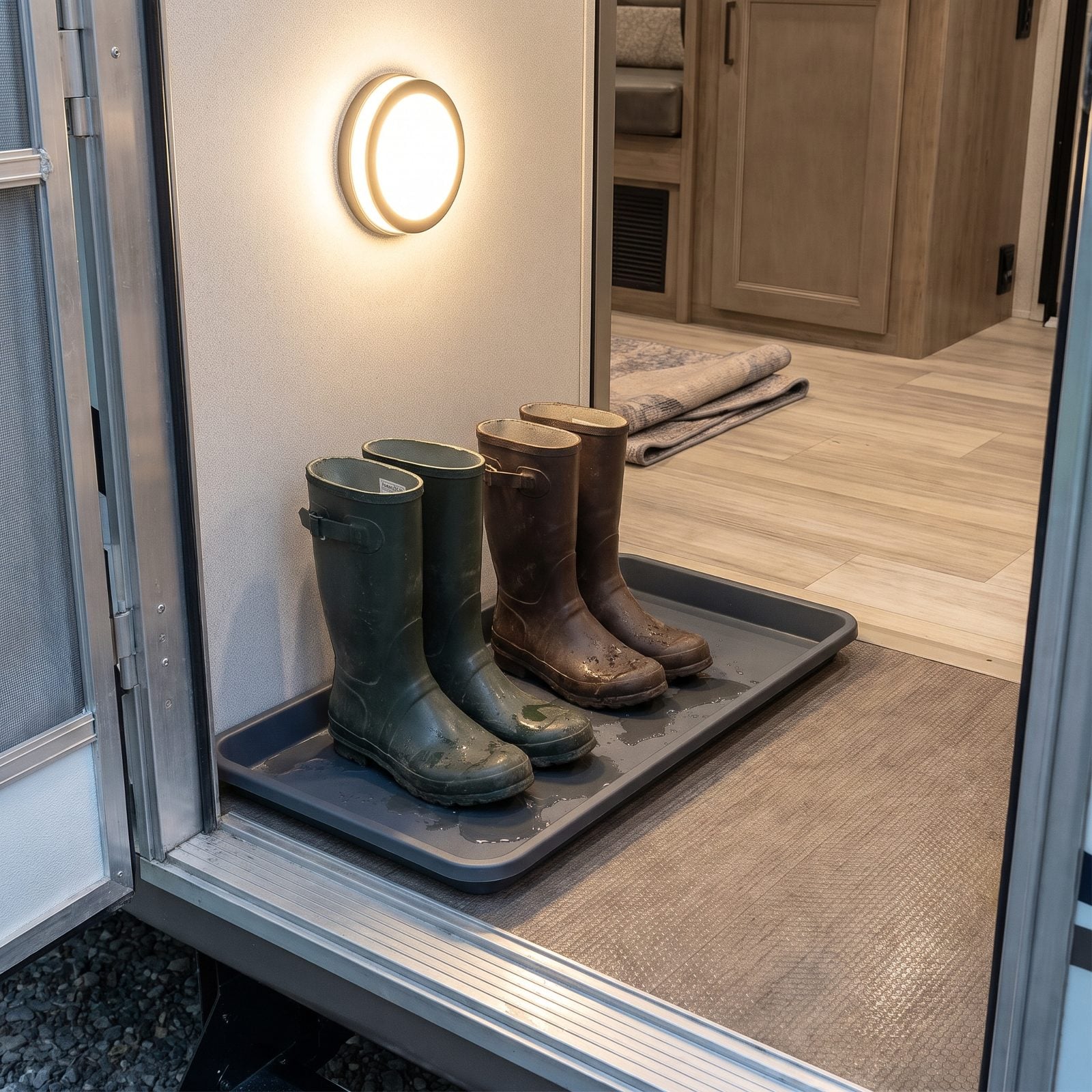
Dirt in an RV travels. One pair of wet boots by the door and three days later you’re finding grit in the bed, which is exactly the kind of mystery nobody wants to solve. A shallow rubber boot tray, the ribbed kind that runs about ten or twelve bucks, catches it all before it gets a vote.
Get one with a raised lip. The cheap flat ones let runoff escape onto your floor the second someone sets down a dripping shoe. Empty it over the picnic table at the end of a muddy weekend and you’ll understand why I keep two.
23. A Screen-Door Crossbar That Prevents Costly Tears
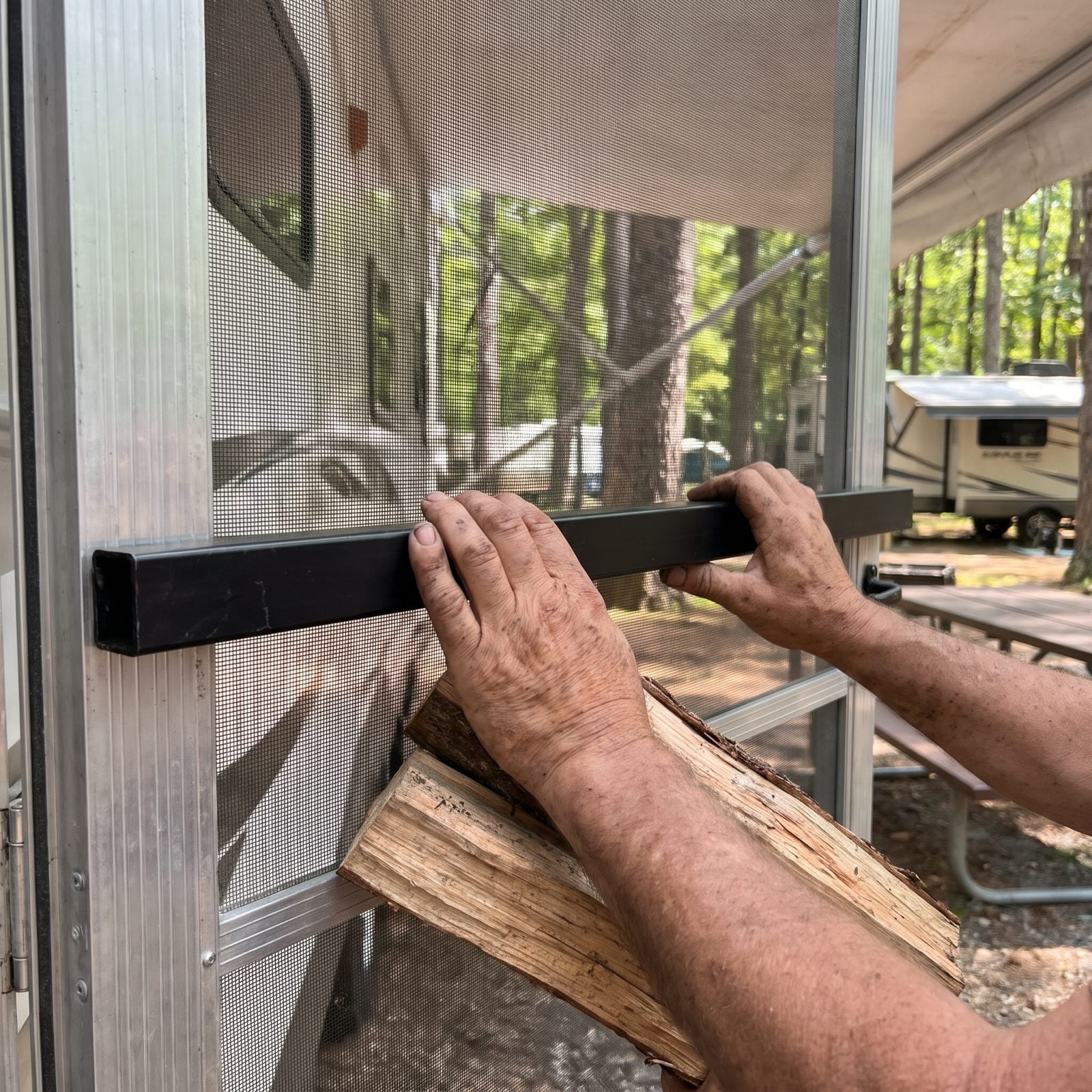
Nobody pushes the frame. Everyone pushes the screen. You know the move — hands full of firewood, you shoulder the door open right through the mesh, and by August there’s a sagging bulge your palm wore into it.
A screen-door crossbar fixes that for around fifteen dollars, mounting across the mesh at hand height so everyone’s got something solid to shove against. A new screen panel or a service callout runs far more than that. And the tears always start small before they go.
22. Glow-in-the-Dark Anti-Slip Tape on Every Step
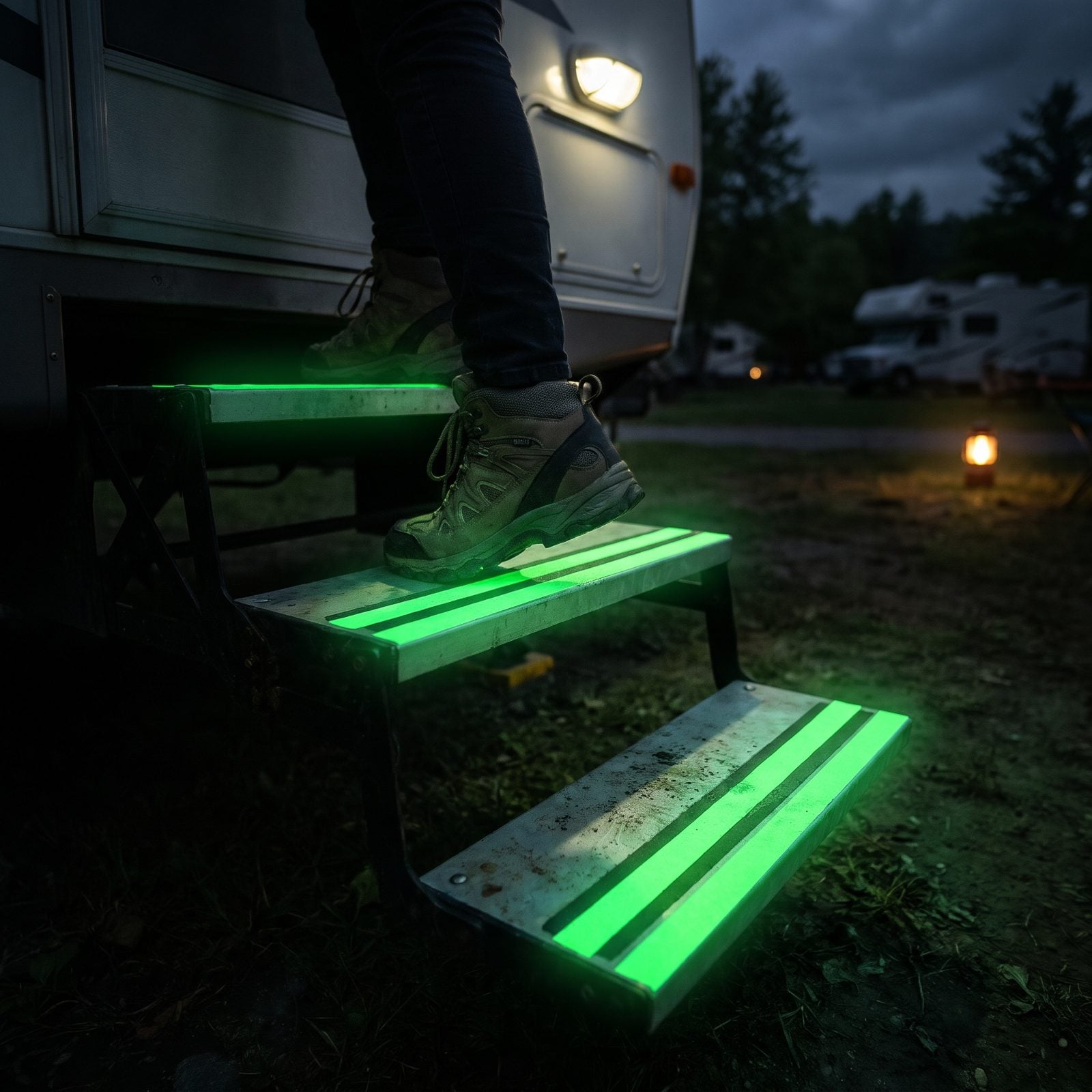
The RV step that gets you is the bottom one, in the dark, when you’re walking back from the bathhouse half-asleep. I’ve rolled an ankle on that step. It’s humbling in a way I won’t describe further.
Luminescent anti-slip tape does two jobs at once. The grit stops the slide when the metal’s wet with dew, and the glow charges off your daylight so the step edge still reads at 2 a.m. A roll costs under ten dollars and outlines every tread in the rig.
21. Wall-Mounted Grippers for the Broom and Mop
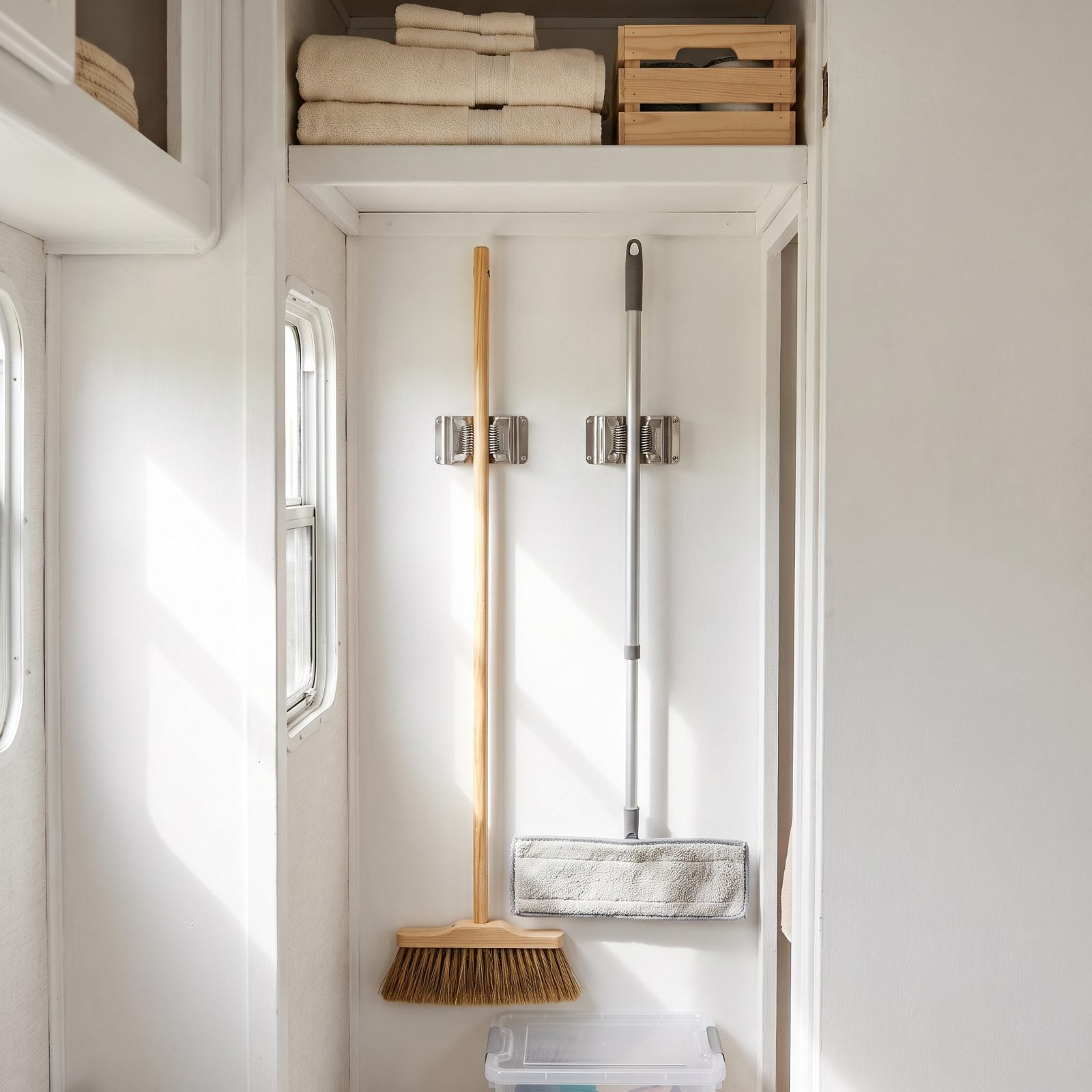
A loose broom in an RV is a projectile. Every corner, every hard brake, it clatters out of the closet and jams the door. Gripper clips — the spring-jaw kind made for garage walls — run about eight dollars for a set and screw straight into any wall stud or cabinet side.
Mount them vertically, high enough that the bristles don’t touch the floor. The handle stays put through the twistiest mountain pass, and you reclaim the closet floor you’d been losing to a pile of cleaning tools.
20. Under-Shelf Baskets That Use Wasted Airspace
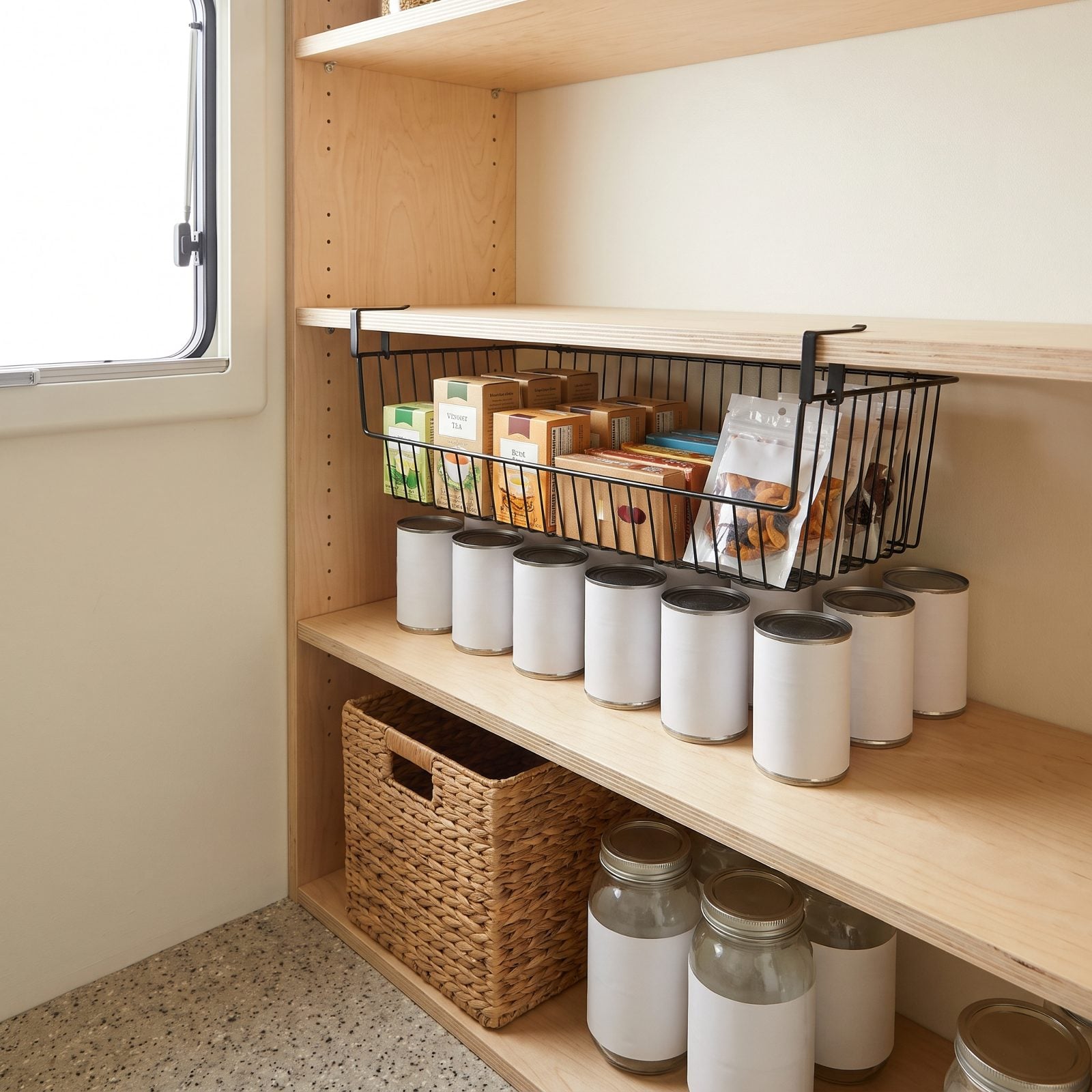
Look at any RV shelf and you’ll spot the waste: cans two inches tall, five inches of dead air above them. That gap is storage you already paid for and aren’t using.
An under-shelf basket slides onto the shelf above and hangs down into that empty space. Tea bags, foil pouches, flat snack boxes — all the small flat stuff that used to avalanche every time you opened the door. Six to ten dollars each.
Vertical space is the storage every RV owner is sitting on and nobody uses.
19. Nonslip Cabinet Liner That Quietens Travel-Day Rattles
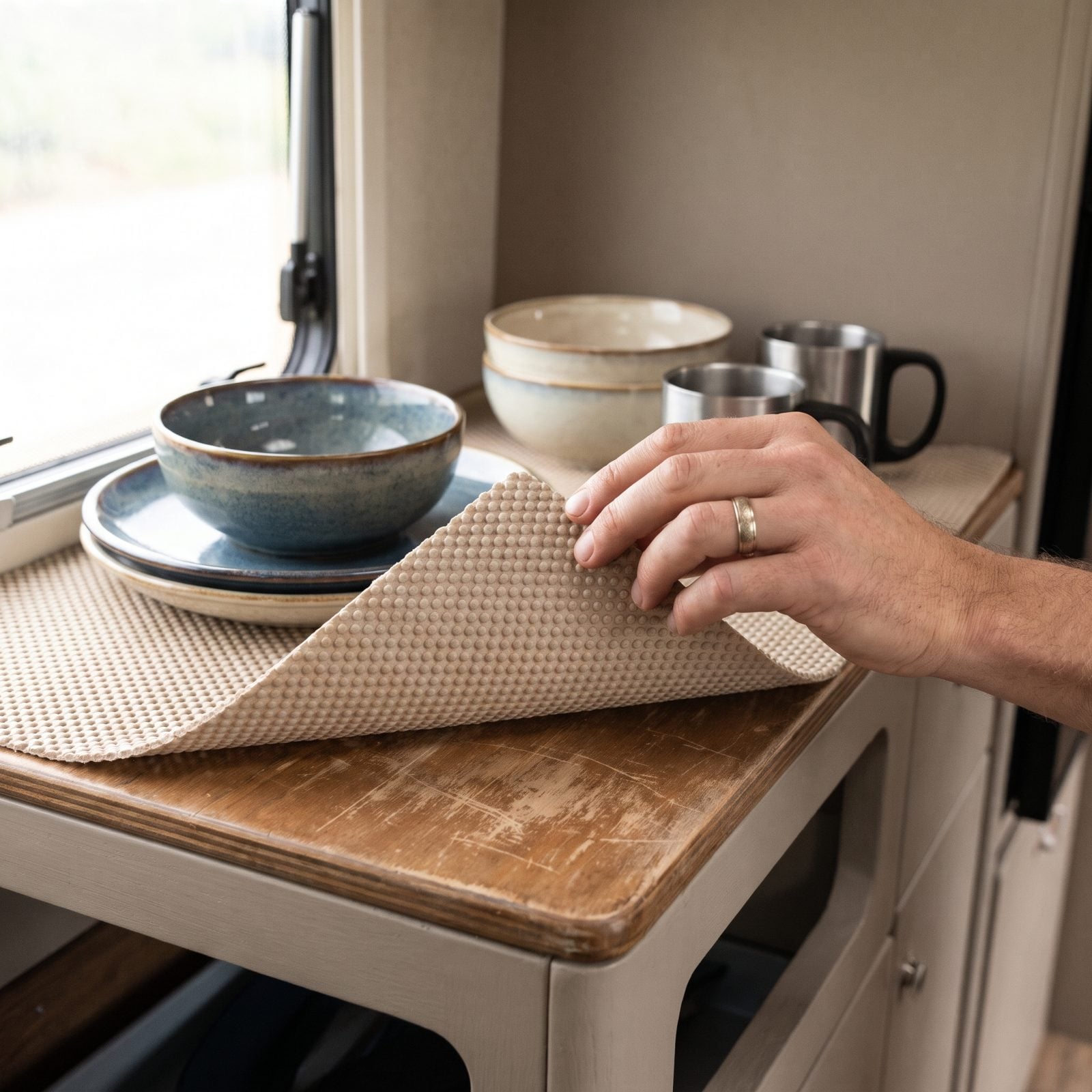
That maddening rattle three hours into a drive? It’s almost always dishes chattering against bare cabinet laminate. A roll of rubberized foam grip-mesh shelf liner, the nonslip PVC kind, costs about ten dollars and shuts most of it up.
Cut it to fit every shelf. The grippy mesh cushions plates and glasses so they don’t creep and knock, and it saves your laminate from the scratch marks sliding cookware leaves behind. I ran my first season without it and spent months wondering what that noise was. Turned out it was my own kitchen.
18. Handled Baskets Under the Dinette Benches
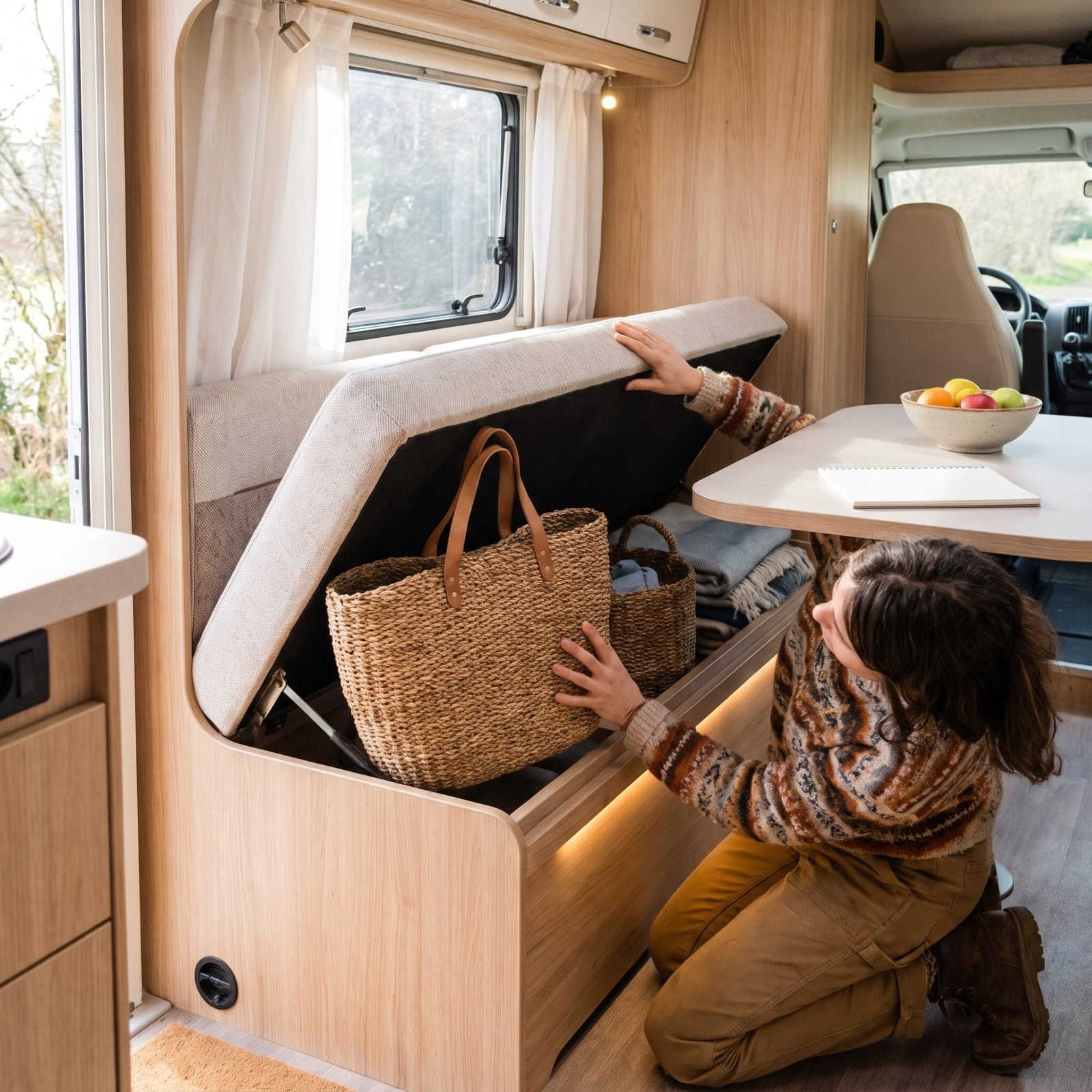
The space under a dinette bench is the best storage in the rig and the worst to actually use. You lift the heavy cushion-lid, then you’re bent double digging through a dark pit for the one thing that’s always at the bottom.
Woven seagrass baskets with leather strap handles turn that pit into pull-out drawers. Group by purpose — games in one, spare bedding in another, the first-aid kit where you can grab it fast — and lift the whole basket out instead of excavating. They run around twelve dollars each, and you’ll stop dreading that cushion lid.
17. A Slim Trash Can That Fits the Gap Beside the Cabinet
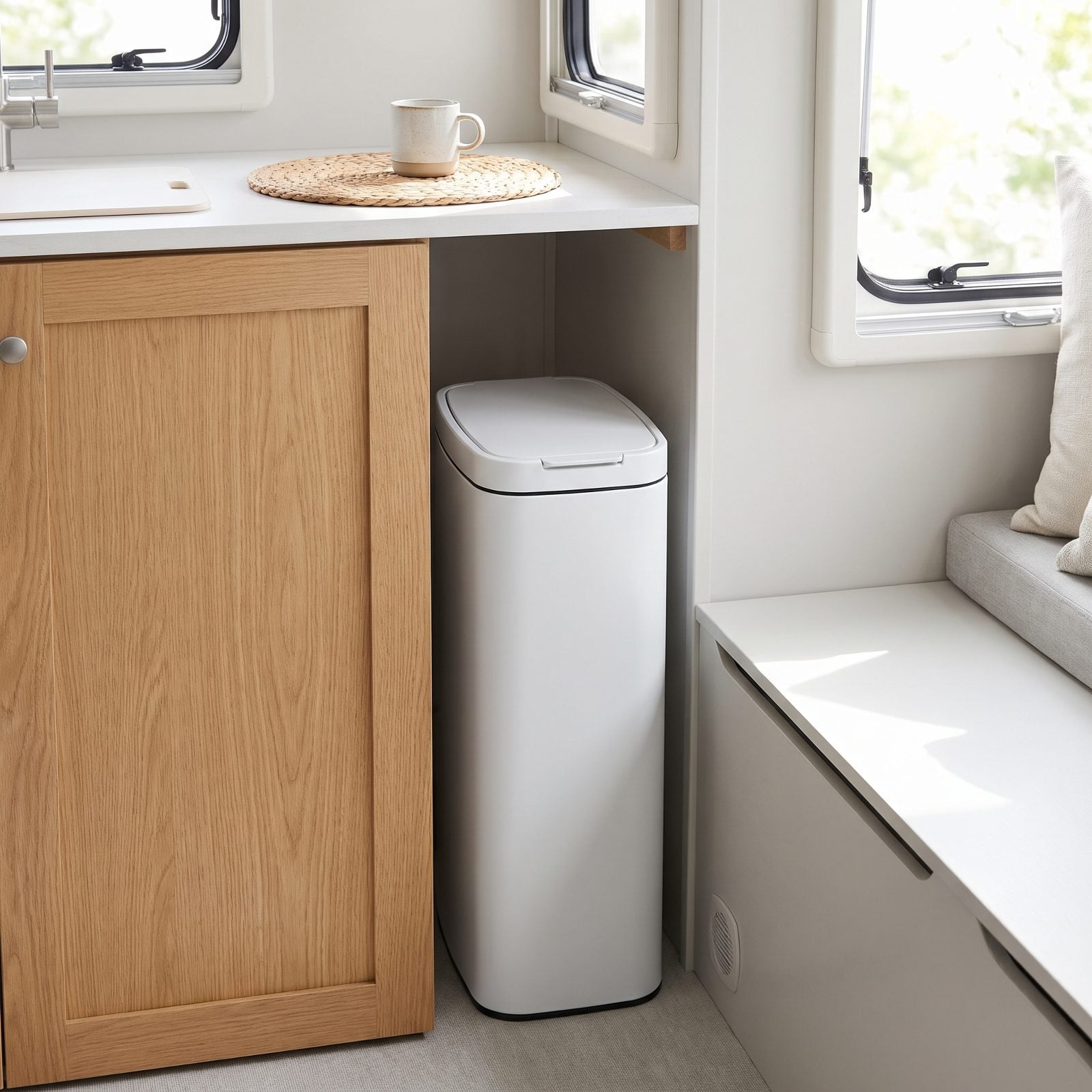
Every RV has a trash problem and nobody mentions it at the dealership. The standard move is a kitchen bag looped over a cabinet knob, swinging into your knees, tearing by day three.
A slim can, four to six inches wide, slides into the dead gap next to the fridge or under the dinette where nothing else fits. Ten to twenty bucks. Measure the gap first, because an inch too wide and it’s riding in the shower all trip.
16. A Collapsible Dishpan Built for Shallow RV Sinks
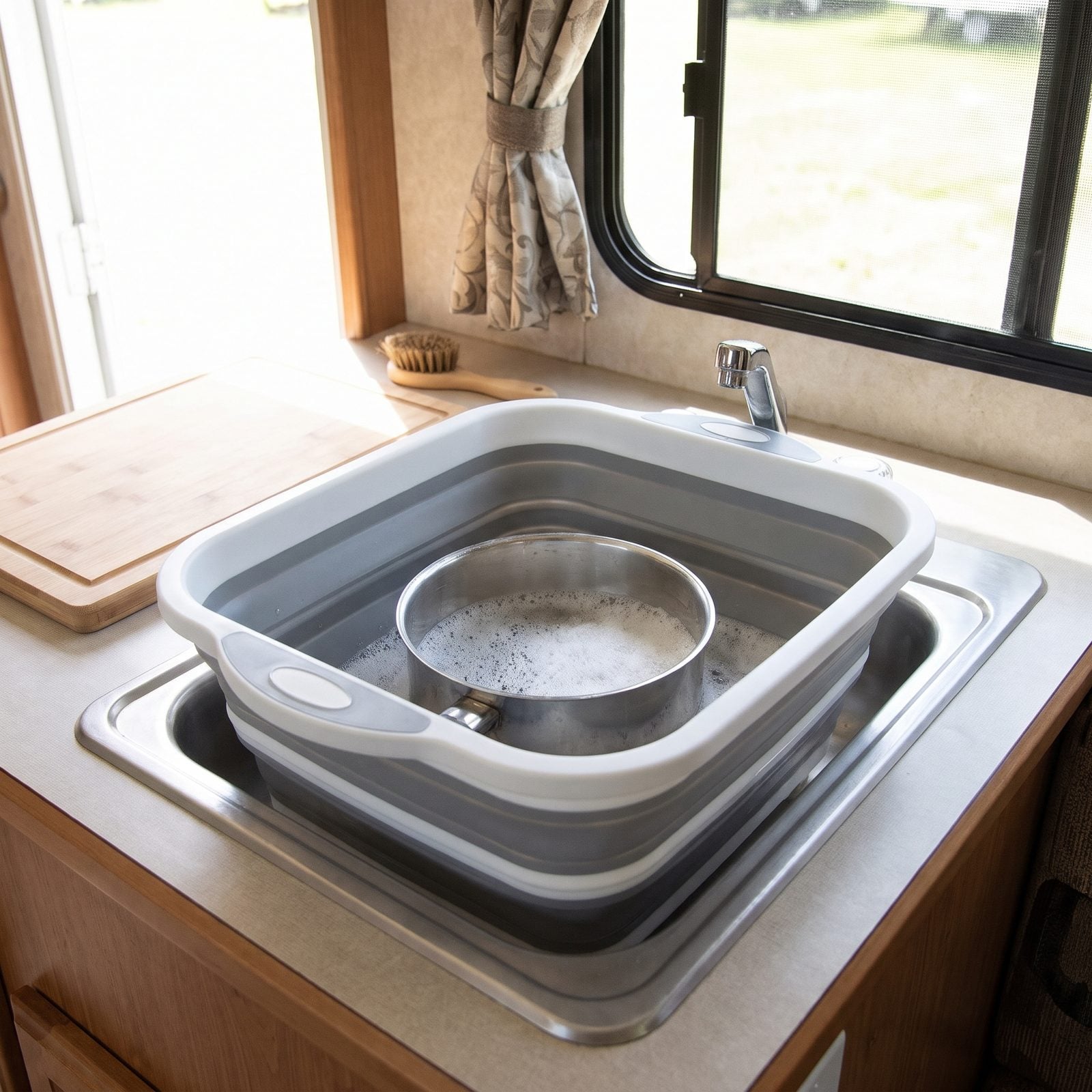
RV sinks are small and shallow, which means washing a single pot sends water everywhere. A collapsible silicone dishpan fixes that for about fifteen dollars and folds to an inch thick when you’re done.
Fill it, soak, carry the gray water out to dump legally instead of letting it run down your tank. On a tight trip the saved water adds up fast. I resisted these for years as fussy camp-store junk. I was wrong, and I’ll say so.
15. A Swiveling Faucet Aerator That Stretches Your Fresh Tank
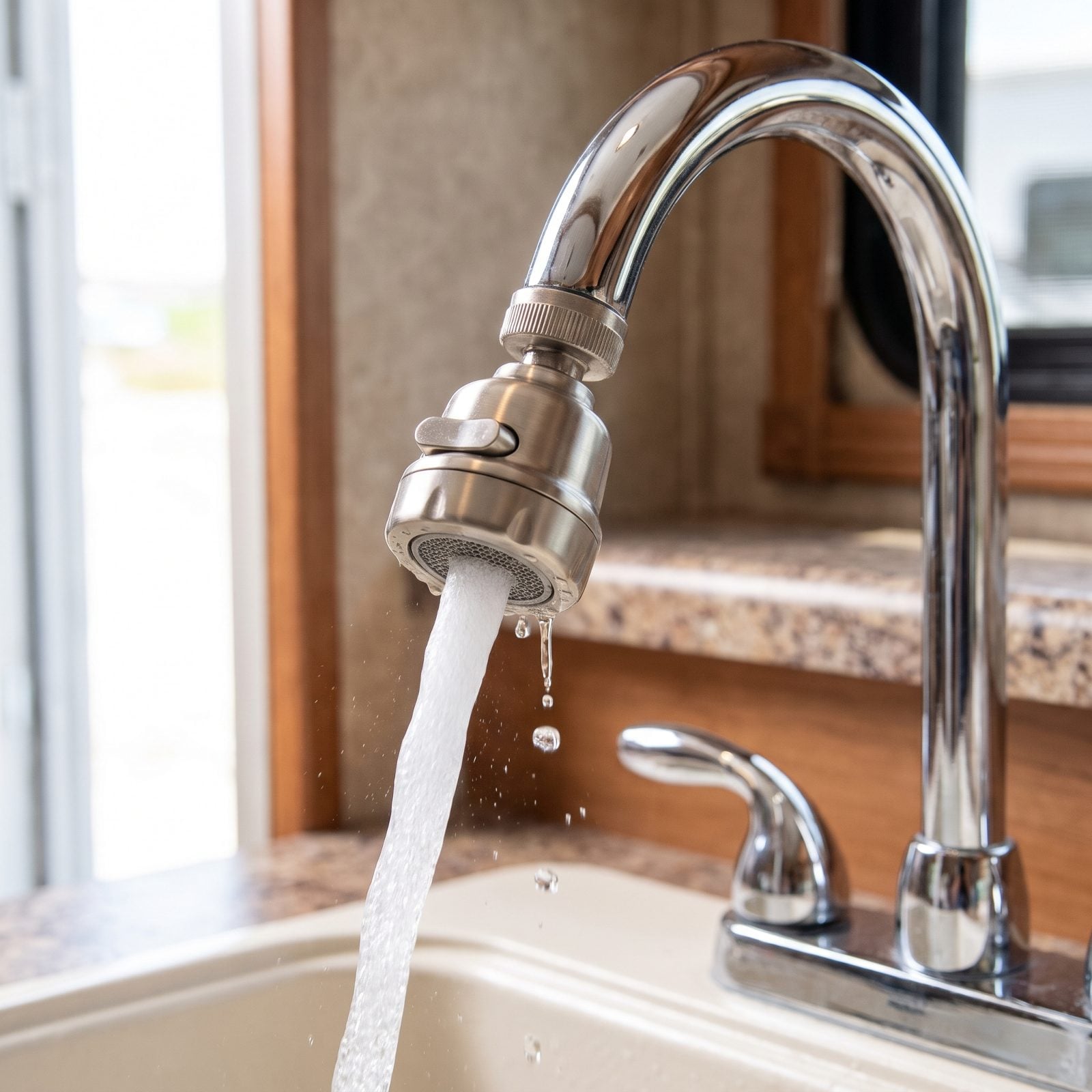
When your fresh tank holds thirty gallons and the nearest fill is forty miles back, every rinse counts. A swiveling low-flow aerator threads onto most RV faucets in under a minute and cuts the water a normal tap wastes.
Five to ten dollars. The swivel is the real trick, letting you aim the stream into the corner of a tiny basin instead of fighting a fixed spout. Check your thread size, because RV faucets run smaller than house ones and the standard aerator won’t bite.
14. Stick-On Bubble Levels You Can See From the Driver’s Seat
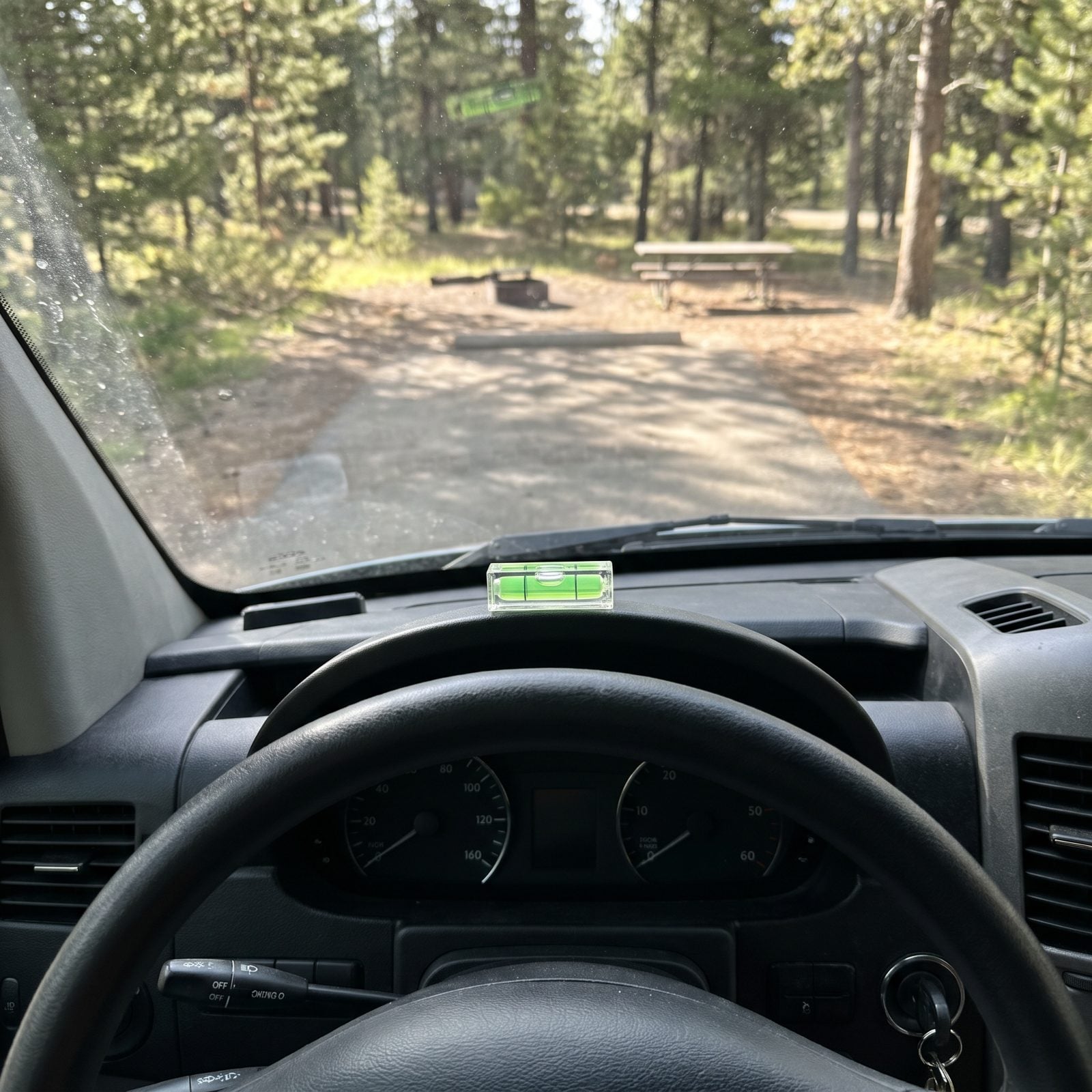
Leveling a trailer by walking around it, squinting, then checking again is how you waste twenty minutes and still wake up rolling toward the wall.
Stick two cheap bubble levels where you can read them without getting out: one on the front near the hitch, one along the side. Three bucks a pair. Now you adjust and confirm from inside the cab. Clean the surface with alcohol first or they peel off in the first hot week.
13. Rubber Wheel Chocks With Bright Pull Ropes Attached
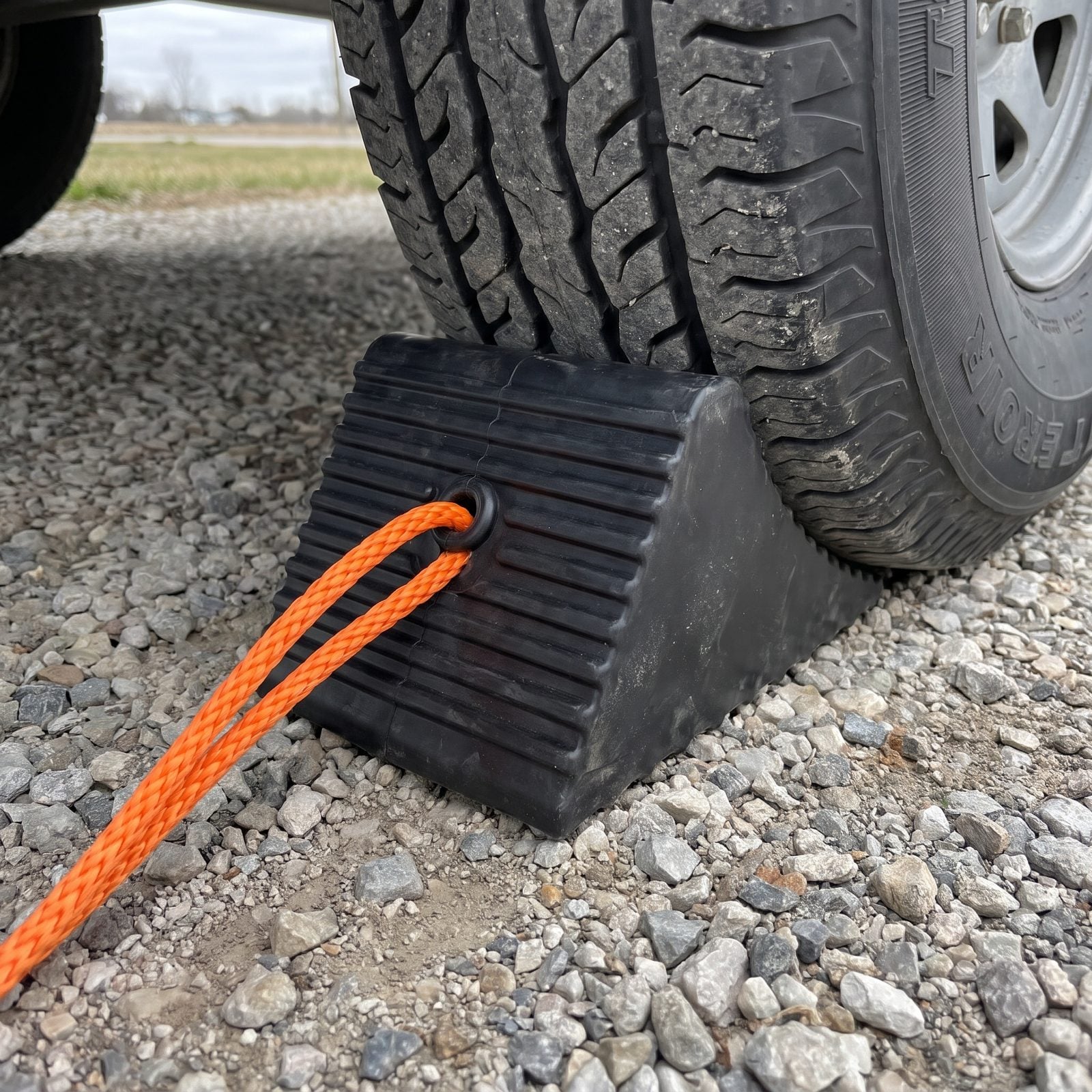
Plastic chocks crack in the sun and vanish into the gravel the second you need them. Solid rubber ones grip better and shrug off the heat.
The pull rope is the quiet upgrade. Shove a chock tight under a tire and good luck fishing it back out with your fingers bruised. A rope means you yank it free standing up, and the bright color means you don’t drive off and leave it in a campground three states back.
12. Interlocking Leveling Blocks That Pack Into One Small Bag
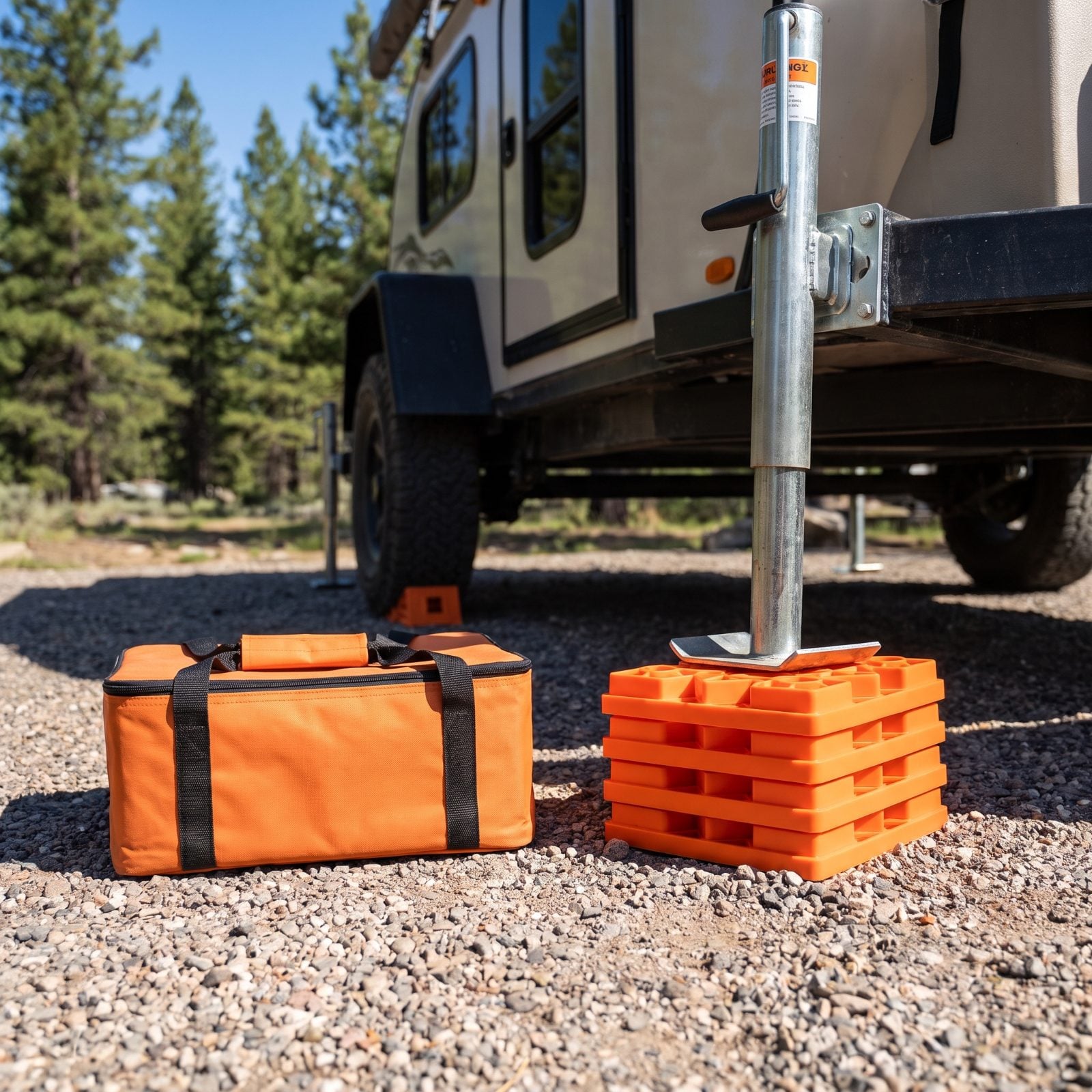
Scraps of lumber work until the one time you need a three-inch lift and only brought two-by-fours. Interlocking blocks stack like oversized building bricks to whatever height the pad demands, then snap into a bag that tucks in a storage bay. Drive up onto the step you build, chock behind, done. A set runs twenty-five to forty dollars.
Get the version with a bag. Loose blocks slide around a bay and end up under the spare where you’ll never reach them.
11. A 90-Degree Brass Elbow That Saves the City-Water Inlet
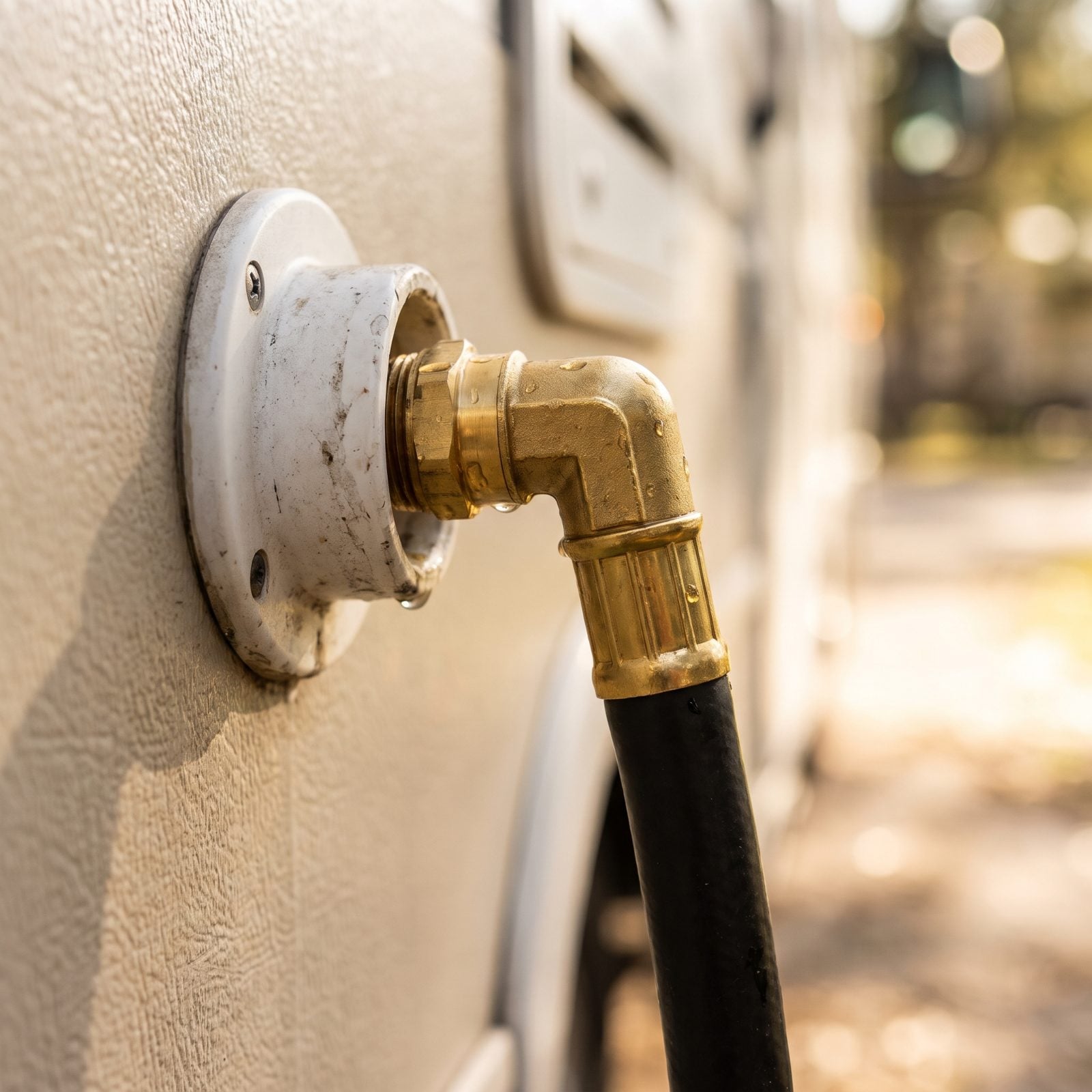
The city-water inlet is a cheap plastic fitting glued into your wall, and the hose screwed straight into it hangs out, catching knees, doors, and the occasional gust that yanks the whole thing sideways.
A little brass 90-degree elbow, five bucks, turns the hose to run down the wall instead of out into the walkway. Less strain on a fitting you really don’t want to crack, because replacing one means pulling a wall panel and a bad afternoon.
10. Quick-Connect Fittings for Every Freshwater Hose
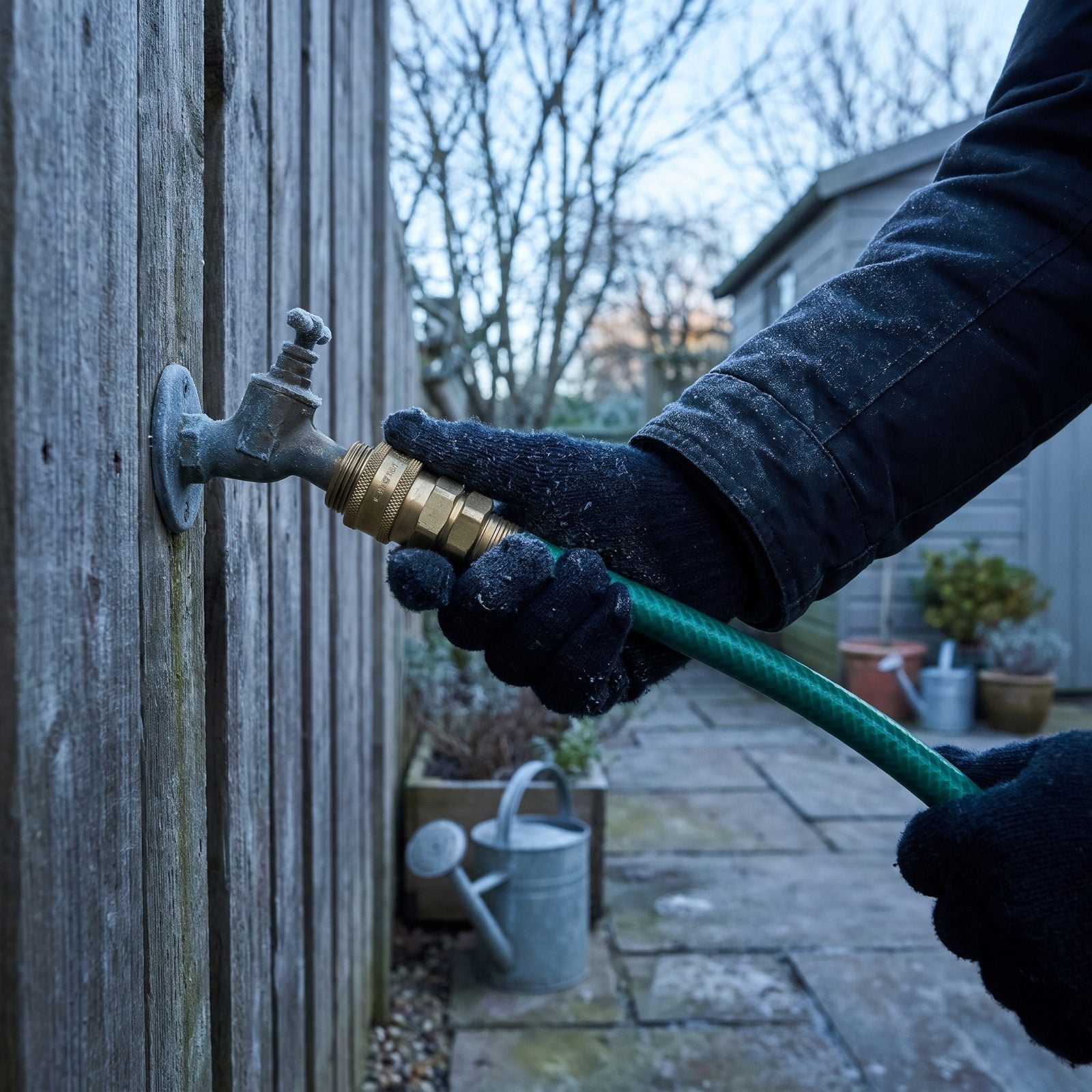
Threading a hose onto a connector with cold hands at dusk is how you learn to hate threads. Quick-connect fittings end that. You crimp a male end on each hose, a female end at the spigot and the regulator, and from then on everything clicks together in a second.
A full brass set runs roughly fifteen to twenty-five dollars. Spend the extra few bucks for brass. The plastic ones crack the first cold snap and strip if you cross-thread them even once.
9. A Clear Sewer Elbow That Confirms the Tank Is Rinsed
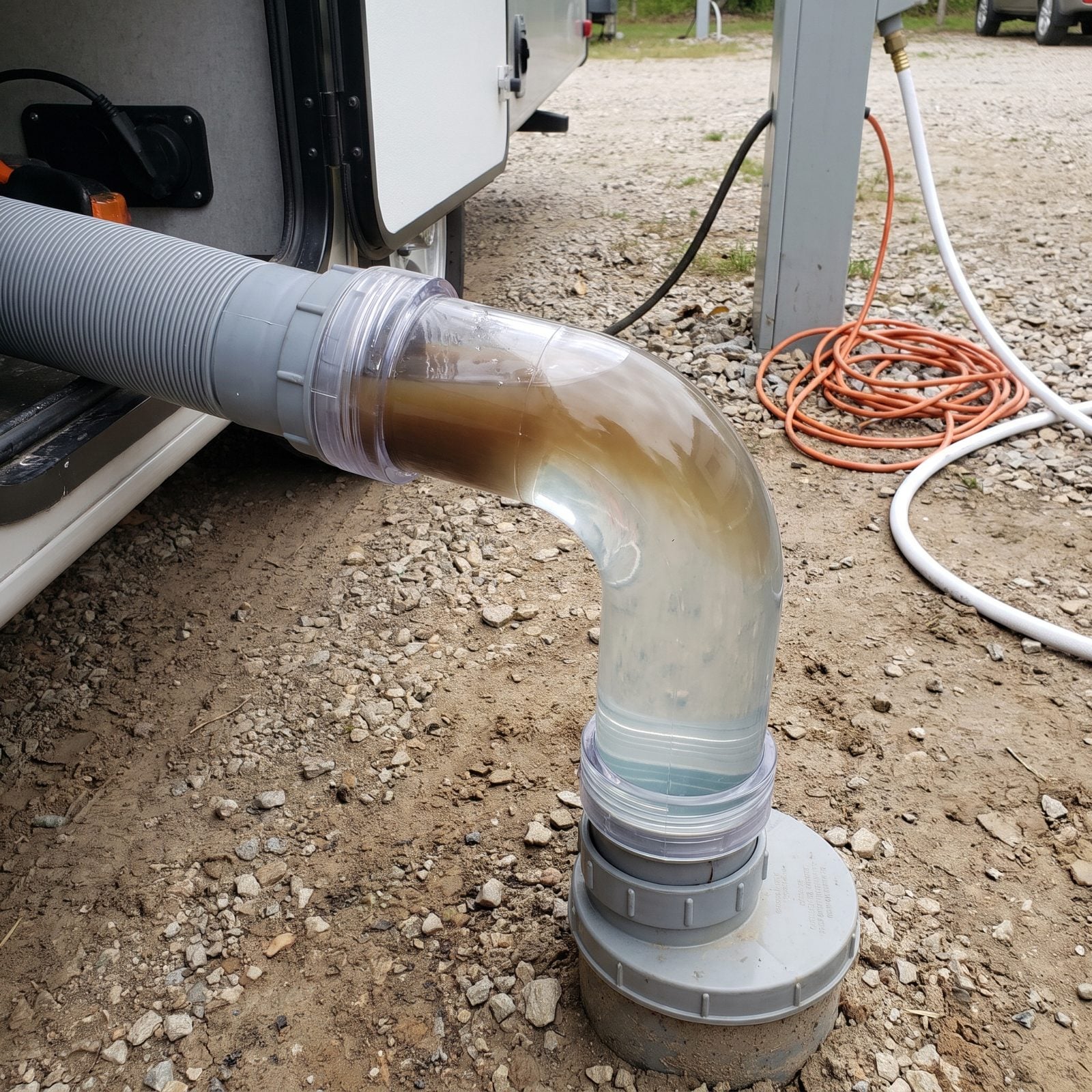
Nobody talks about this one at the dealership, and it’s the single best five dollars in the whole kit. A clear elbow goes between your sewer hose and the campground sewer inlet, and it does exactly one thing: it tells you the truth.
You run the black tank flush and watch. When the water turns from brown to clear, you’re done. No guessing, no running it forever, no pulling up with a half-rinsed tank that smells like regret by Wednesday.
It’s not pretty. You don’t need it to be. You need it honest, and it is.
In a short how-to video, one longtime RV industry expert recommends leaving a clear elbow on the sewer outlet so you can watch the flush water run cleaner instead of guessing by sound.
8. A Wall-Mounted Glove Dispenser in the Utility Bay
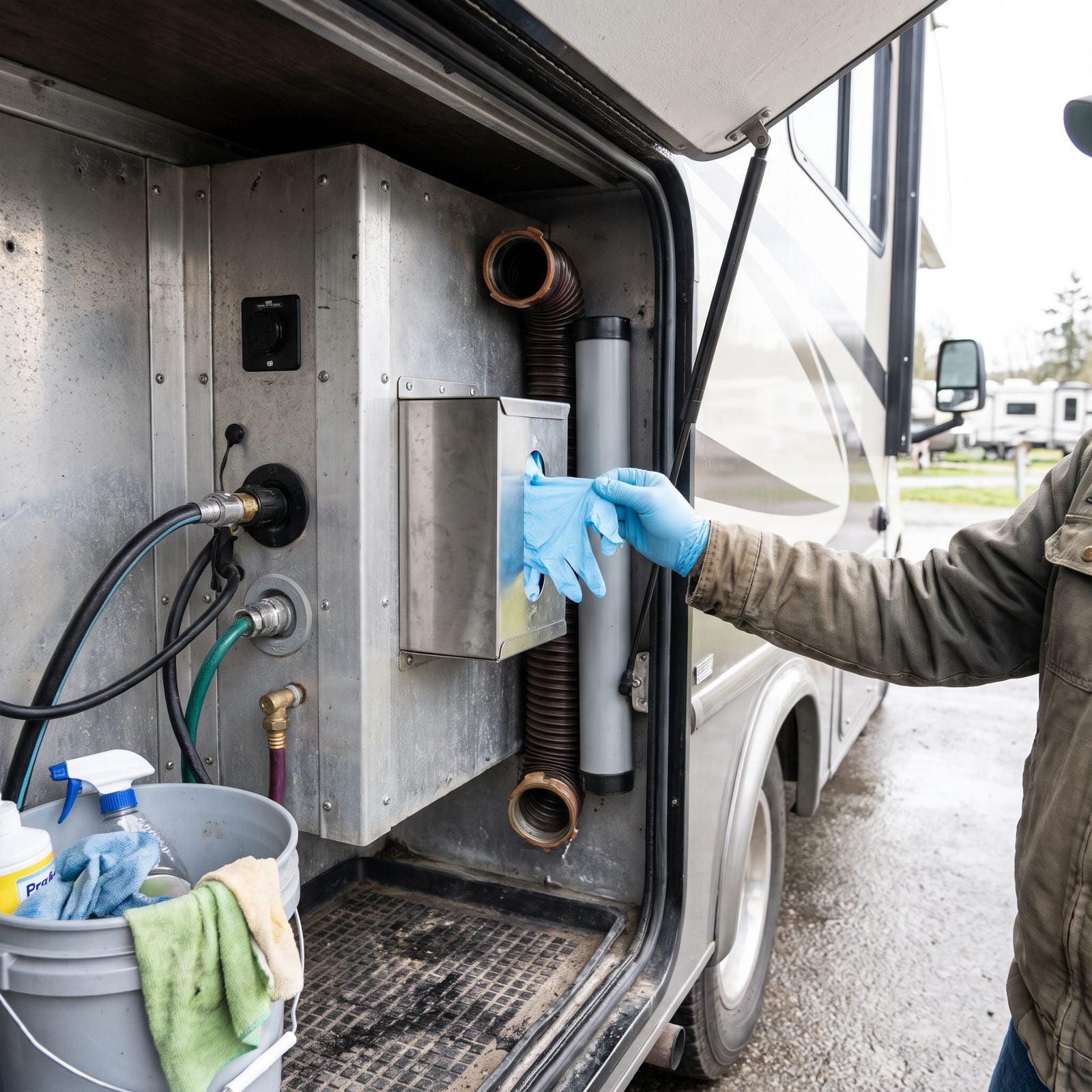
Here’s the mistake: keeping the glove box inside the RV, under the sink, three steps and a door away from the one place you actually touch the sewer hose. So you skip the gloves. We’ve all done it.
Screw a basic wall-mount dispenser right inside the utility bay, next to the connections, and the gloves are there at the exact moment your brain says wear gloves. Five dollars, two screws, done. Keep hand sanitizer mounted beside it and you’ve built a little dignity station into the dirtiest corner of the rig.
7. Tablecloth Clips That Survive Windy Campground Meals
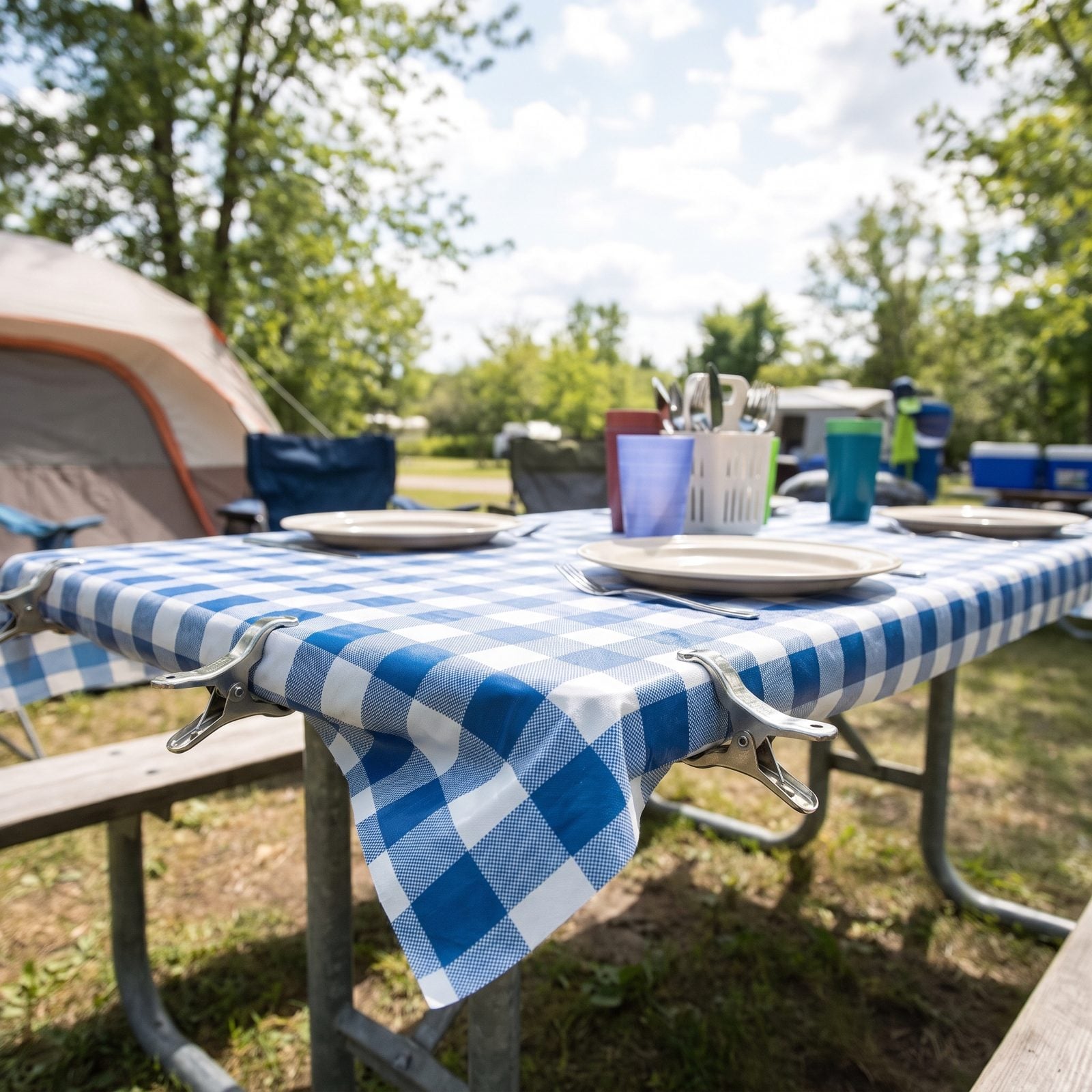
You know the sound. A gust, a slap of vinyl, and the paper plates are suddenly three sites over. A set of spring tablecloth clips kills that comedy for under ten dollars.
The trick most folks miss: picnic-table tops are thicker than kitchen tables, so grab the wider-jaw clips rated for an inch and a half or more. The skinny ones made for home tables won’t open far enough, and you’ll stand there pinching plastic while your napkins blow into the fire ring.
6. Mesh Insect Screens Over Furnace and Water-Heater Vents
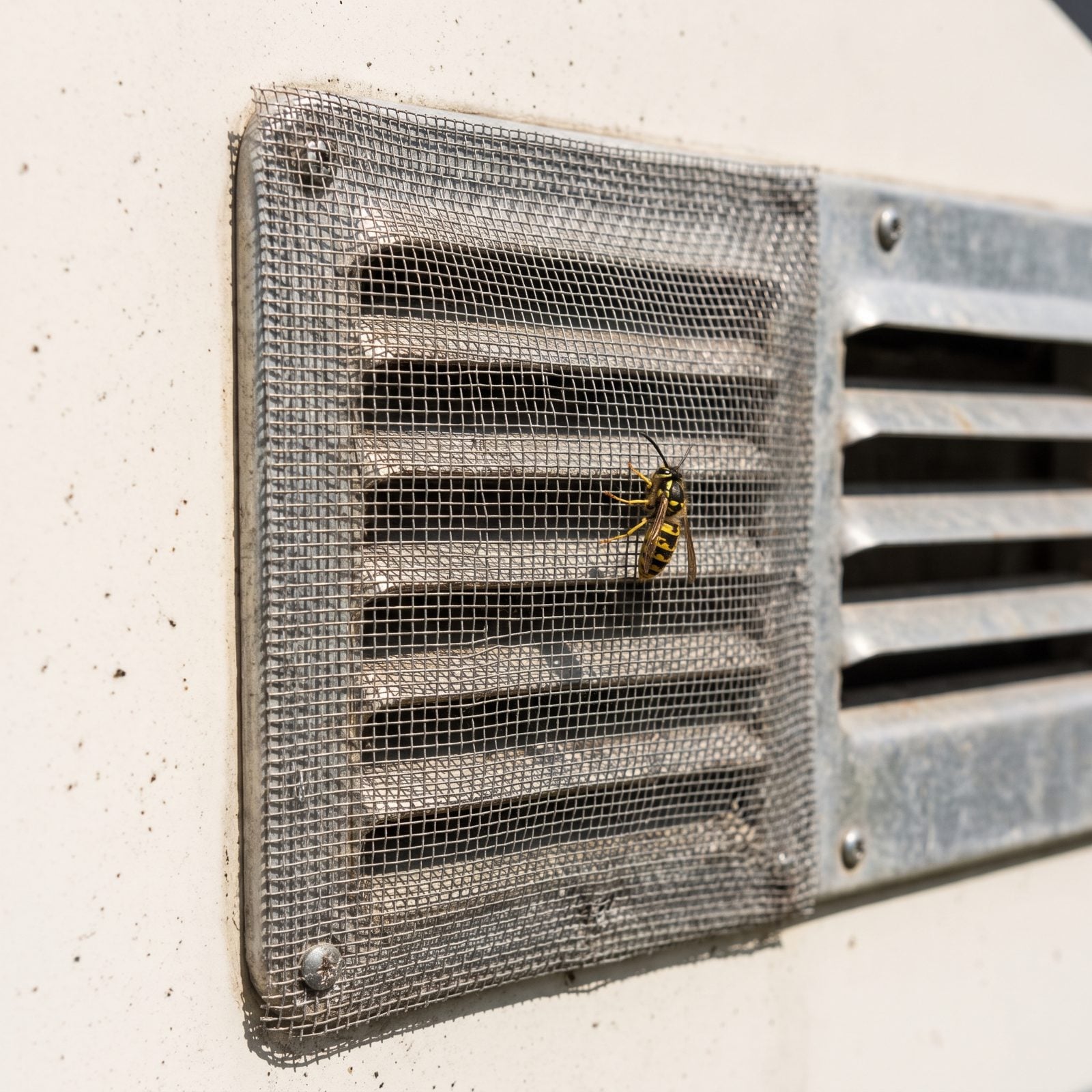
Mud daubers and wasps love the warm dark tube of a furnace or water-heater vent. They build a nest inside, block the airflow, and your heat quits on the first cold night of the trip. Ask anyone who’s chased that ghost in October.
Fine stainless mesh screens made to fit common vents cost around fifteen to twenty dollars a set and clip right over the exterior openings. Air flows, bugs don’t. One of those tiny purchases that saves a service appointment and a very cold evening.
Recommending stainless steel screens for furnace and water-heater vents, two longtime full-time RVers warn about mud dauber nests: “Not only can these nests prevent your rig’s appliances from functioning properly, but they can also lead to hazardous situations, such as fire.”
5. A Combination Lockbox for a Spare RV Key
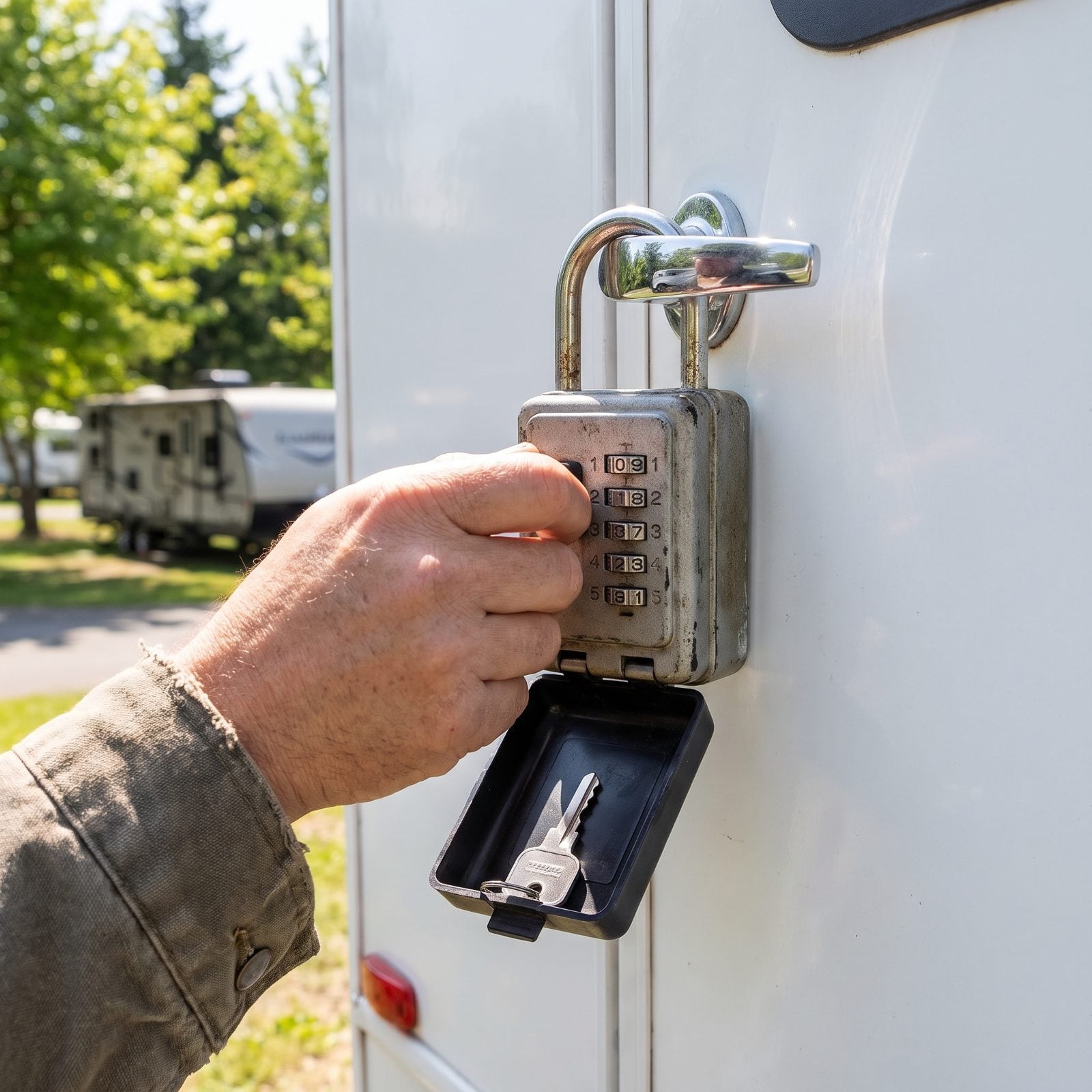
Lock yourself out of an RV once and you’ll understand why this made the list. Keys walk off at beaches, fall out of pockets on hikes, get left in a jacket at the laundromat. The cab key and the entry key are rarely the same, which doubles your odds of trouble.
A small combination lockbox, the same kind real estate agents use, holds a spare for ten to fifteen dollars. Hang it on the door handle, the bumper, or the tongue, set a code everyone in the group knows, and the panic goes away.
4. A Folding Side Table That Fits Beside a Camp Chair

You buy the fancy chair and then you’ve got nowhere to put your coffee, so it goes on the ground and gets knocked over by a passing shoe or a curious dog inside the hour.
A folding side table solves the single most annoying little problem at a campsite, and the slatted wooden ones fold flat to about laptop size and don’t weigh much. Mine lives in the storage bay year-round. If getting it in and out were any trouble at all, I’d never bother, and that’s the honest truth of why cheap and light wins.
Get one with little feet that splay out instead of thin spikes. Thin legs sink into soft dirt and tip your drink over. Learned that one the expensive way.
3. A Collapsible Bucket for Washing, Carrying, and Cleanup
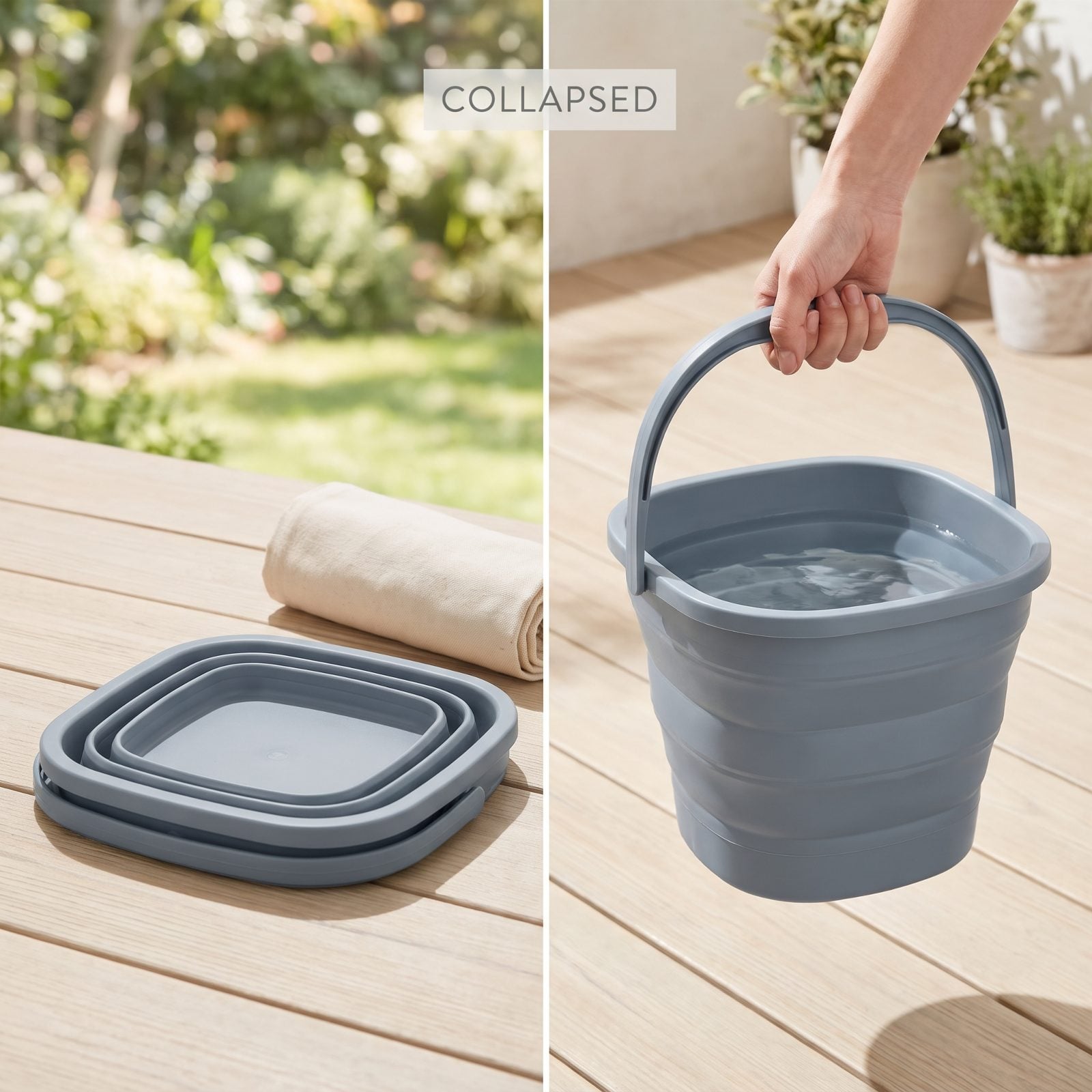
A rigid five-gallon bucket is dead weight in an RV. It swallows a cubic foot of storage and sits there mocking you from the corner of the bay every single time you load up for a trip.
The silicone kind collapses down to a couple inches tall, then pops back up when you need it. It’ll carry water from the spigot, hold dishes while you boil the wash water, haul firewood, and pull double duty as a bail bucket if your gray tank decides to back up at the worst possible moment.
2. A Showerhead Shutoff Valve That Saves Tank Water
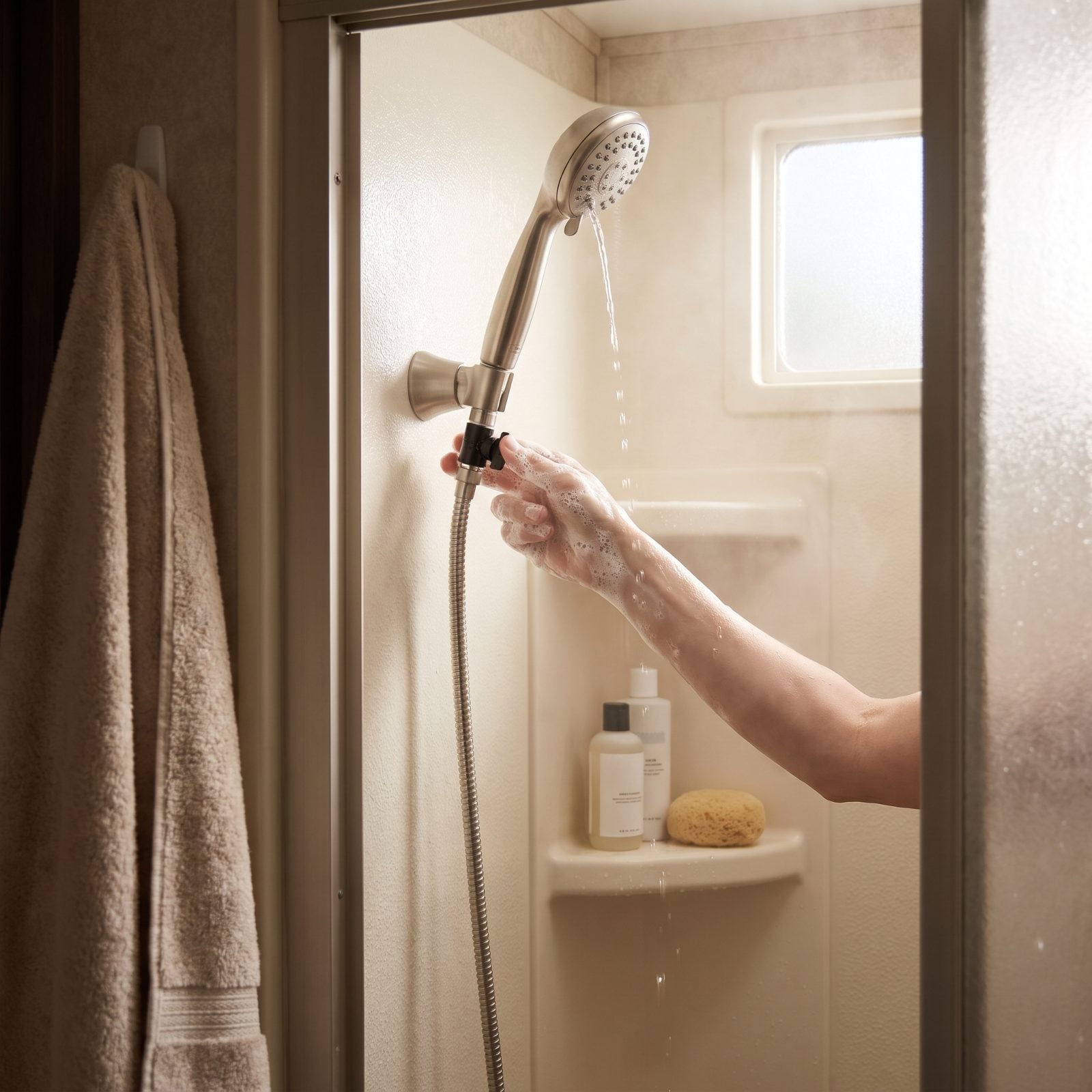
Nobody warns you how fast a fresh tank empties until you’re soaped up and the water sputters out on you. Leave an RV shower running the whole time and it’ll drain a full tank in a hurry.
A showerhead with a built-in shutoff valve — or a little inline one you thread on cheap — lets you kill the flow while you lather without ever touching the temperature mixer. Flip it back and the water returns at the same warmth you left it. You’re only running water when it’s actually rinsing you, and that’s the entire trick.
1. A Plug-In Voltage Monitor for Campground Power
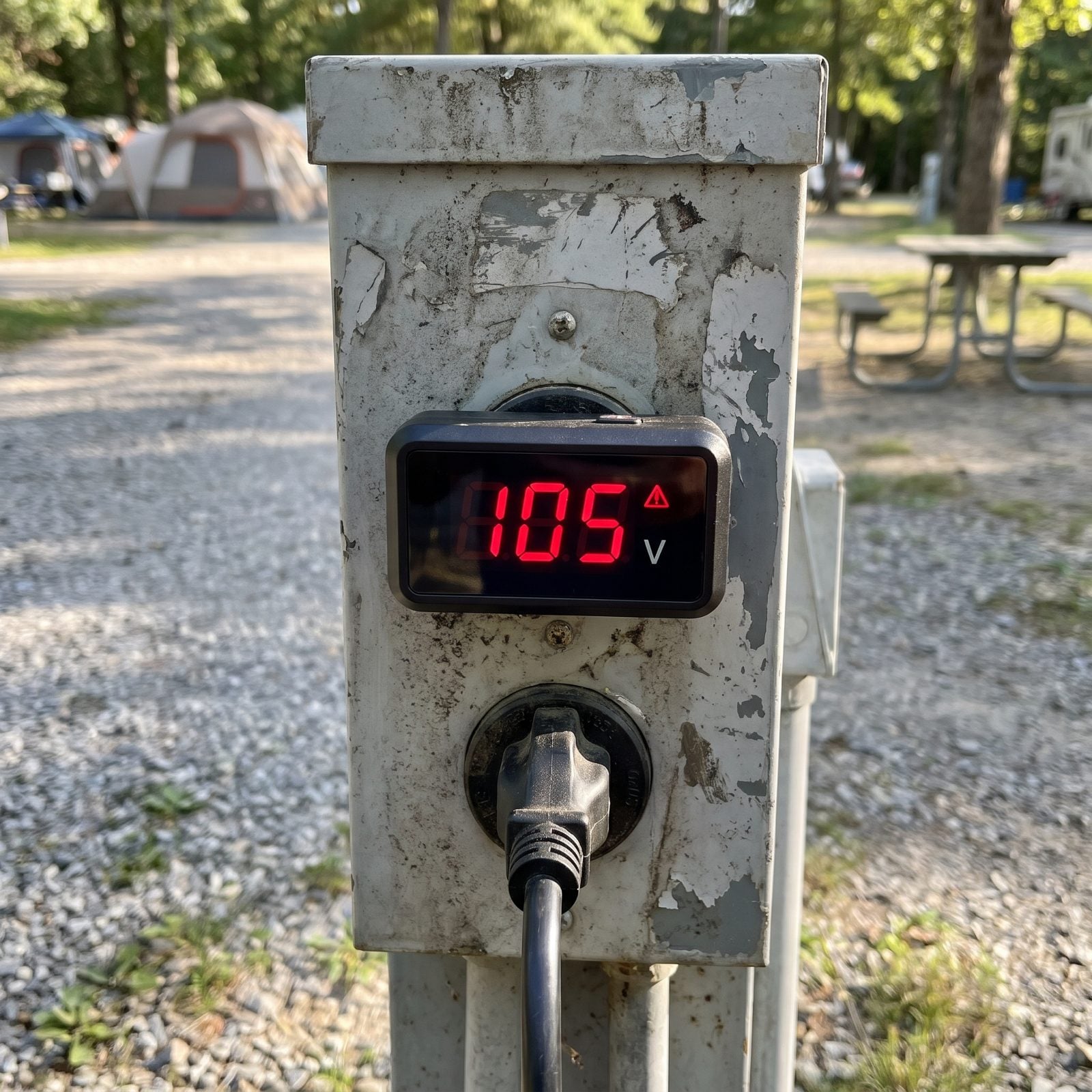
Campground power is a coin flip. Some pedestals are rock solid. Others sag down to 105 volts on a hot July evening when every rig on the loop has its air conditioning cranking at once — and that low voltage is exactly what quietly cooks your AC compressor and your fridge while you’re none the wiser.
A plug-in voltage monitor shows you the number in real time. Dip below 105 or so and you shut the big stuff down, saving yourself a repair bill that dwarfs the little gadget a hundred times over.
It’s not a surge protector — those cost more and do more. As a cheap early warning that something’s gone sideways at the post, though, this thing earns its spot in the drawer every summer.
Recommending a power line monitor as the low-cost protection against bad pedestal voltage, two veteran RV writers note “This simple plug-in device shows the system voltage and some models can indicate whether the campground outlet is wired safely.”