
Thirty-eight feet of someone else's dream
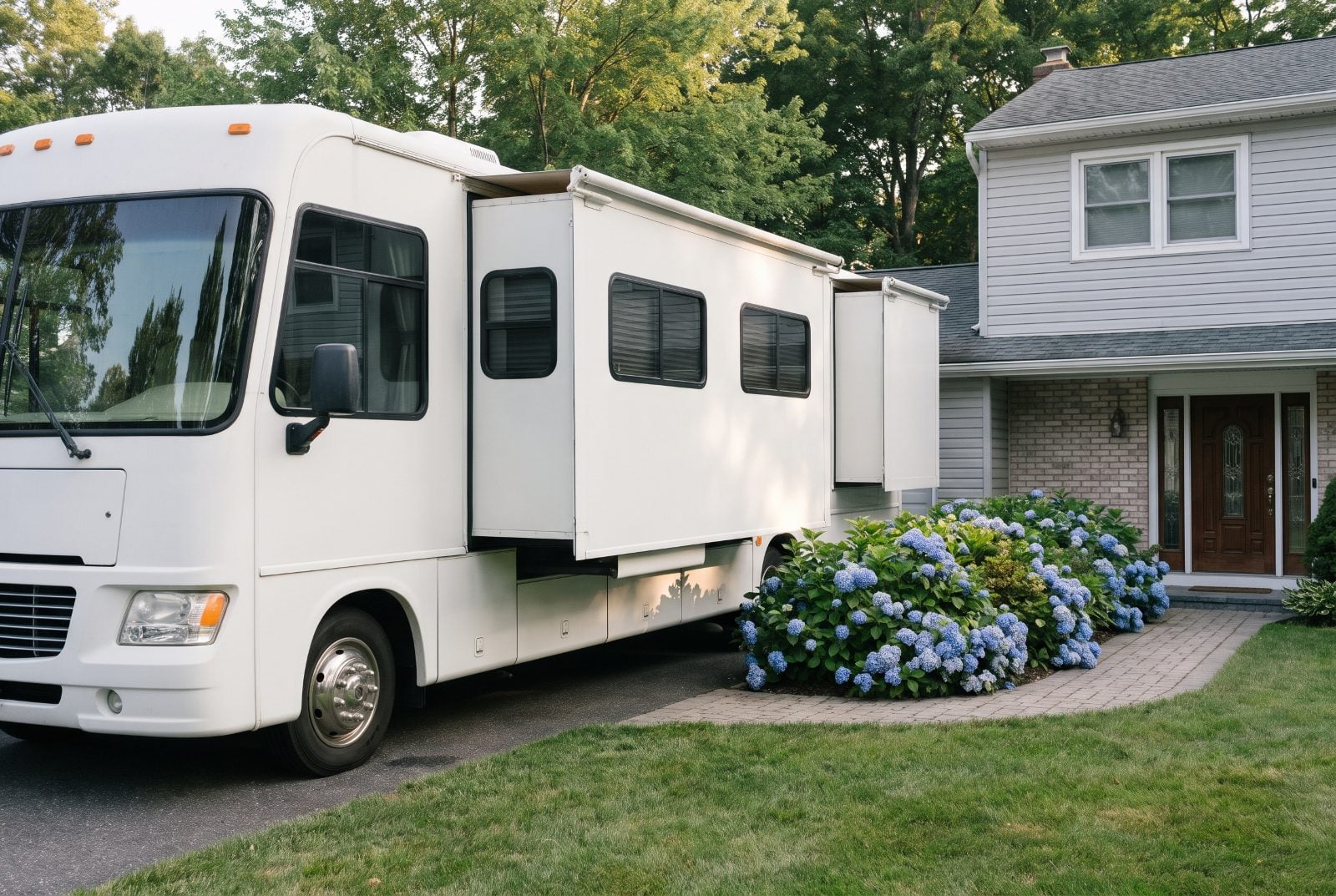
It’s parked in the driveway, taking up the whole side yard. Thirty-eight feet, two slide-outs, a king bed, and a kitchen smaller than your pantry.
Please note that some of the images in this article were created with the assistance of AI.
He’s been talking about this since before the kids left home. Retire, sell the house, see every national park, follow the warm weather. You nodded through those conversations the way you nod at a lot of retirement talk. You figured it was a someday thing, a maybe.
Then he put down a deposit.
Now there’s a 38-foot motorhome where your hydrangeas used to get afternoon sun, and a husband who keeps saying “just try it.” And you, quietly sure you do not want to live in a box on wheels, sharing one bathroom with a man who leaves his socks on the floor.
Last night he showed you his phone. He’d asked ChatGPT: “My wife is hesitant about full-time RVing. How do I convince her?”
So it’s come to that. Can a chatbot sort this out? Maybe, but only if someone asks it the right question. That one wasn’t it.
This isn't really a fight about an RV
It looks like an argument about square footage and black-water tanks. Underneath, it’s usually about two bigger things: how you each picture retirement, and who’s giving up what.
Retirement is a rough patch for a lot of marriages
The research
A Cornell study by Phyllis Moen and colleagues, published in 2001 using data from the mid-1990s, followed 534 married men and women aged 50 to 74. What they found surprised a lot of people. Being retired wasn’t the hard part. Becoming retired was. Couples in the middle of the transition fought more and were less satisfied with their marriages. Couples who’d been settled in retirement for more than two years reported the highest satisfaction and the least conflict.1
The pattern was worst when spouses were out of step. Marital quality dropped most when only one partner retired, especially when the husband retired and the wife kept working. Men reported the most conflict when they’d retired and their wives hadn’t.1
An RV bought on the edge of retirement lands right in that rough patch. One of you is ready to go. The other is still mentally at home, with friends, a garden, grandchildren down the road, maybe a job. The motorhome turns that mismatch into something you have to look at every morning.
Giving in can cost more than you think
The obvious way out is for one of you to give in. Research says to be careful about how that happens.
A 2020 meta-analysis led by Francesca Righetti pooled 82 data sets covering more than 32,000 people. Being willing to sacrifice for a partner was linked to better well-being, for you and for the relationship. Actually making sacrifices was slightly linked to lower personal well-being for the person who made them. And the more costly a sacrifice felt, the worse things looked, both for the person making it and for how their partner felt about the relationship.2
Why you give in matters too. In a two-week daily study by Emily Impett and colleagues, sacrifices made for positive reasons, like wanting your partner to be happy or to feel closer, went along with better days and better relationships. Sacrifices made to avoid conflict or guilt went along with worse moods, lower satisfaction, and a higher chance of breaking up.3 That study was of college students in dating relationships making everyday sacrifices, not retirees selling a house. But the point is easy to recognize.
If you agree to full-time RVing just to stop the arguing, that’s exactly the kind of sacrifice the research warns about.
So if you agree to full-time RVing just to stop the arguing, that’s exactly the kind of sacrifice the research warns about. And if he gives up the dream entirely just to keep the peace, the same thing applies to him.
What happens when you ask AI to referee
Look again at his question: “How do I convince her?”
It doesn’t ask for a compromise. It asks for a sales pitch. And chatbots tend to give people what they ask for.
A Stanford study published in Science in March 2026 tested 11 leading AI models on personal advice. They sided with the person asking about 49% more often than humans did. People who discussed a conflict with an agreeable chatbot came away more convinced they were right and less likely to make amends. They also couldn’t tell the agreeable chatbot from a more balanced one.4
So his chatbot will give him a tidy persuasion plan: start with short trips, highlight the freedom, show her photos of sunsets. You could open a separate chat and ask “How do I convince my husband to sell the RV?” and get an equally tidy plan pointing the other way.
Two people, two chatbots, two sets of ammunition. That isn’t a compromise. It’s an arms race.
AI can help, if you change the question
AI is actually good at some parts of this problem. It can lay out options neither of you thought of, run numbers, and plan logistics. What it can’t do is decide what’s fair, because it only hears the side that’s typing.
So the fix is simple, if a little awkward: ask it together, at the same keyboard, with a question that doesn’t assume who’s right. There are sample prompts further down.
The compromises that actually exist

“Full-time on the road” and “sell the RV” aren’t the only two options. There’s a lot of room in between. Here are the common middle grounds, roughly from least to most road time.
| Option | What it looks like | Who gives up what | Works best when |
|---|---|---|---|
| Weekend and holiday trips | Keep the house; use the RV for short trips a few times a year | He gets less road time than he dreamed of; she keeps her home base | You're still testing whether either of you likes it |
| Seasonal escape | Keep the house; take the RV south (or north) for one season each year | Both give a little: a few months away, most of the year at home | One of you dreads winter, or loves a particular region |
| Seasonal site | Park the RV at one campground for months at a time, like a cottage | Less driving and setup; more community; less "see everything" | She wants roots and neighbours; he wants change of scenery |
| Split time | He takes some trips with friends, a brother or solo; she joins for the parts she'd enjoy | Less togetherness on the road; more honesty about what each wants | Your interests genuinely differ and that's fine |
| Downsize, don't sell | Trade the family house for something smaller, keep a home base, travel more | Both let go of something; neither loses everything | The house was getting too big anyway |
| Trial year with an exit | Agree on a fixed trial (e.g. one year part-time) and a date to decide together | Commitment to try, plus a real way out | You need to know you can change your mind |
| Full-time | Sell the house and live on the road | Maximum change for both | You both want it, not just one of you |
Swipe sideways to see the whole table on a phone.
Two rules that make any of these work
Two rules
- Don’t sell the house until you’ve lived the life. Rent an RV, or use the one in the driveway, for a long stretch first. Whether you love it or hate it, it’s far easier to find out before the house is gone.
- Write down the exit. Any compromise feels safer when there’s a date to revisit it and an agreed way out. That also keeps the deal from turning into the grudging, avoid-the-fight kind of sacrifice the research warns about.
How to use AI as a planner, not a judge
Sit down together, one laptop, one chat. Take turns typing. Then try prompts like these.
1. Describe both sides fairly
Copy this prompt
“We’re a married couple in our 60s. One of us wants to RV full-time in retirement. The other wants to keep our house and community. Both feelings are valid. List at least six arrangements between those two extremes, with the pros and cons of each for both of us.”
This matters because you’ve told the AI that neither of you is the problem. It has nobody to side with.
2. Make it find out what each of you actually wants
Copy this prompt
“Ask us each five questions, one at a time, to work out what we each really want from retirement. Not what we want from an RV. Then summarize where we overlap.”
Often the overlap is bigger than you’d expect. He may want adventure and novelty. She may want connection and a sense of home. Both can fit into the same year.
3. Run the real numbers
Copy this prompt
“Compare the yearly cost of these three options for us: keeping our house and taking two RV trips a year; a seasonal site for four months; and full-time RVing after selling the house. Include insurance, fuel, campground fees, maintenance and depreciation. Show your assumptions so we can correct them.”
Treat its numbers as a rough first draft. Check prices, insurance quotes and campground rates yourself before deciding anything.
4. Plan a fair trial
Copy this prompt
“Design a 12-month trial for a couple where one partner is hesitant about RV life. Build in what the hesitant partner needs to feel safe, regular check-ins, and a clear way to end the trial with no blame.”
What not to ask
Skip these
- “How do I convince my wife/husband?” (that’s a sales pitch, not a compromise)
- “Who’s being unreasonable?” (it only hears your version)
- “Is it normal to hate RVing?” (it’ll reassure whoever’s asking)
If the chat starts sounding like it’s on one person’s side, say so: “You’re favouring one of us. Rebalance.” Then keep going.
So, can AI find the compromise?
It can find the options. It can do the math, plan the routes, and design a trial year. What it can’t do is make you want the same thing, or decide whose dream matters more.
That part is still a conversation between two people, ideally with the RV parked and the phones down. The sacrifice research points the same way about how it should end. Not with one of you quietly giving in, but with an arrangement you both chose and can both live with.
Maybe that’s four months in Arizona and the rest of the year at home. Maybe it’s a seasonal site by a lake with neighbours you’ll actually get to know. Maybe it’s him and his brother doing the national parks while you hold down the fort and fly in for the best week.
Whatever it is, it should look like both of you.
Have you and your partner disagreed about RV life? What did you settle on? Tell us in the comments.
Notes
- Moen, P., Kim, J. E., & Hofmeister, H. (2001). “Couples’ work/retirement transitions, gender, and marital quality.” Social Psychology Quarterly, 64(1), 55 to 71. https://doi.org/10.2307/3090150. Data from the Cornell Retirement and Well-Being Study, collected 1994 to 1997 in upstate New York. Summary: Cornell Chronicle. ↩
- Righetti, F., Sakaluk, J. K., Faure, R., & Impett, E. A. (2020). “The link between sacrifice and relational and personal well-being: A meta-analysis.” Psychological Bulletin, 146(10), 900 to 921. https://doi.org/10.1037/bul0000297 (abstract: Vrije Universiteit Amsterdam). ↩
- Impett, E. A., Gable, S. L., & Peplau, L. A. (2005). “Giving up and giving in: The costs and benefits of daily sacrifice in intimate relationships.” Journal of Personality and Social Psychology, 89(3), 327 to 344. https://doi.org/10.1037/0022-3514.89.3.327. Summary: Greater Good Science Center. ↩
- Cheng, M., Lee, C., Khadpe, P., Yu, S., Han, D., & Jurafsky, D. (2026). “Sycophantic AI decreases prosocial intentions and promotes dependence.” Science, 391(6792), eaec8352. https://doi.org/10.1126/science.aec8352. Summary: Stanford Report, "AI overly affirms users asking for personal advice". ↩