
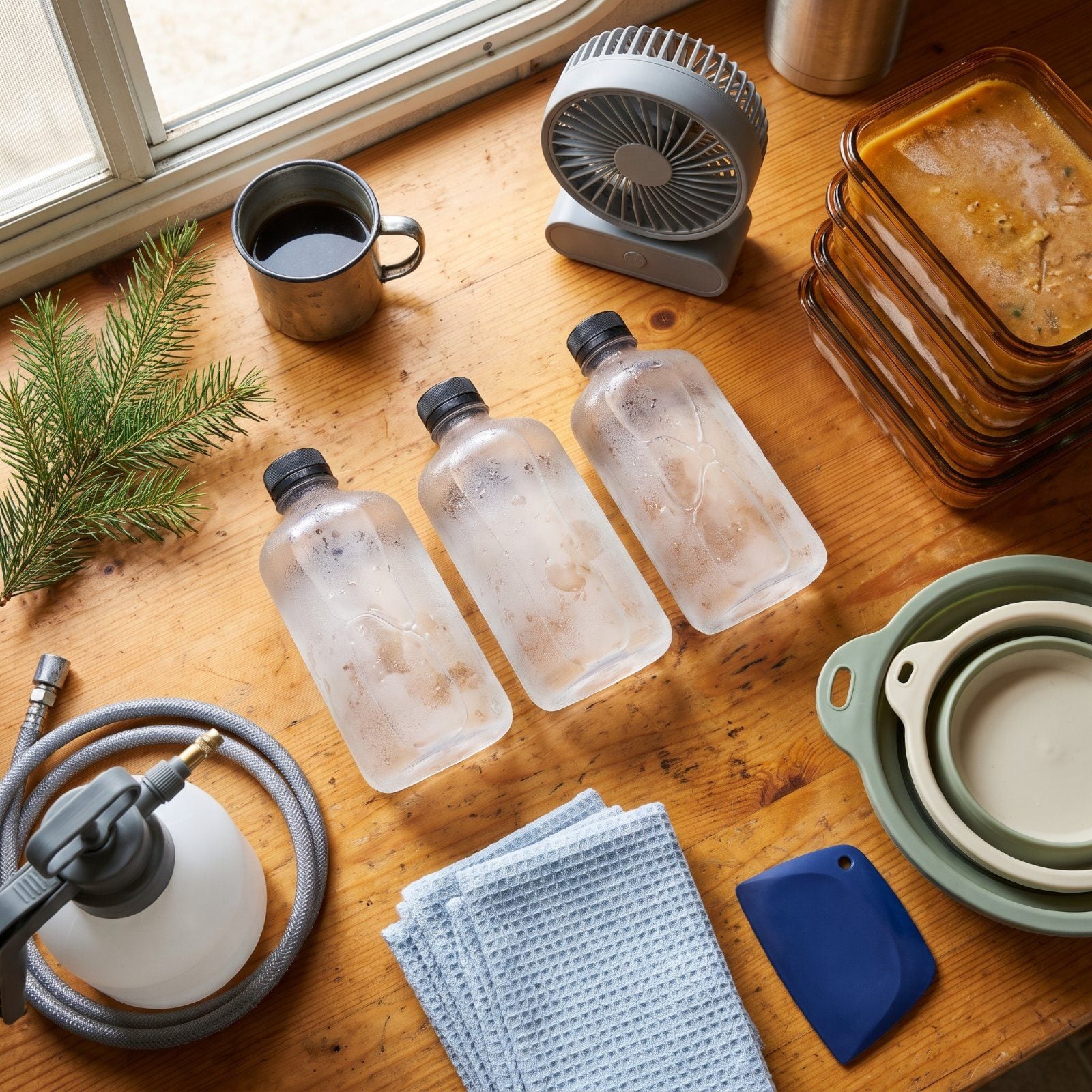
Day three off-grid is where the cracks show. The battery’s at 60 percent by breakfast, the fresh tank sounds hollow when you knock on it, and the fridge is doing that thing where the beer went warm but the lettuce froze. Seven days without a hookup isn’t about buying a bigger everything. It’s the small moves that pile up on each other. A frozen water bottle earning its keep as cold storage. A dishpan that quietly saves you four gallons a day. We learned most of these the hard way, usually after running out of something at the worst possible moment. Here’s what actually works.
Please note that some of the images in this article were created with the assistance of AI.
30. Freeze Flat-Sided Water Bottles as Free Fridge Thermal Mass
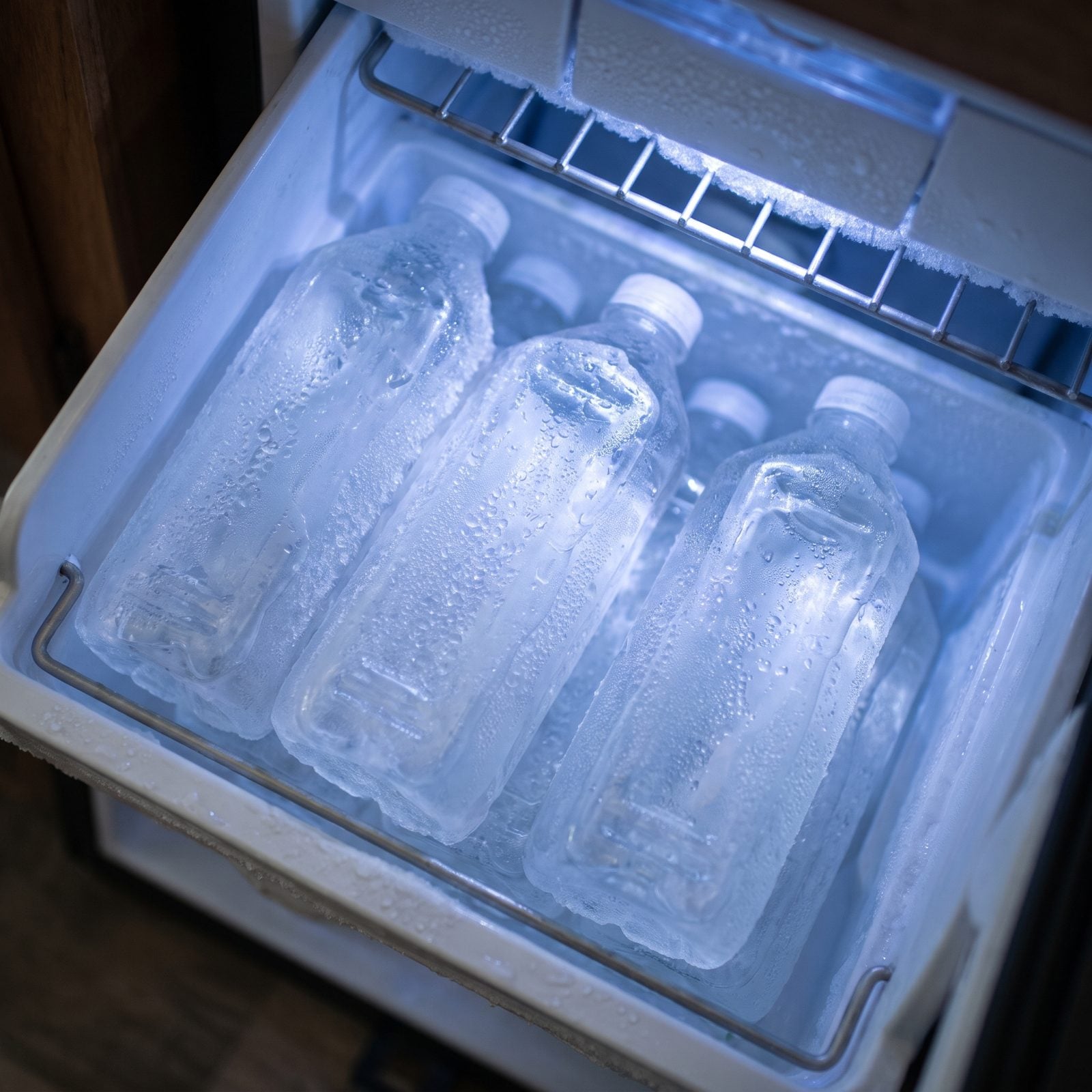
A fridge that’s half empty works twice as hard. Every time the compressor kicks on to cool that warm air, it drinks amps you can’t spare off-grid.
So fill the gaps with flat-sided bottles of drinking water, frozen solid before you leave the driveway. They hold the cold between cycles, which means the compressor runs less and your battery lasts longer. As they thaw you drink them. Cold storage that turns into your water supply. I use the flat rectangular kind because the round ones roll around and waste space.
29. Clip a Battery Fan to the Bottom Fridge Shelf
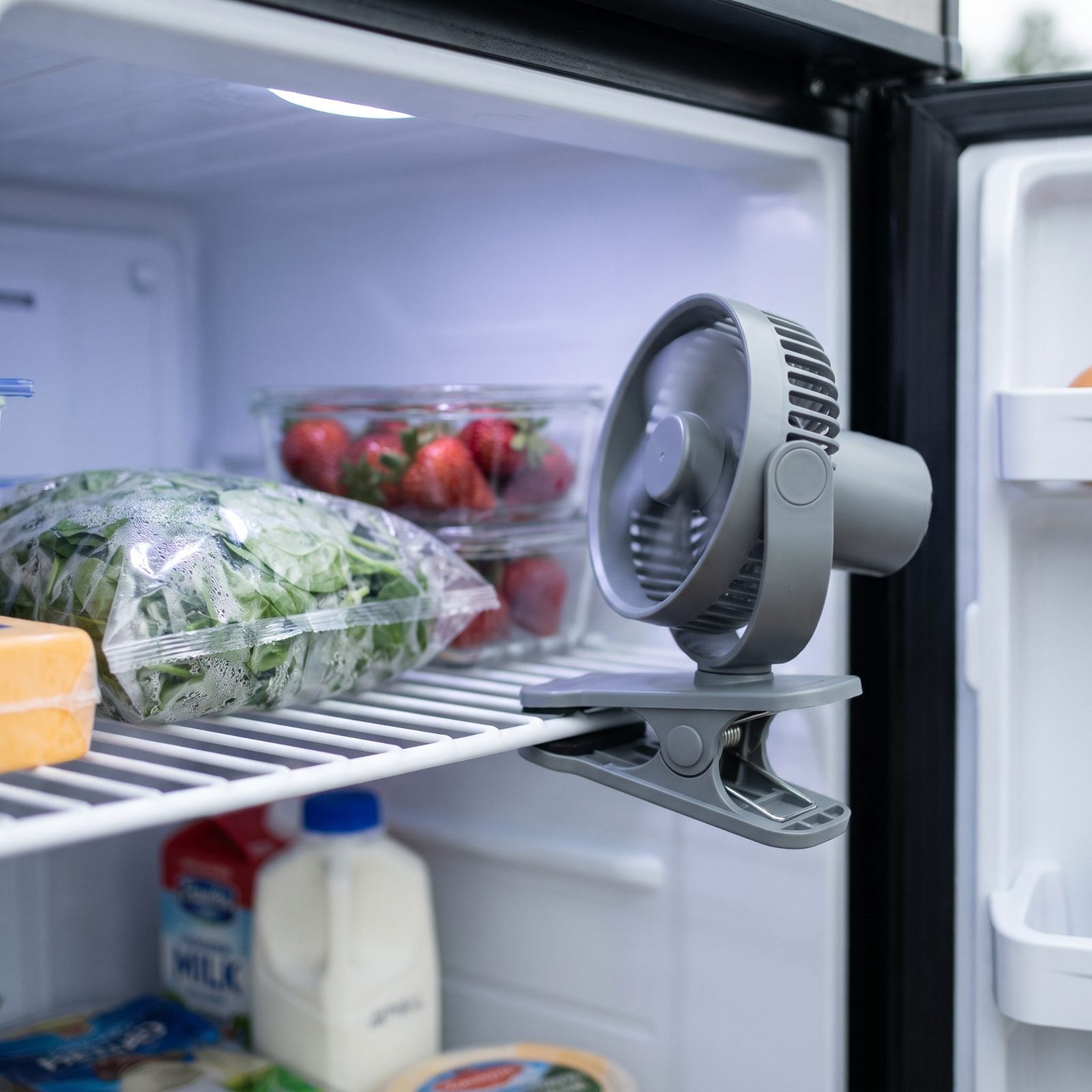
Cold air sinks. In an RV fridge that means the bottom shelf runs frigid and the top shelf runs warm, so your eggs are fine while the butter sweats.
A little battery fan on the bottom shelf, blowing sideways across the compartment, stirs the air and evens the temperature top to bottom. The fridge reaches your set temp faster and holds it with fewer compressor cycles. It runs on a couple of AA batteries for weeks. Cheap, nearly silent, and it fixes the one thing every RV fridge gets wrong.
28. Keep Drinks in a Separate Cooler So the Fridge Door Stays Shut
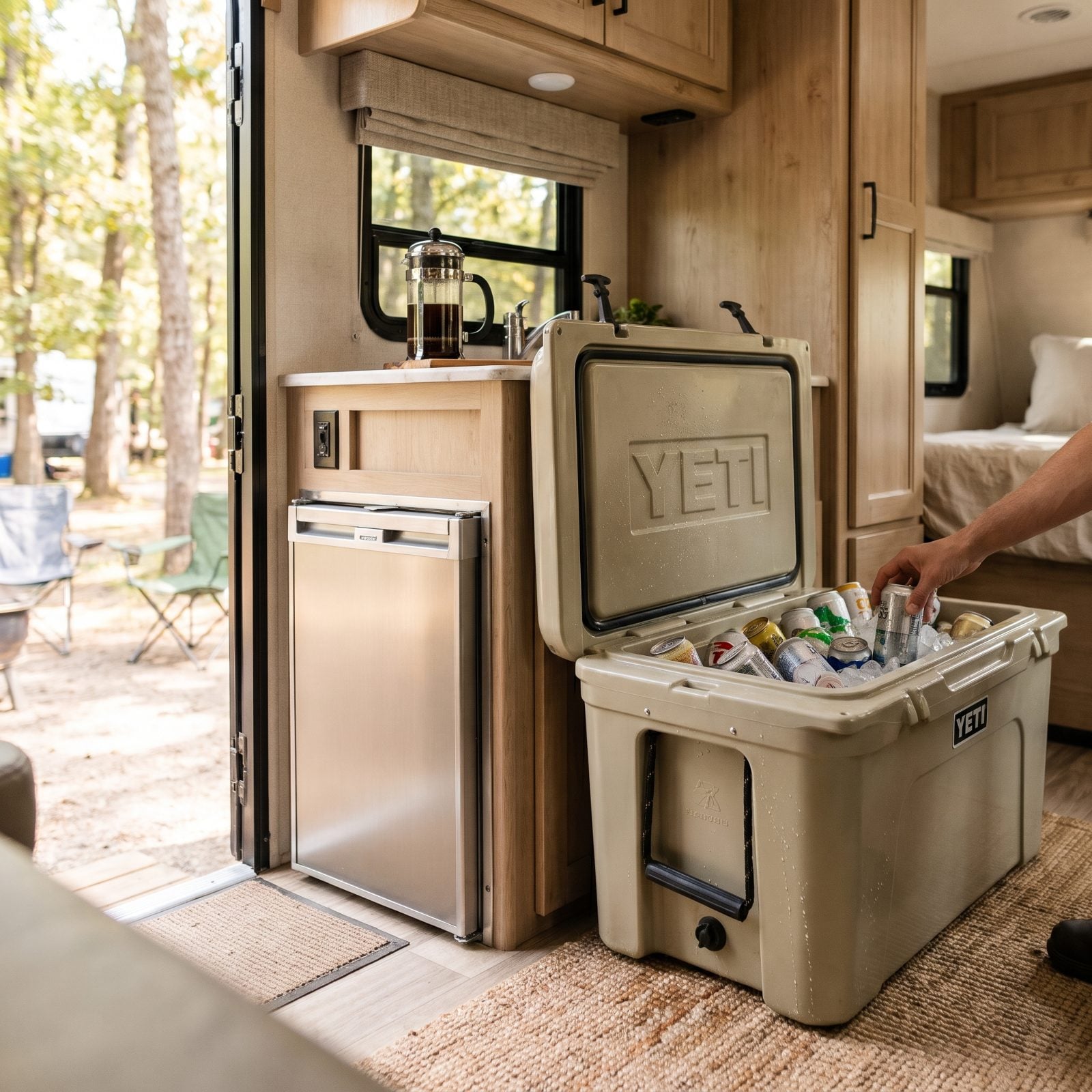
Count how many times a day someone opens the fridge just for a cold drink. It’s a lot. Every open dumps cold air and makes the compressor work.
Give the beer, soda, and water their own cooler outside the door. The fridge gets opened far less, so it holds temperature with less power. A cooler doesn’t care how often it’s opened, because ice is forgiving in a way a 12-volt compressor never is. Toss in your frozen soup bricks or a block of ice and it’ll stay cold most of the week.
27. Open the Fridge Once, From a Written Meal List
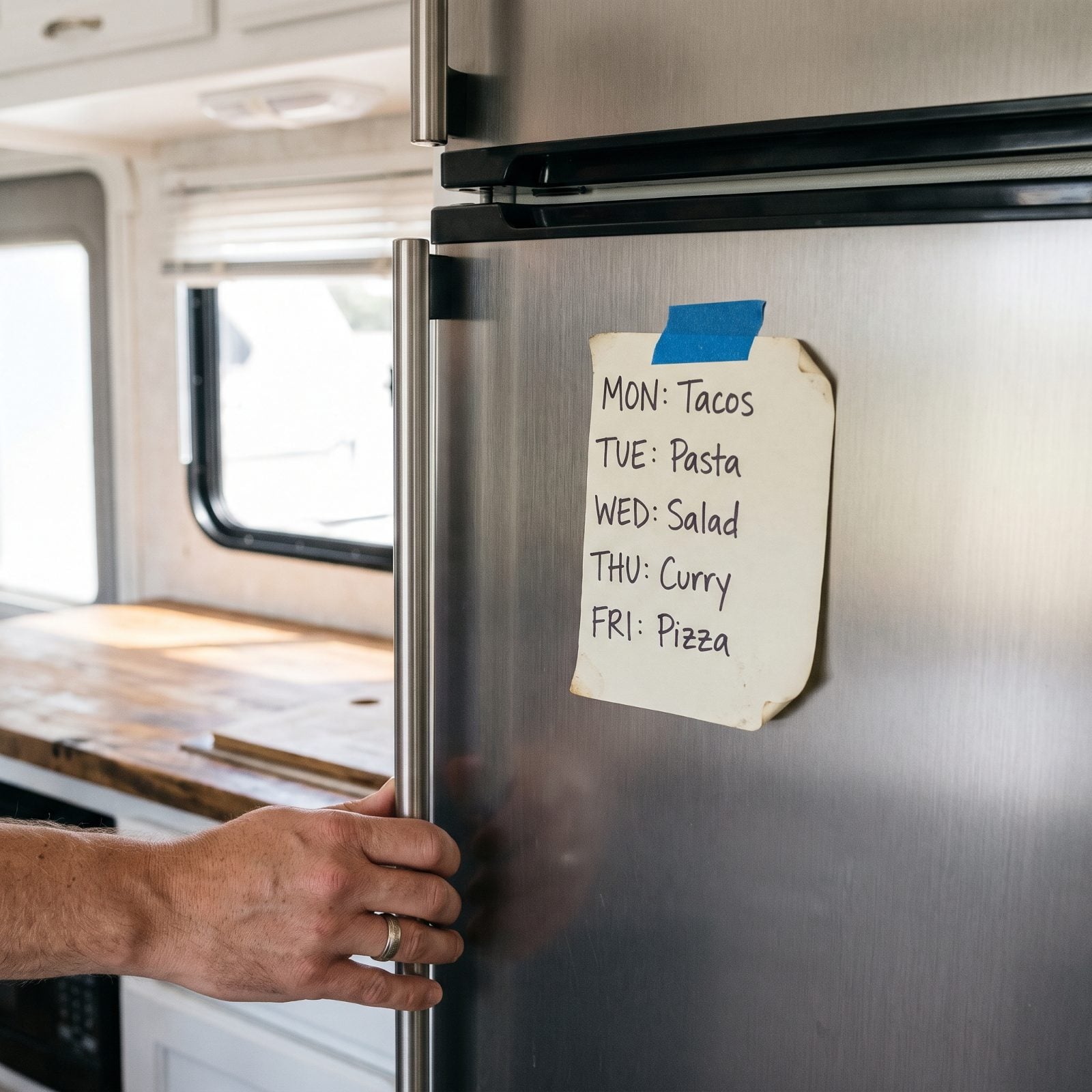
The worst thing you can do to an off-grid fridge is stand there holding the door open deciding what to eat. Twenty seconds of indecision costs you real power over a week.
Write the week’s meals on a sticky note on the door. You walk up knowing exactly what to grab, open once, pull it all, and close. Grab-and-go instead of browse-and-ponder.
Sounds almost too simple to bother with. Then you realize how many times a day the whole family cracks that door just to look. This stops it cold.
As an industrial equipment designer puts it, “Standing and browsing the contents of an open fridge for a long time wastes energy. Limit the amount of time that your fridge’s doors are open.”
26. Catch the Shower Warm-Up Water in a Bucket for Dishes
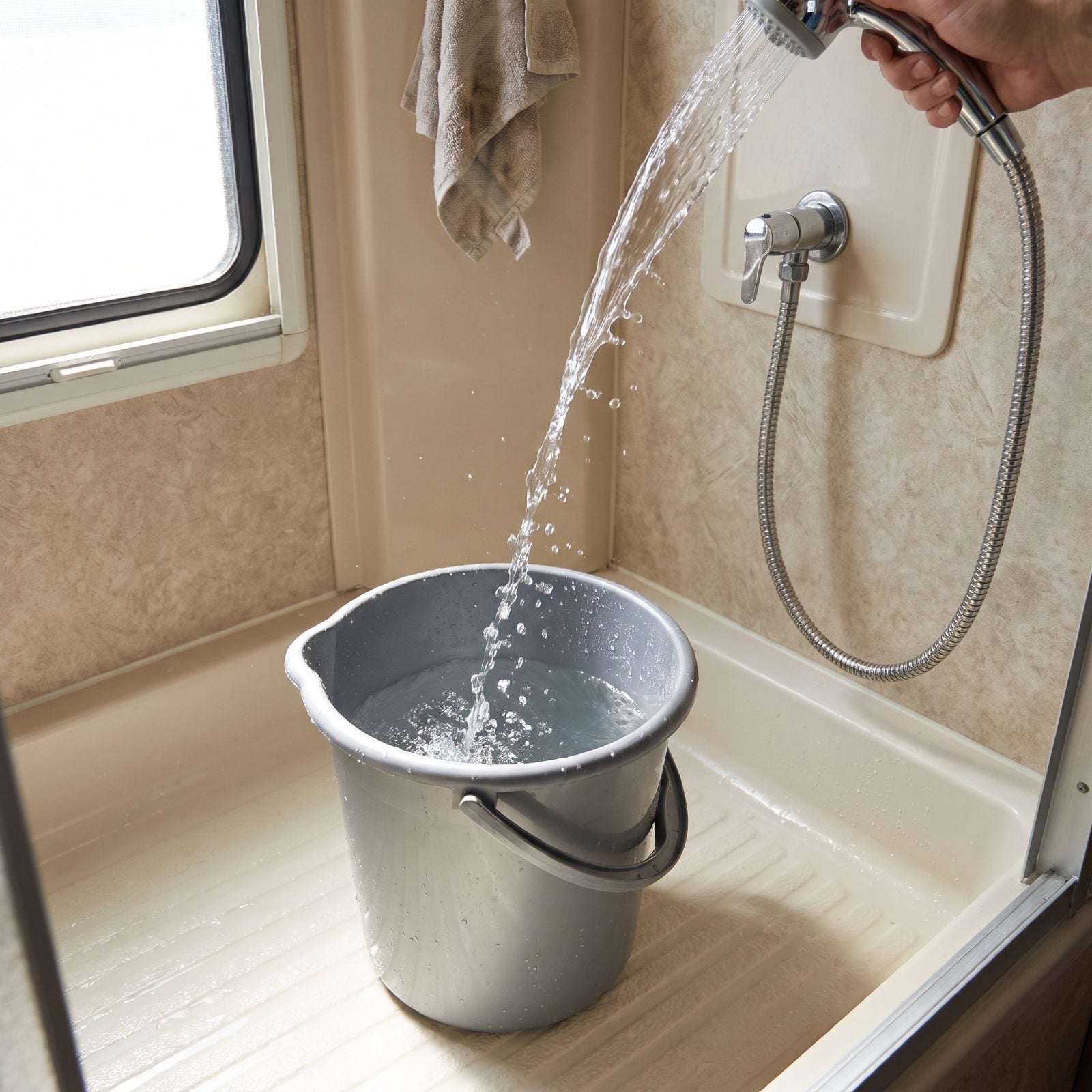
Every shower starts with a run of cold water you let swirl down the drain while you wait for warm. In a stick house that’s a nuisance. Off-grid it’s a gallon of fresh water and a gallon of grey tank gone for nothing.
Stick a metal pail under the showerhead during the warm-up. Catch that clean water and use it to wash dishes or flush the toilet. You’ve stretched the fresh tank and delayed filling the grey tank in one move. Over seven days that’s gallons you didn’t have to haul.
Making a 55-gallon fresh tank last, a couple who boondock regularly suggest reusing that first cold burst: “For instance, the water coming out of the shower head until it warms can be collected and used for dishes.”
25. Use No-Rinse Bathing Cloths on the In-Between Days
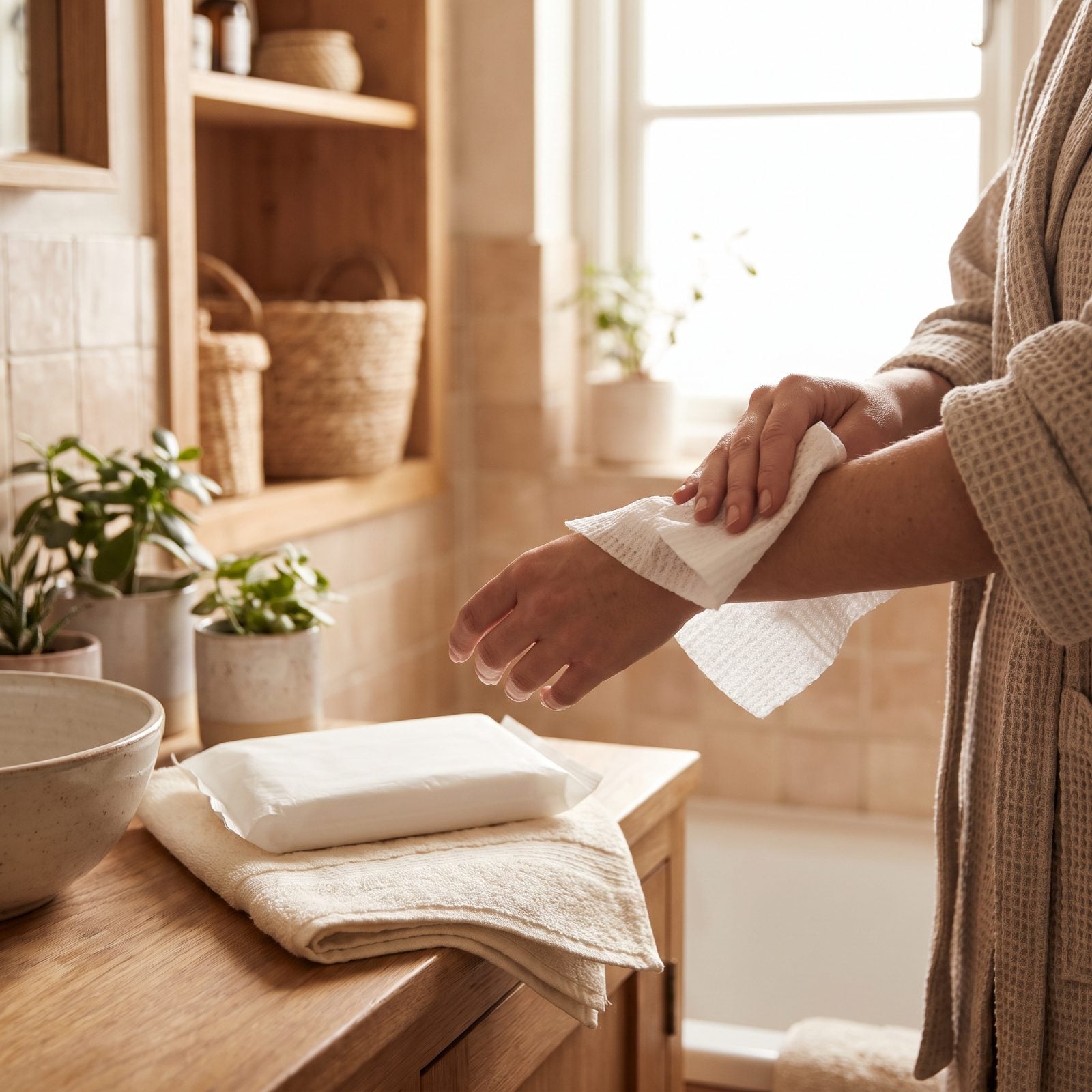
A full shower in an RV can burn several gallons of fresh water and dump the same into the grey tank. Do that daily for a week and you’re hauling water on day four.
You don’t need a full shower every day. No-rinse bathing cloths, the big thick ones made for campers and hospitals, get you clean with zero water. Shower on day one and day four, use cloths in between, and you’ve cut your shower water use by more than half. Nobody mentions how much tank space your showers eat until the grey light starts blinking.
24. Wash in Two Dishpans Instead of Filling the Whole Sink
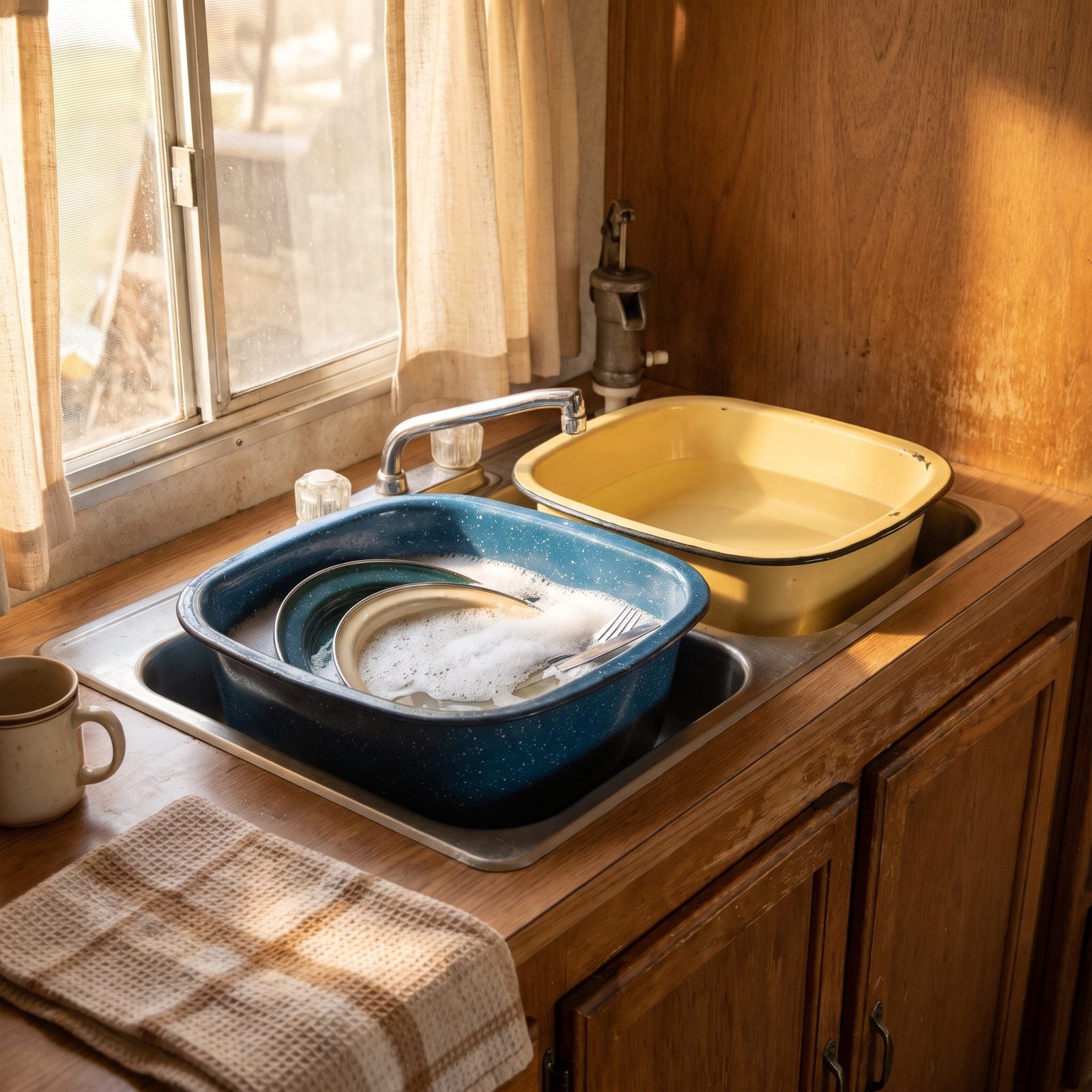
Fill an RV sink to wash and you’ve committed gallons to a job that needs pints. Then all of it runs straight to the grey tank.
Two small dishpans fix it. One holds a shallow pool of soapy water, the other a shallow rinse. You wash in the first, dunk in the second, done. The water you use is measured in cups, not gallons, and you control exactly how much grey you make. Collapsible silicone pans fold flat when you’re done, which matters when every cabinet inch is spoken for.
A veteran Class B RVer washes dishes in a flat-bottomed basin set in the sink, then dumps the wash water and puts rinse water in the same basin, and says a meal’s dishes for two take about a gallon. (via a veteran Class B RVer)
23. Scrape Pans Clean With a Silicone Scraper Before They See Water
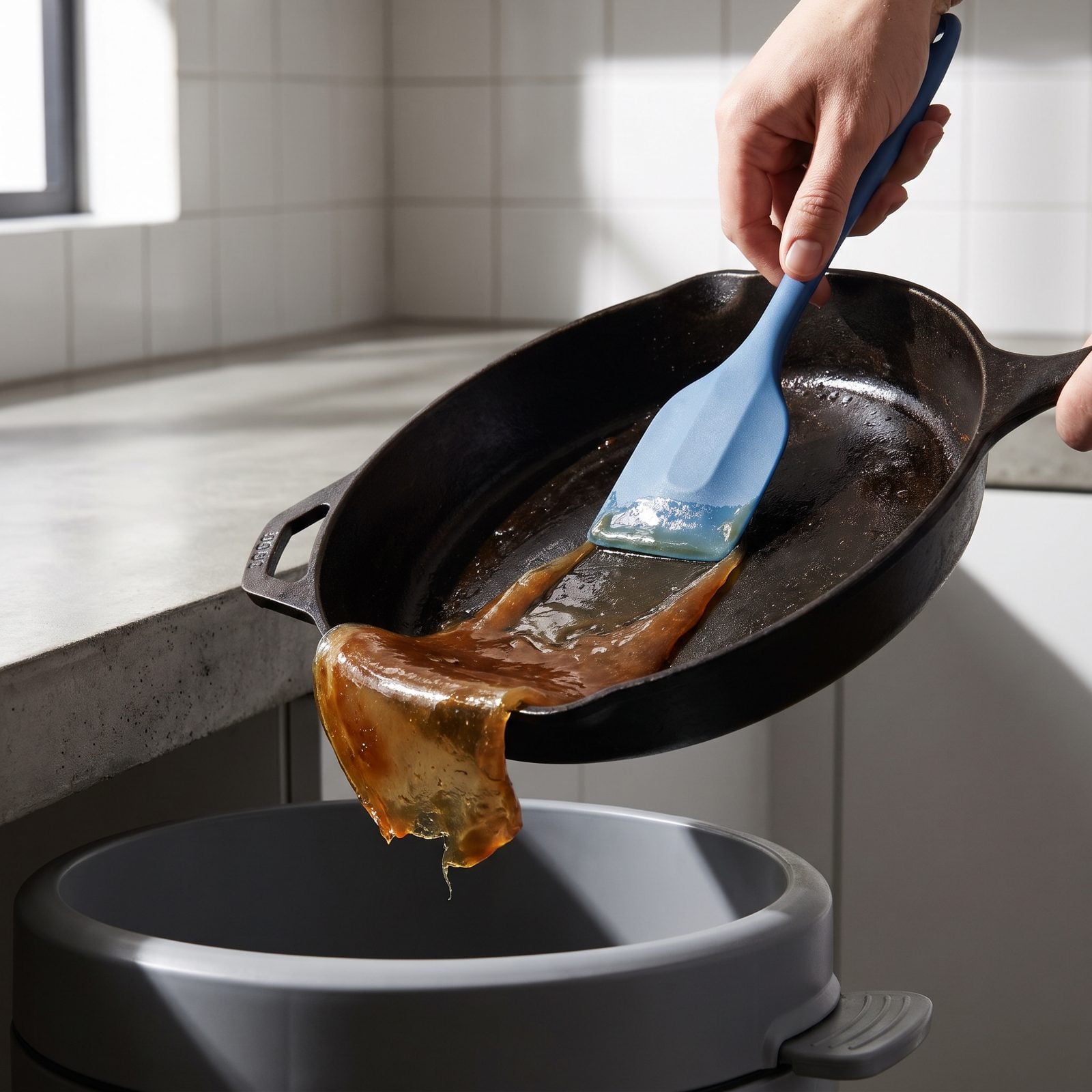
Grease is the enemy off-grid. Rinse a greasy pan and you’ve used water to turn solid mess into a filmy grey-tank problem, and the pan still isn’t clean.
Scrape first. A flexible silicone scraper lifts nearly everything into the trash while it’s dry: sauce, stuck rice, bacon fat, the lot. What’s left is a quick wipe instead of a scrub, which means a fraction of the water and no fat coating the inside of your grey tank. I keep a cheap one hanging by the stove and it earns its keep every single meal.
Do this and your tank stays sweeter longer. That alone can buy you an extra day or two before you have to pack up and dump.
22. Cook Pasta the Absorption Way and Skip the Drain Entirely
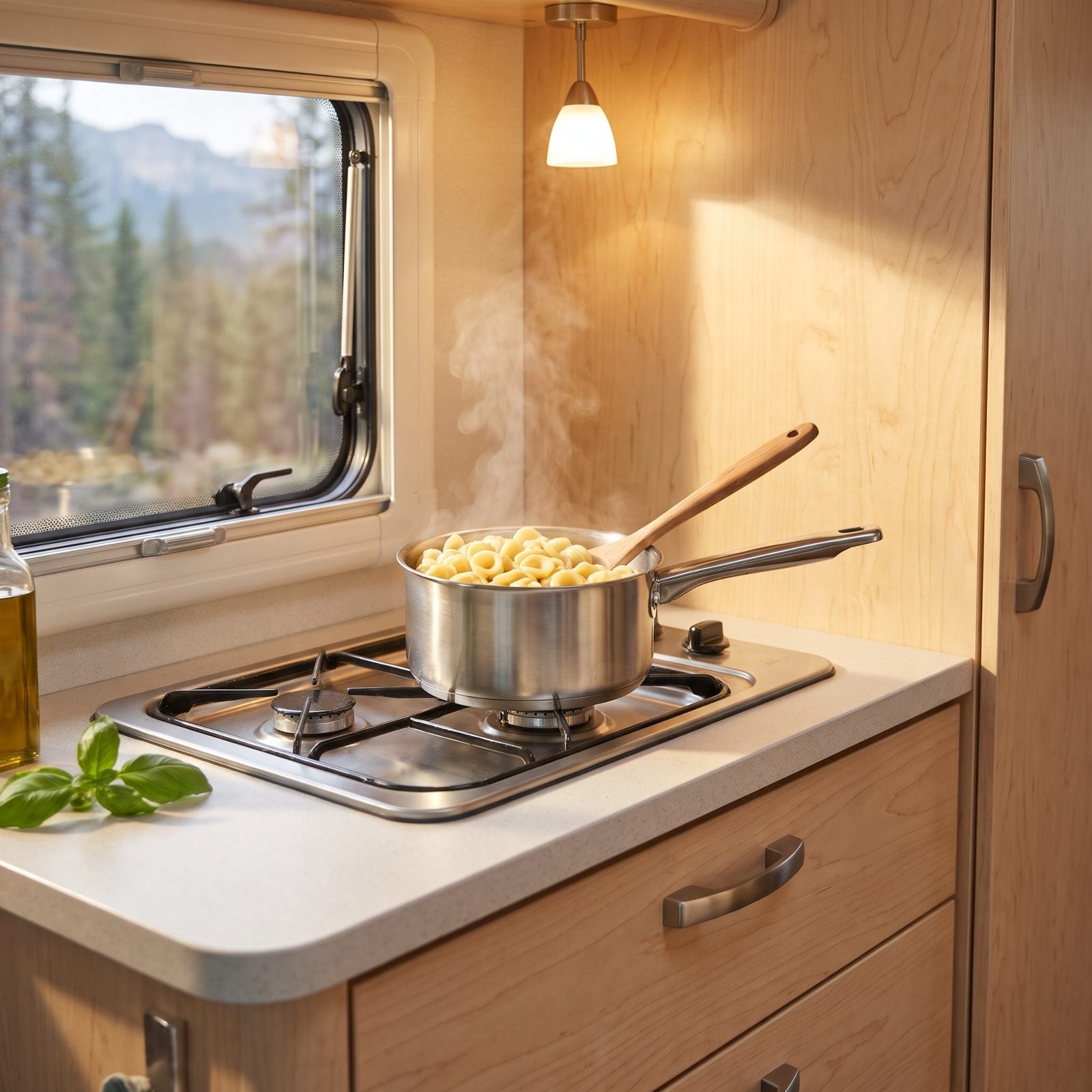
You don’t need a rolling gallon of water to cook pasta. That’s a restaurant habit that followed you into a fresh tank where it has no business being.
Use just enough water to cover the noodles, a little under two cups per serving, and simmer until the water’s almost gone. The pasta drinks it. Nothing to drain, nothing to dump, and the starchy film left behind clings to sauce beautifully.
Stir more than you think you need to, because low water means more chances for a stuck, scorched clump on the bottom. Keep the heat gentle and your spoon moving.
21. Steam Your Vegetables in a Basket Over the Pasta Pot
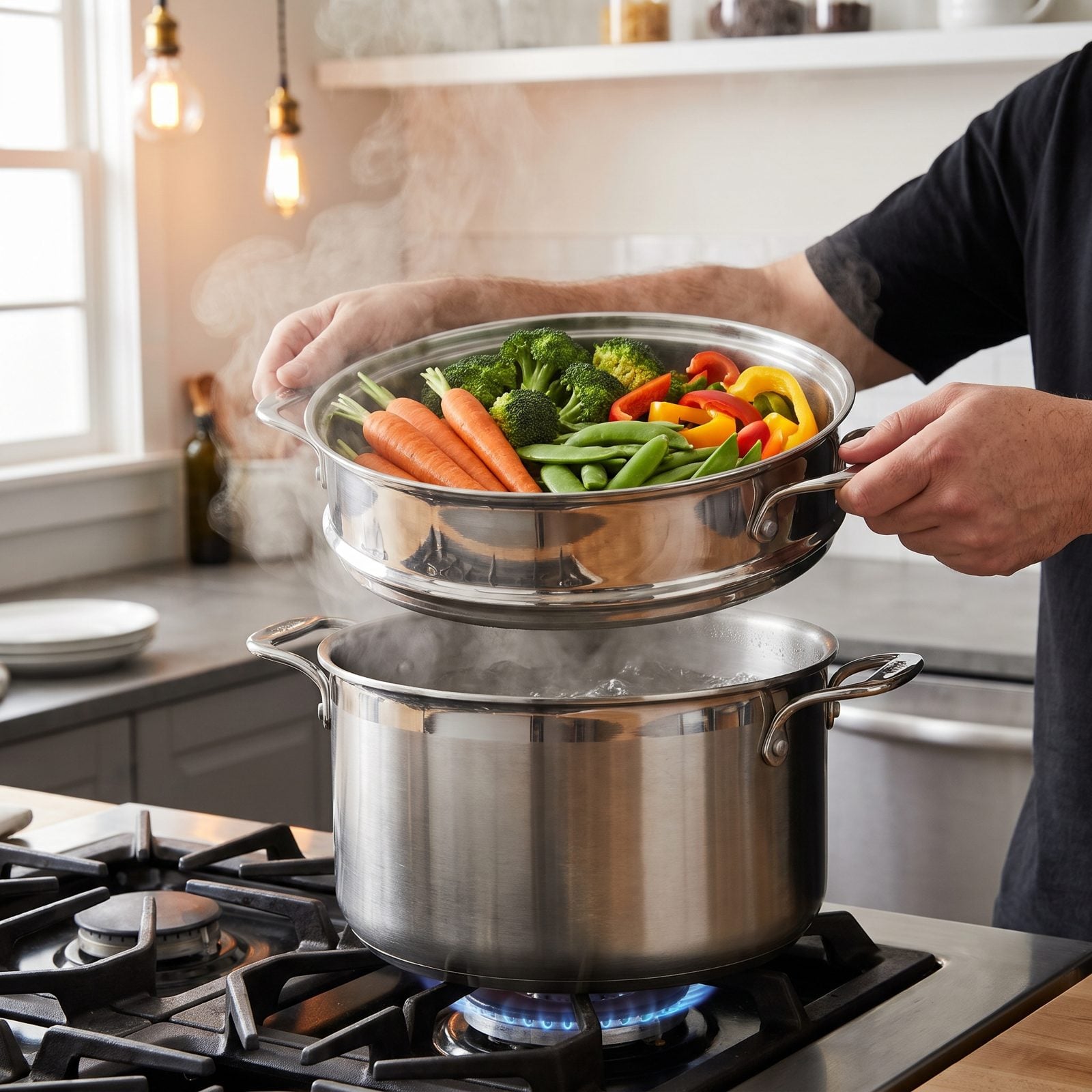
One pot, one burner, two foods. While something boils below, a steamer basket turns that same rising heat into dinner’s vegetables.
You skip a second pan and a second batch of water to heat. The vegetables come out brighter than boiled ones, too, because they never sit soaking in the water. Stack a lid on top and a full basket cooks in the time your rice or pasta needs underneath.
20. Serve Lunch in Tortilla Bowls You Can Actually Eat

The bowl you eat is the bowl you never wash.
Press a flour tortilla into an oven-safe dish or drape it over an upturned mug, crisp it in a toaster oven or dry skillet, and you’ve got a sturdy vessel for taco rice, chili, or a grain bowl. When lunch is done, the bowl is gone. Set it on a plate to catch crumbs and drips, and that plate needs only a quick wipe instead of a scrub.
It feels like a kid’s trick until day five off-grid, when every dish you barely dirty is a small, quiet win. Soft tortillas work for wraps on the move, but the crisped bowl is the one that saves your tank.
19. Line Up Seven Water Tokens by the Faucet, One for Each Day
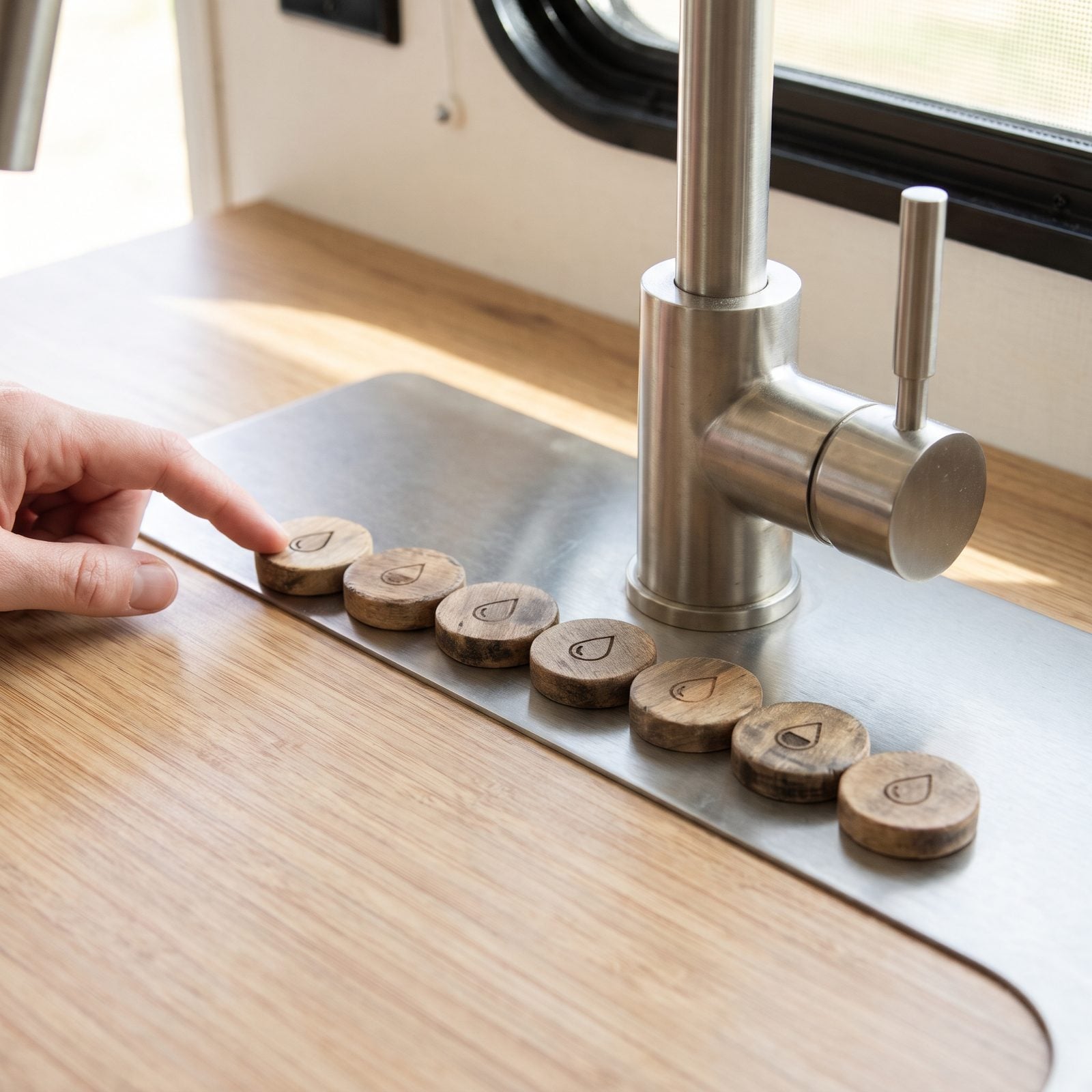
Water runs out quietly. You feel fine on day three, then day six arrives and the pump sputters and you realize you were careless the whole time.
So make it visible. Count your fresh tank into daily rations and set out a small token for each day, seven pebbles, seven poker chips, whatever’s handy. Move one aside each morning. That row shrinking in front of your eyes does more than any mental math ever will.
18. Hang a Gravity Water Jug Outside for Hands and Dishes
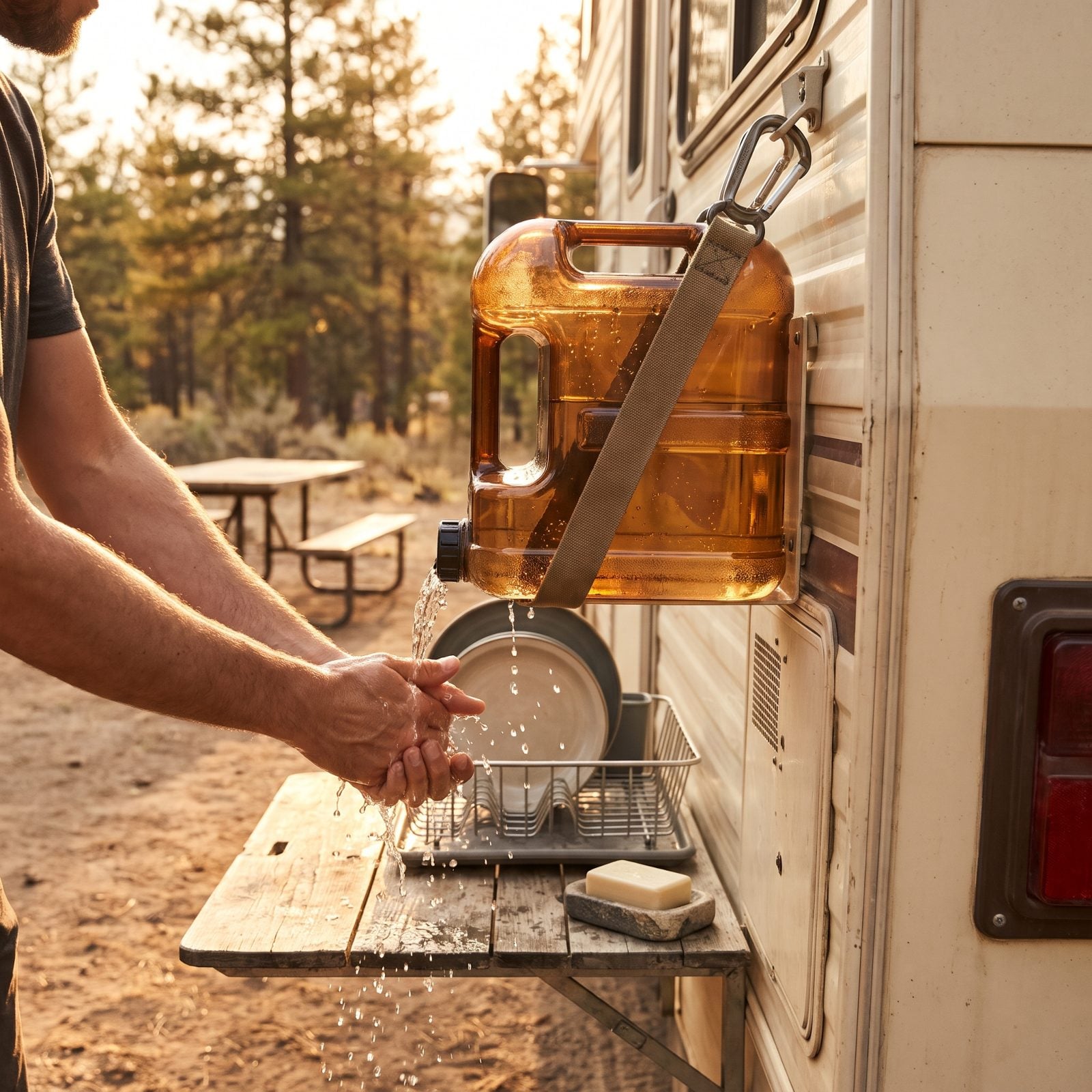
Your RV faucet pulls from the tank you’re trying to protect. A jug with a spigot sitting outside doesn’t.
Fill a five or seven gallon container at the source before you arrive and keep it on your camp table for handwashing, dish rinsing, and topping off the kettle. A thin trickle from a spigot uses a fraction of what a pressurized indoor tap does, because you can’t blast it the way you mindlessly do inside.
It keeps grime and the smell of soap out of the galley, too. And honestly? Washing up outside in the pines beats hunching over the little sink any day of the week.
17. Reuse Captured Gray Water for Flushing, Where Rules Allow
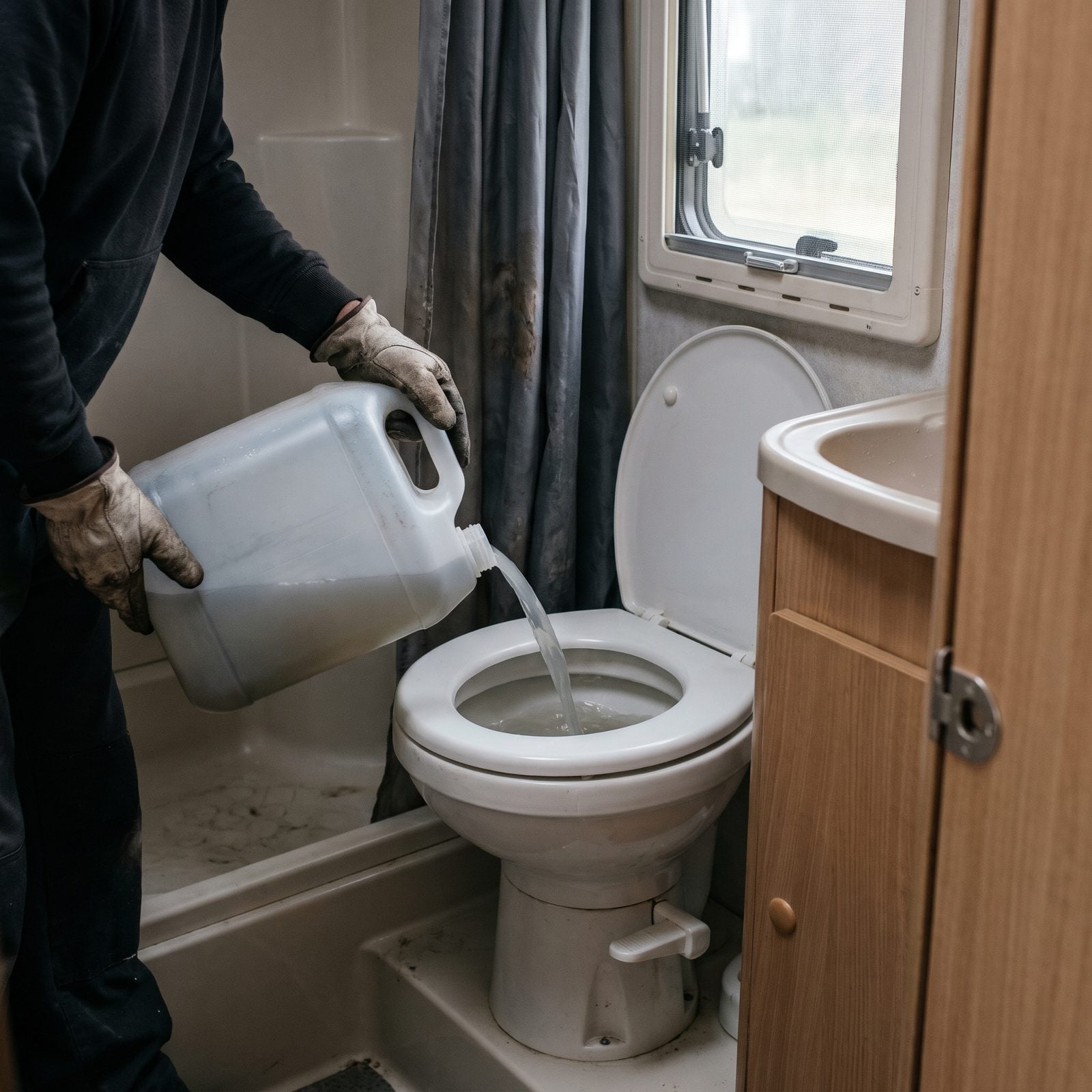
The water you used to rinse a plate is clean enough to flush a toilet, and flushing with it pulls nothing extra from your fresh tank.
Catch your dishwater in a basin, skim out any food bits, and pour it into the bowl instead of hitting the flush lever. One good rinse covers a flush or two.
Check your park’s rules first, since some campgrounds and most dispersed sites have specific requirements, and never do this with water carrying grease or chemicals. Plain soapy rinse water only.
16. Kill the Water Pump Switch Before You Climb Into Bed
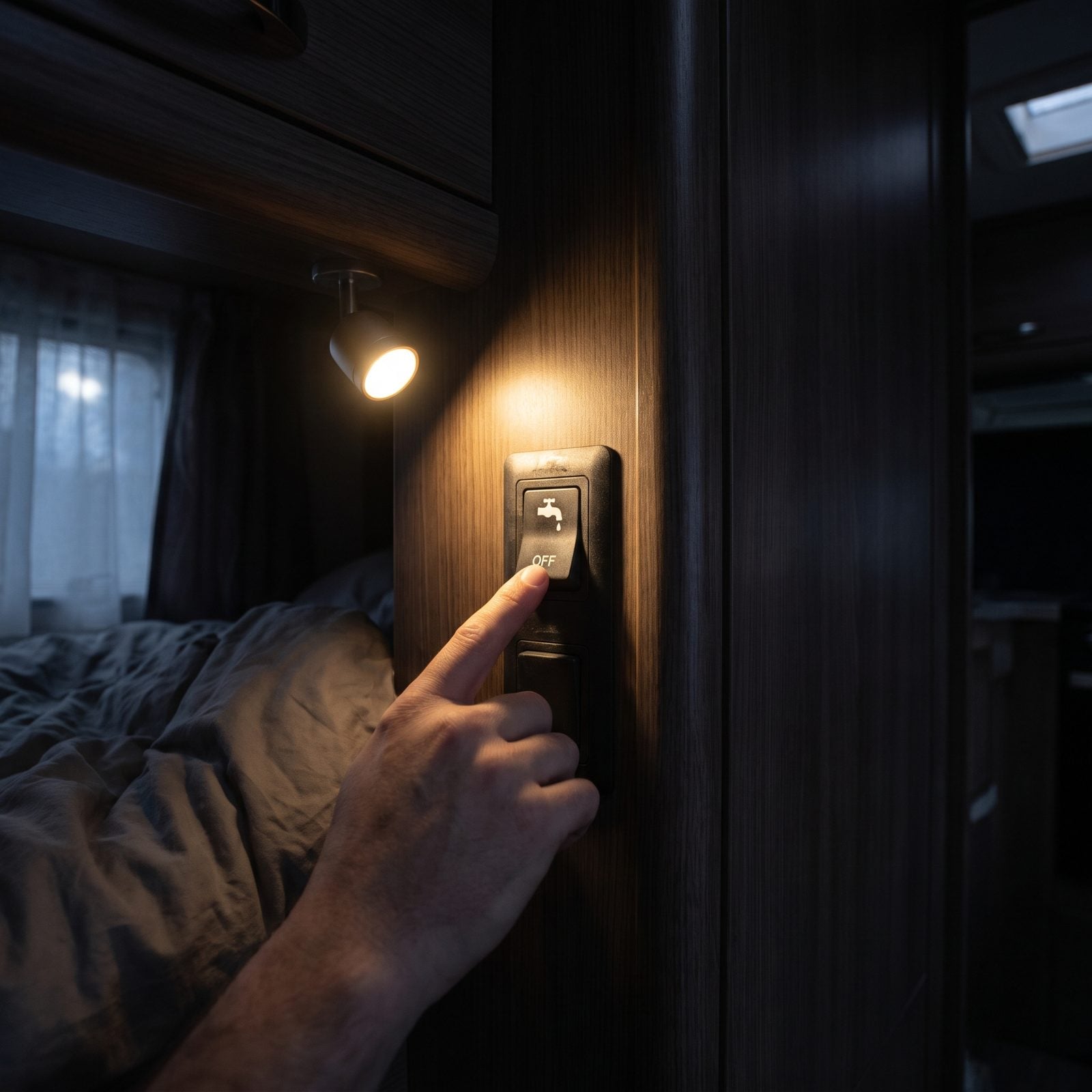
Pressurized water lines are always holding back. A fitting under the sink loosens, a toilet valve weeps, and the pump keeps re-pressurizing all night to replace what’s leaking out. You wake up to a lower tank and a wet floor.
Flip the pump switch off before bed. The lines depressurize, a small leak can’t drain your tank, and nothing cycles on at 3 a.m. to startle you awake.
You lose nothing. Nobody’s doing dishes at midnight. Two seconds, and it saves you the one scenario nobody wants on day five with no hookup in sight.
15. Tuck a Battery Leak Alarm Right Under the Water Pump
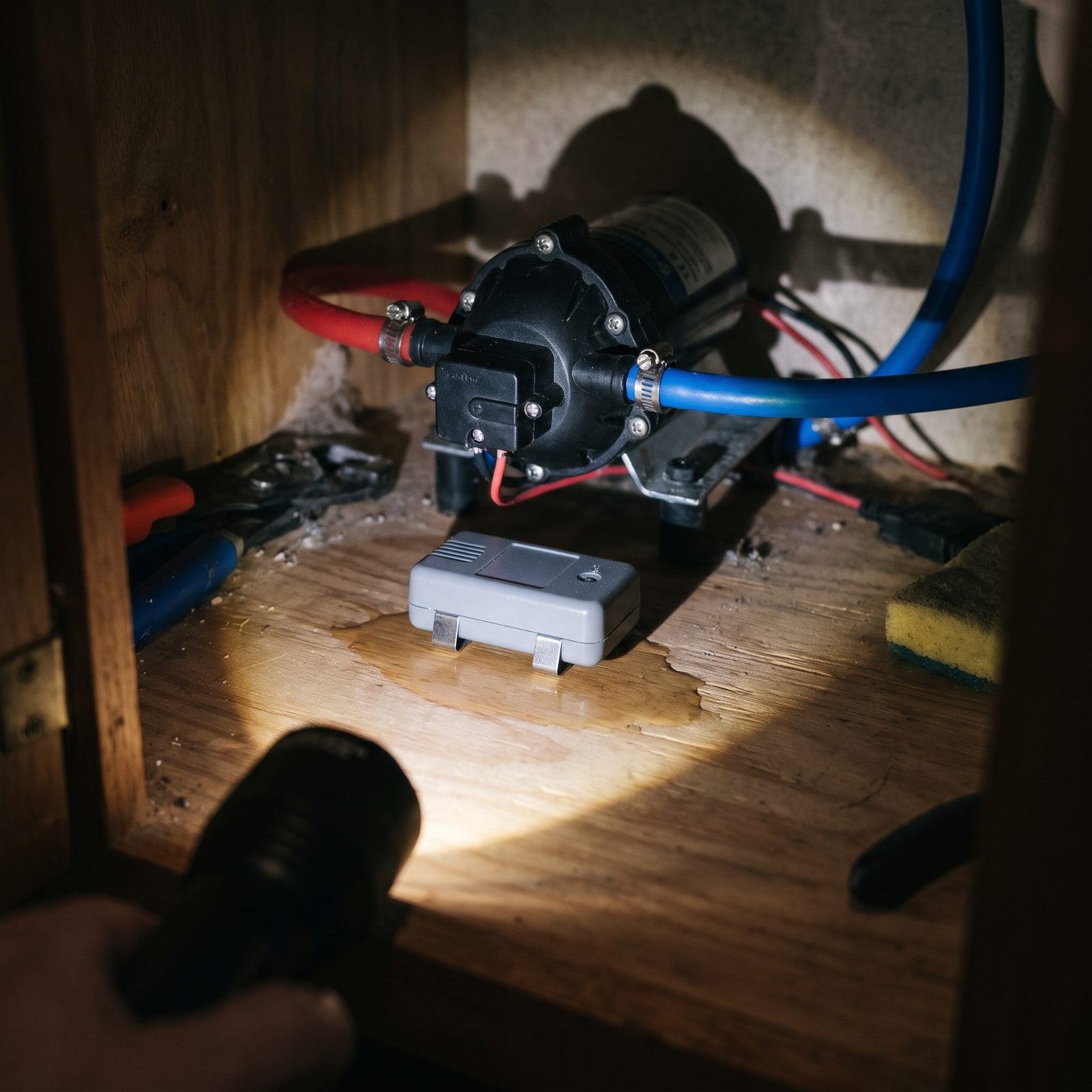
The pump is where the leaks start, and the one place you never look.
Drop a cheap battery leak alarm, the kind people put under water heaters, flat on the floor beneath your pump and fittings. It runs cheap and screams the moment the first drops touch it.
Off-grid, a slow leak is a double disaster. It drains the fresh water you rationed, and it soaks subfloor you can’t easily dry out. Catch it at drop one instead of puddle fifty, and test the alarm at home first, not on night three in the backcountry.
14. Trade Your Broom for a Rubber Squeegee on Hard Floors
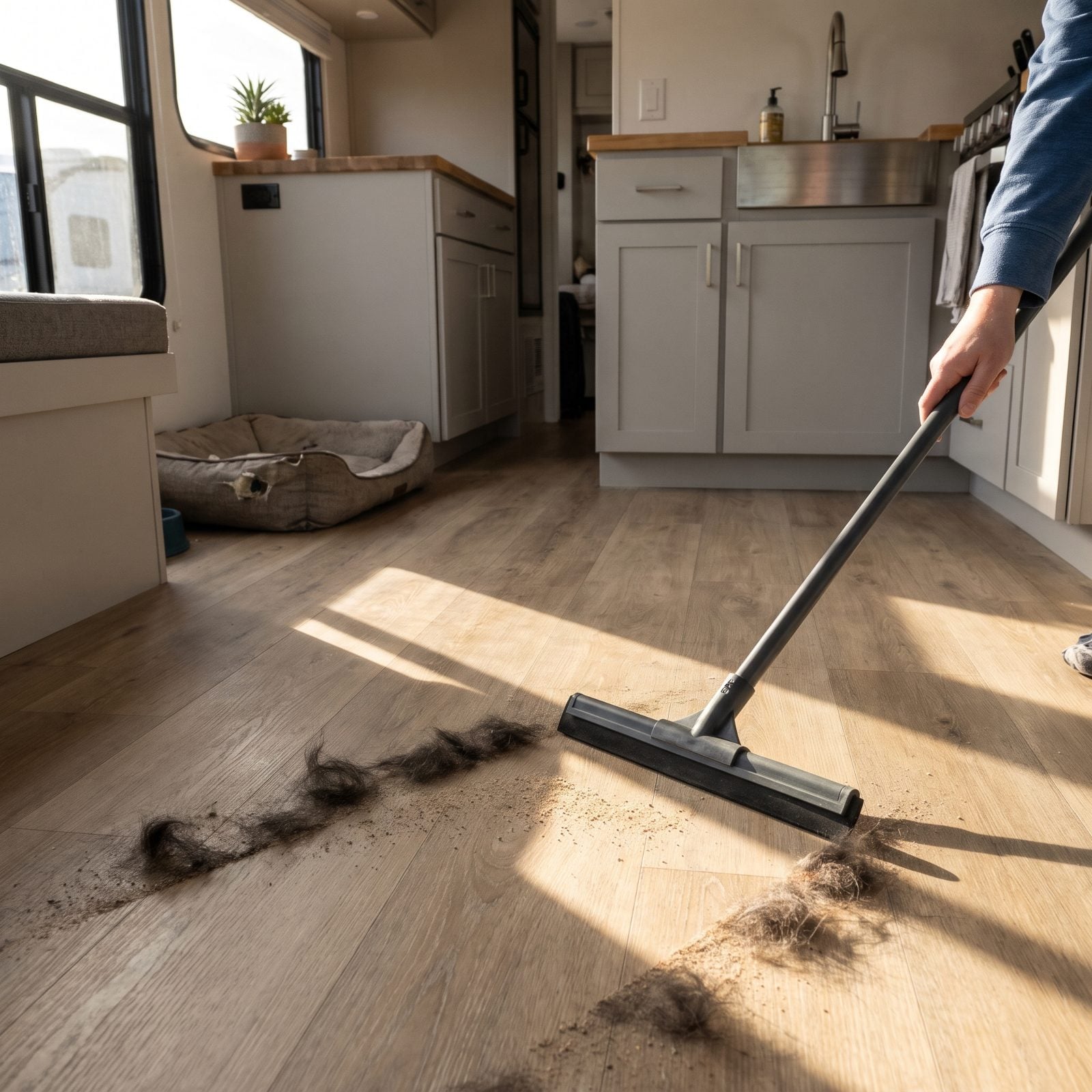
A squeegee moves dirt a broom can’t touch. The rubber blade grabs fine sand, dust, and fur and drags it into a neat line instead of flinging half of it back into the air.
In a small rig this matters more than it sounds. A broom scatters, and in a cabin that tight, scattered dust just resettles on your bed and your food. The squeegee corners everything into one tidy ridge you sweep into the pan and dump outside.
No water, no vacuum, no battery drain. The one people use in showers works fine, and it stores flat behind a cabinet door. Small trick, outsized difference by the end of a dusty week.
13. Cool Off at the Dinette With a Wet Bandanna
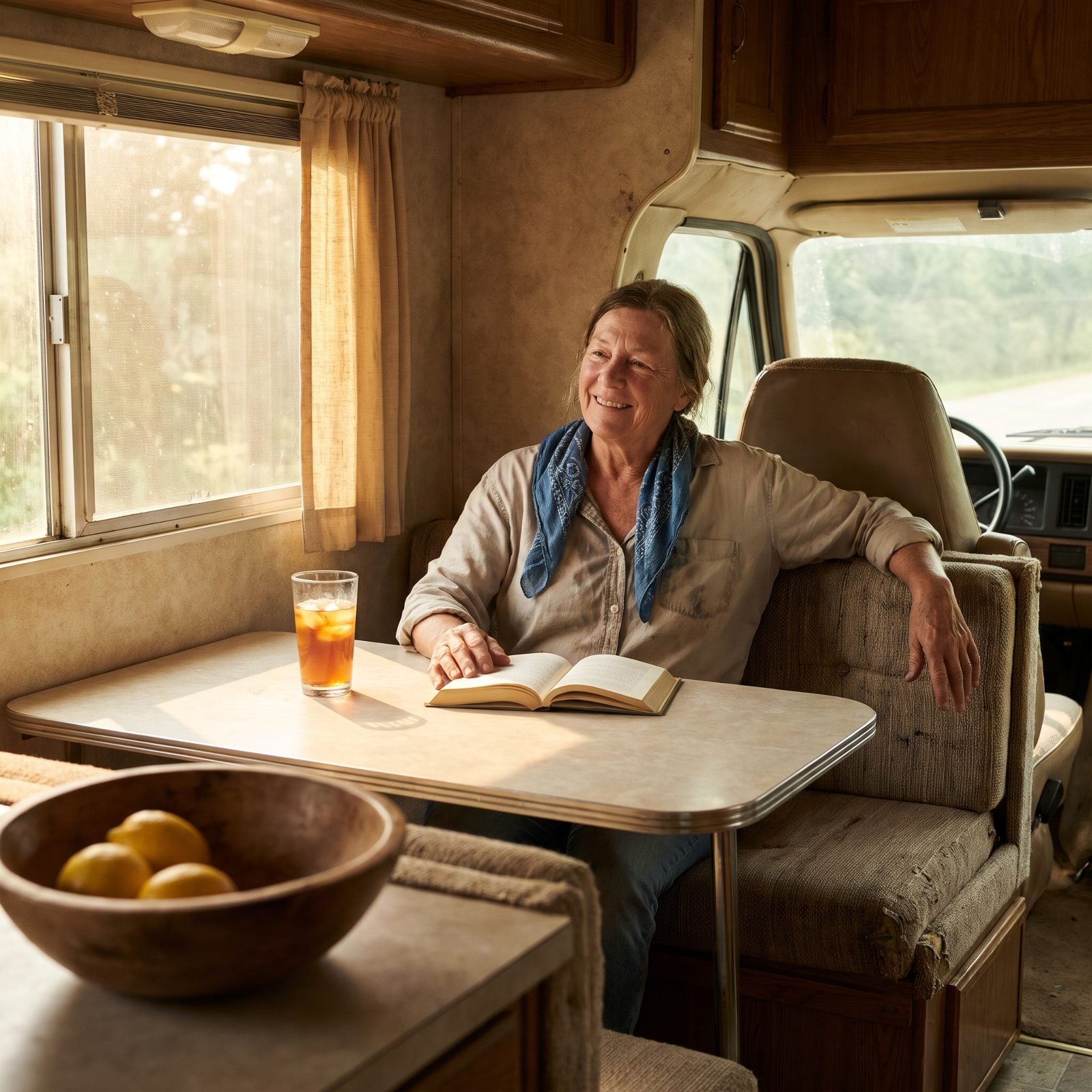
Soak a cotton bandanna, wring it out, and lay it across the back of your neck while you sit. That spot where neck meets skull cools your whole body faster than a fan ever will — it’s the trick trail runners swear by, and it works just as well parked at a dinette with the air conditioning dead.
Costs you nothing but a cup of water. Re-wet it every twenty minutes or so. On a day pushing into the 90s, I’ve kept a rig livable with three bandannas and a bowl of ice water, no generator running.
12. Reflect Morning Sun With Removable Window Panels
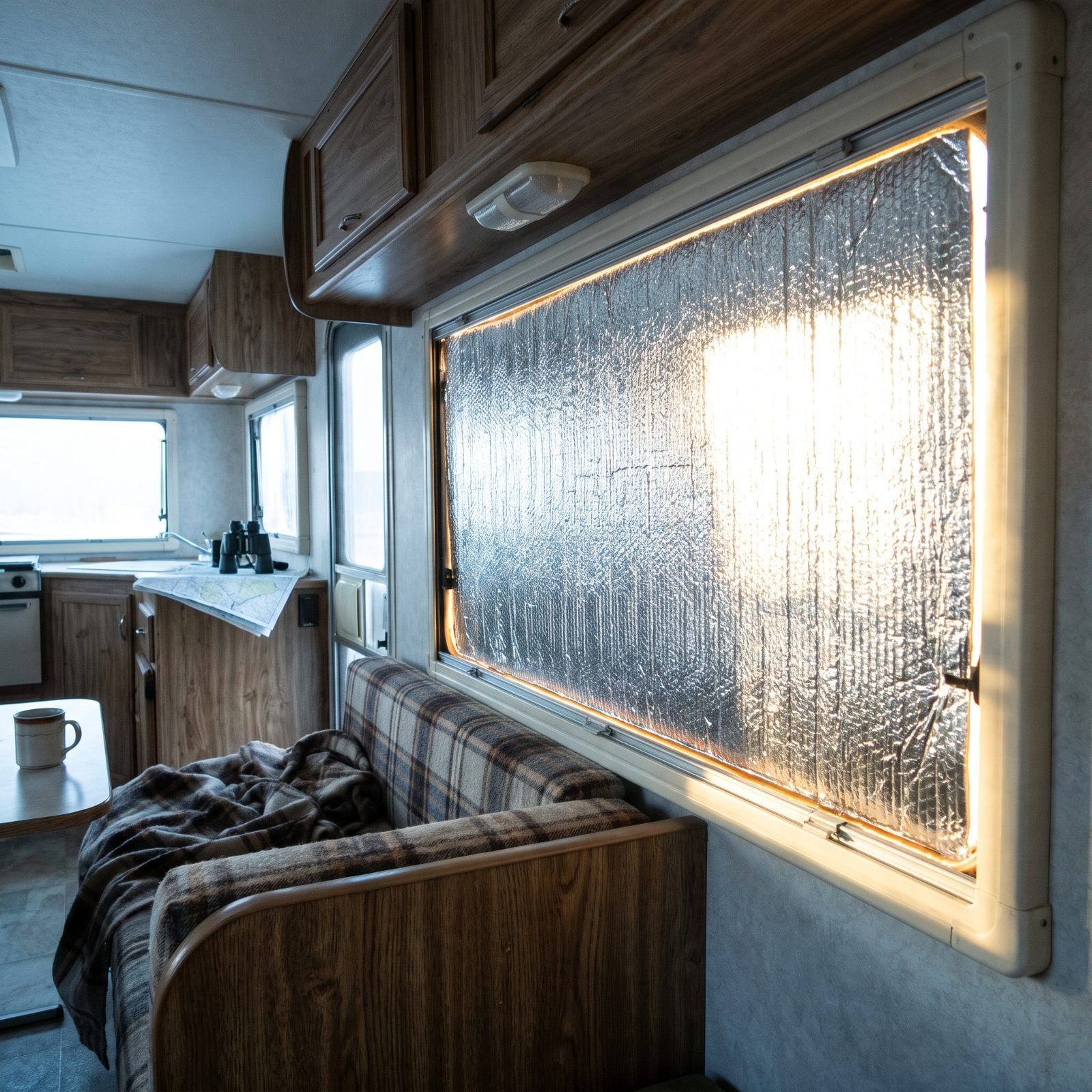
East-facing windows turn an RV into an oven by 7 a.m. Reflective foam panels cut to each window shape, silver side out, knock back much of that heat.
Reflectix runs cheap, and a single roll does most of a small rig. Trace each window onto the foam, cut with a utility knife, friction-fit them into the frame. They pop in and out in seconds and store flat behind the mattress. Windshield panels matter most — that glass is a greenhouse, and a tucked-in panel there drops cabin temperature by mid-morning in a way you’ll feel the second you step back in.
11. Shade the Refrigerator Wall With an Awning
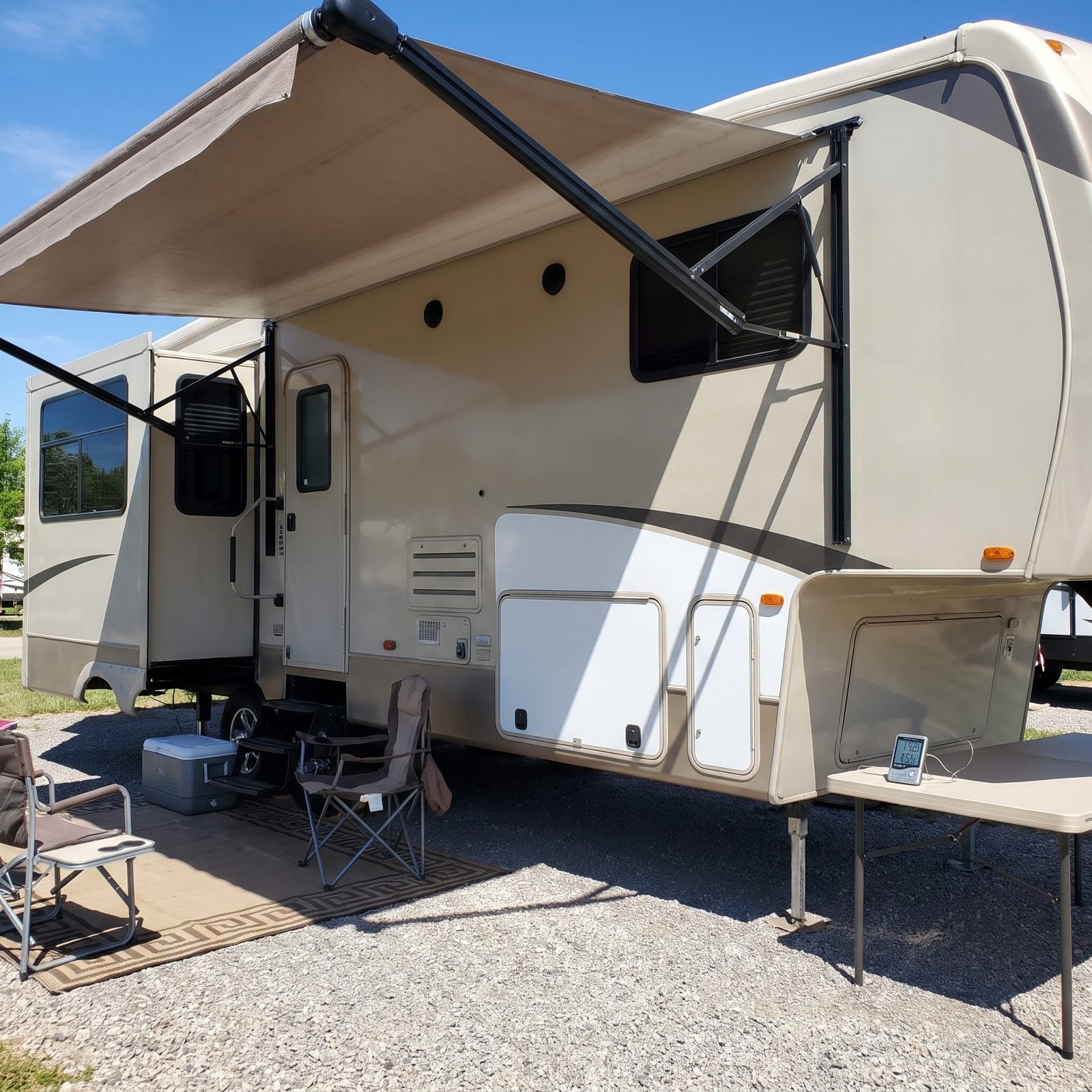
If your RV fridge is an absorption model, it fights to stay cold when the wall behind it bakes in afternoon sun. Park so that wall faces away from the sun. Can’t manage it? Run the awning out over it.
Shade on the vent side makes the cooling cycle work less, which saves propane or battery and keeps your food actually cold. Nobody mentions this until their lettuce wilts on day three and they’re standing there wondering why the fridge can’t keep up. It’s the sun on the wall. Always has been.
For absorption fridges that struggle in the heat, two 20-year full-time RVers advise “Whenever you travel in hot weather, be sure to try to park your RV so that the fridge side is in the shade.”
10. Use Pool Noodles to Seal Skylight Gaps
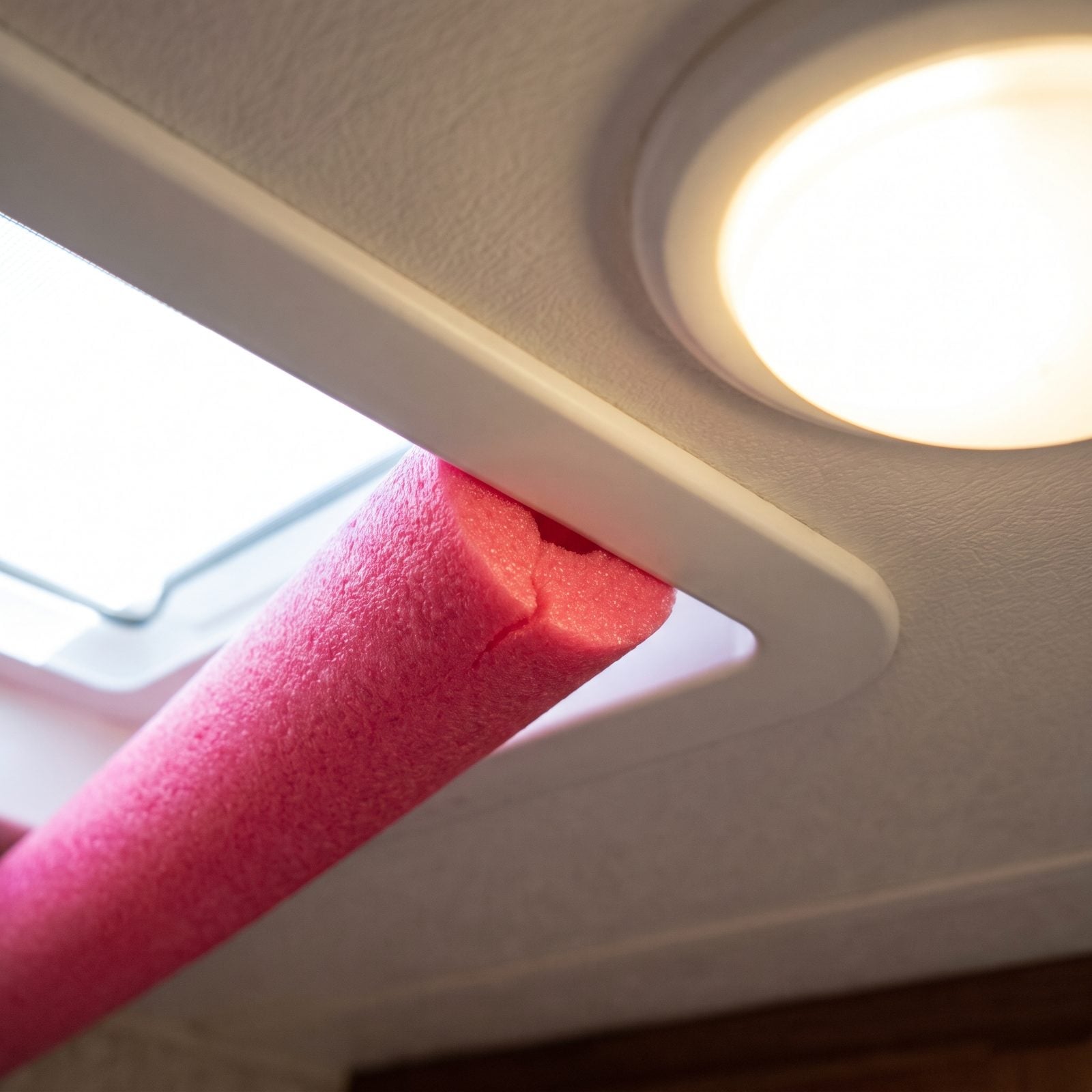
Skylights leak heat around the edges — warm air in, cool air out, depending on the season. A pool noodle solves it for pocket change.
Slit a foam noodle down one side and press it into the gap around the skylight frame. It wedges in, blocks the draft, and comes out just as easily when you want the light back. I keep a couple of noodle offcuts in the storage bay for exactly this, and they also pad the corners of anything that rattles on a rough road. Earns its space twice.
9. Make a Roof-Vent Baffle From Reflective Foam
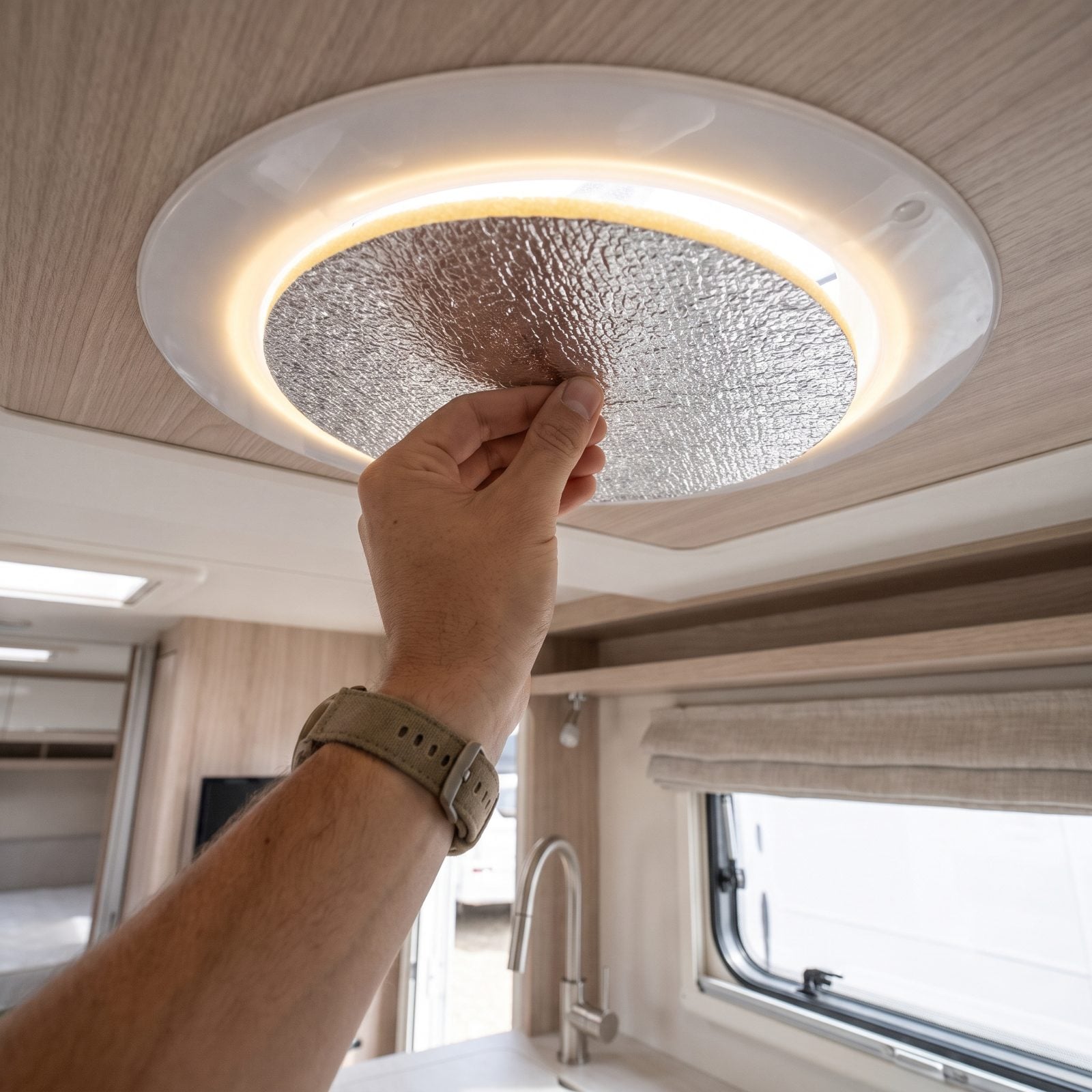
A clear roof vent dome is a magnifying glass aimed at your ceiling. Cut a reflective foam circle to fit the opening and press it in, silver side up.
It blocks the direct overhead sun while letting the vent breathe around the edges. On a sunny afternoon the difference under the vent hits you right away. Pop it out at night when you want the heat to escape and the stars overhead.
8. Put the Mattress on a Ventilation Mat
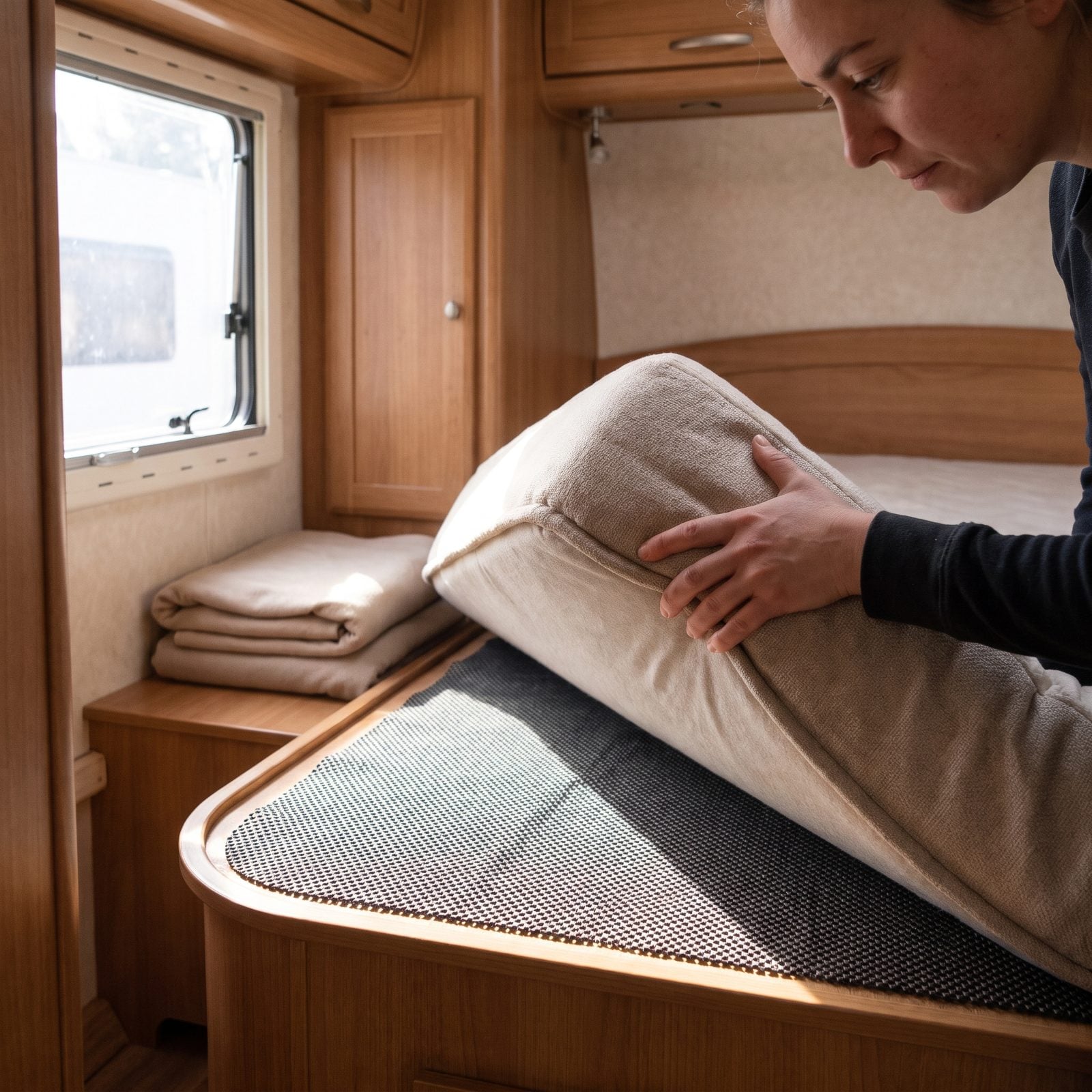
Lift your RV mattress and you’ll often find the underside damp, sometimes worse. Your body sweats all night, even on an open slatted frame the moisture lingers wherever the mattress presses against the wood, and mold sets in.
A ventilation mat — Hypervent or Froli-style — is a lattice of tangled plastic that sits under the mattress and lets air move through. It keeps the underside dry and the mattress cooler, which matters more than you’d ever guess on a muggy week off-grid.
7. Warm the Bed With a Hot-Water Bottle
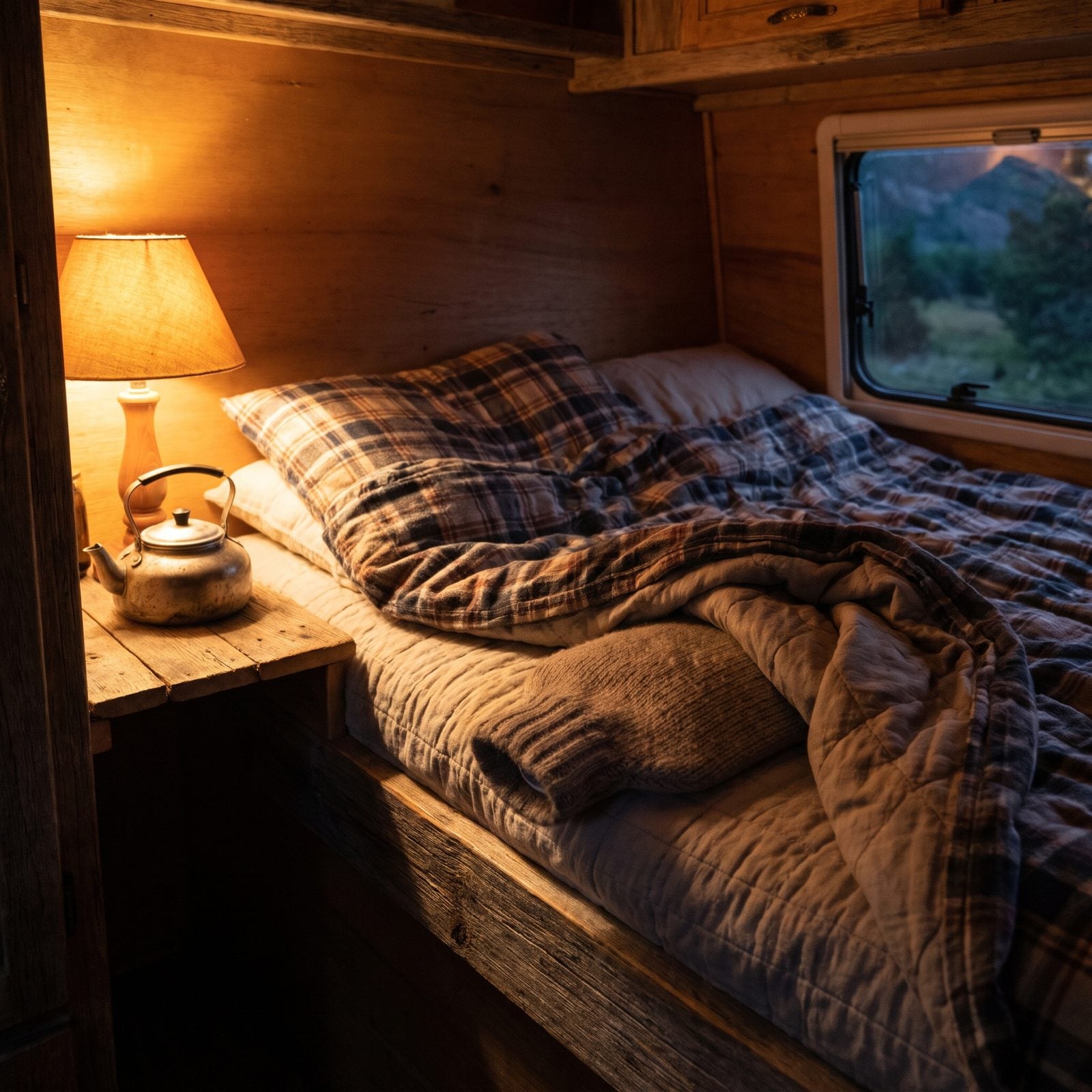
Running the furnace all night drains propane and battery, and it’s loud. Boil a kettle before bed instead and fill a rubber hot-water bottle.
Slide it to the foot of the bed ten minutes before you climb in and it holds warmth for hours. Your feet set the thermostat for the rest of you, so warm feet mean you drift off faster and wake up less. It’s the old cabin trick my grandparents used, and it still beats a fancy heater on a cold off-grid night.
6. Pitch a Windbreak Around the Outdoor Kitchen
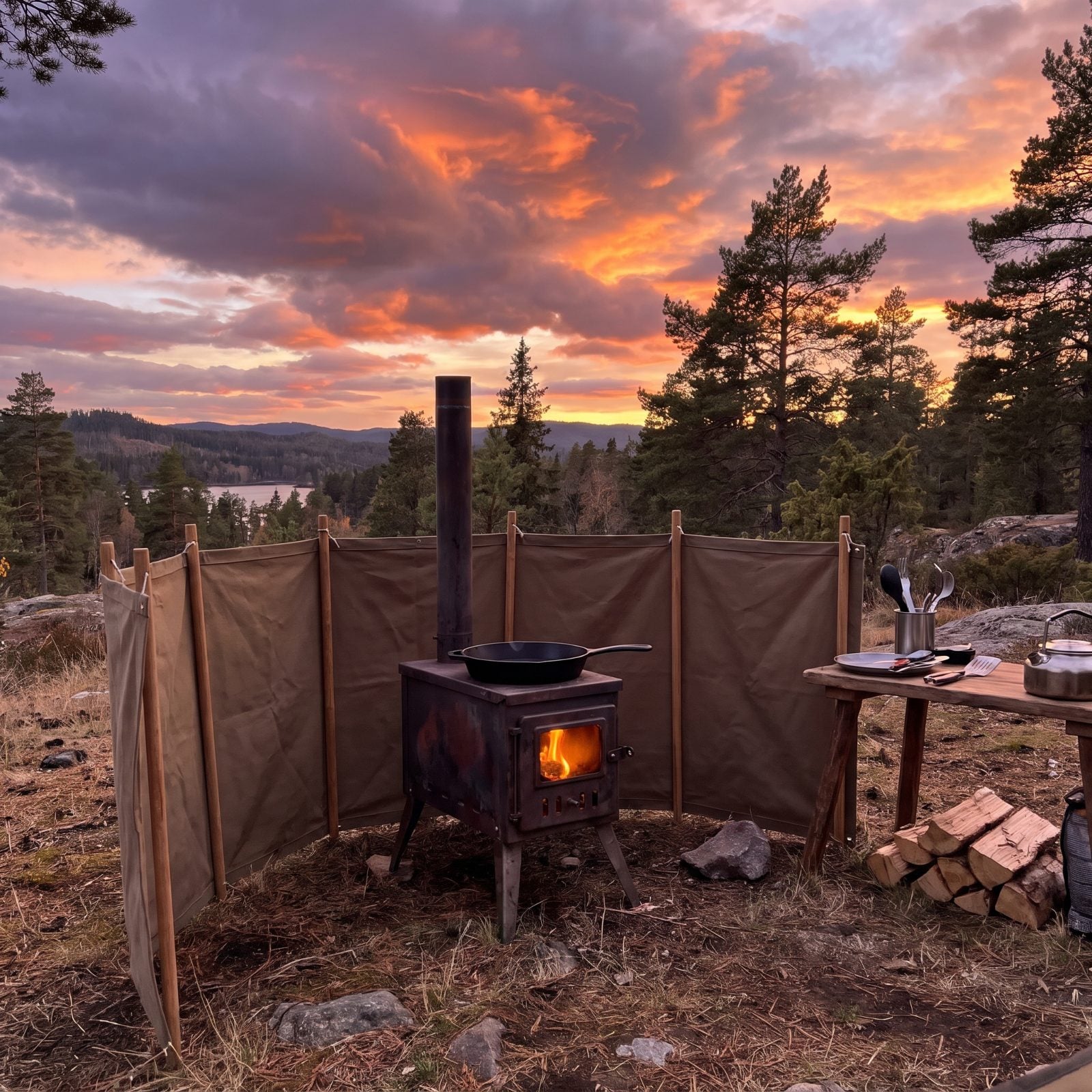
Wind is why your camp stove takes forever and burns through fuel. A windbreak staked in a semicircle around the burner fixes both at once.
Even a cheap folding fabric screen works, or a reflective panel propped up behind the stove — anything that keeps the flame steady and the heat on the pot instead of blown sideways into the sagebrush. Dinner cooks faster, you stretch your fuel over a week, and your morning coffee comes to a boil before you give up on it. One rule: keep the screen back from the flame and never box the stove in tight. You want steady air, not zero air.
5. Charge Every Device During Peak Solar Hours, Not After Dark
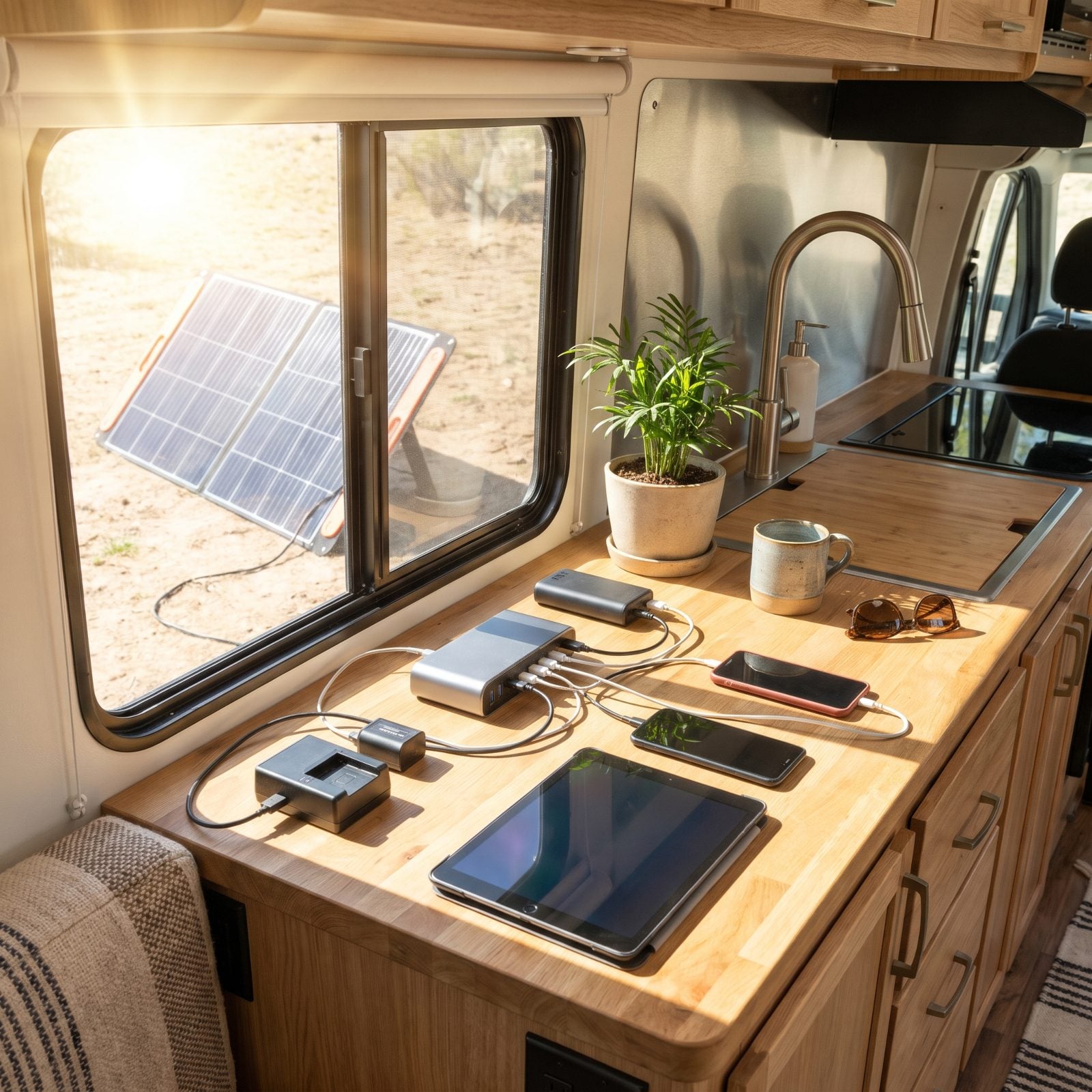
Your solar panels make their biggest haul of power in the bright middle of the day, which happens to be exactly when most folks are off hiking with phones in their pockets, charging nothing. Flip it. Plug everything in at noon and run your fridge hard while you’re at it.
Here’s the part people miss: power you pull straight off the panels at high sun is power that never touched your battery. No charge-cycle loss, no draining the bank overnight. Guard that midday window like a tee time.
4. Stick Rechargeable Puck Lights Inside Every Dark Cabinet
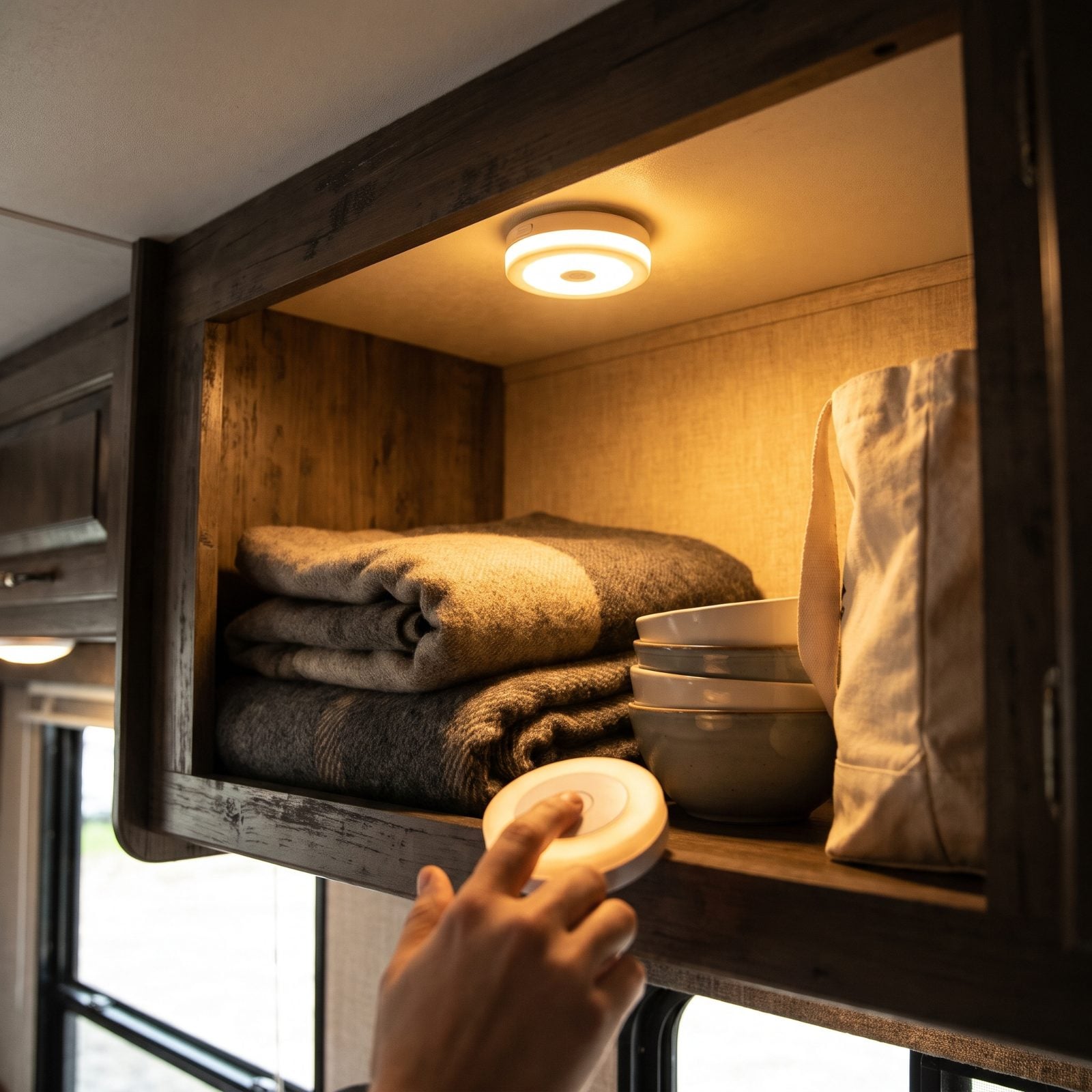
Those magnetic USB-rechargeable puck lights cost a couple bucks apiece and solve the problem nobody warns you about: cabinets are caves. At night you’re groping around for the coffee by feel while your ceiling lights drain the battery for nothing.
Tap on, tap off, maybe five minutes of real use a day, and one charge lasts most of a week. You light the single cubic foot you’re actually looking into instead of the whole rig.
3. Tie a Physical Reminder Tag to the Inverter Switch
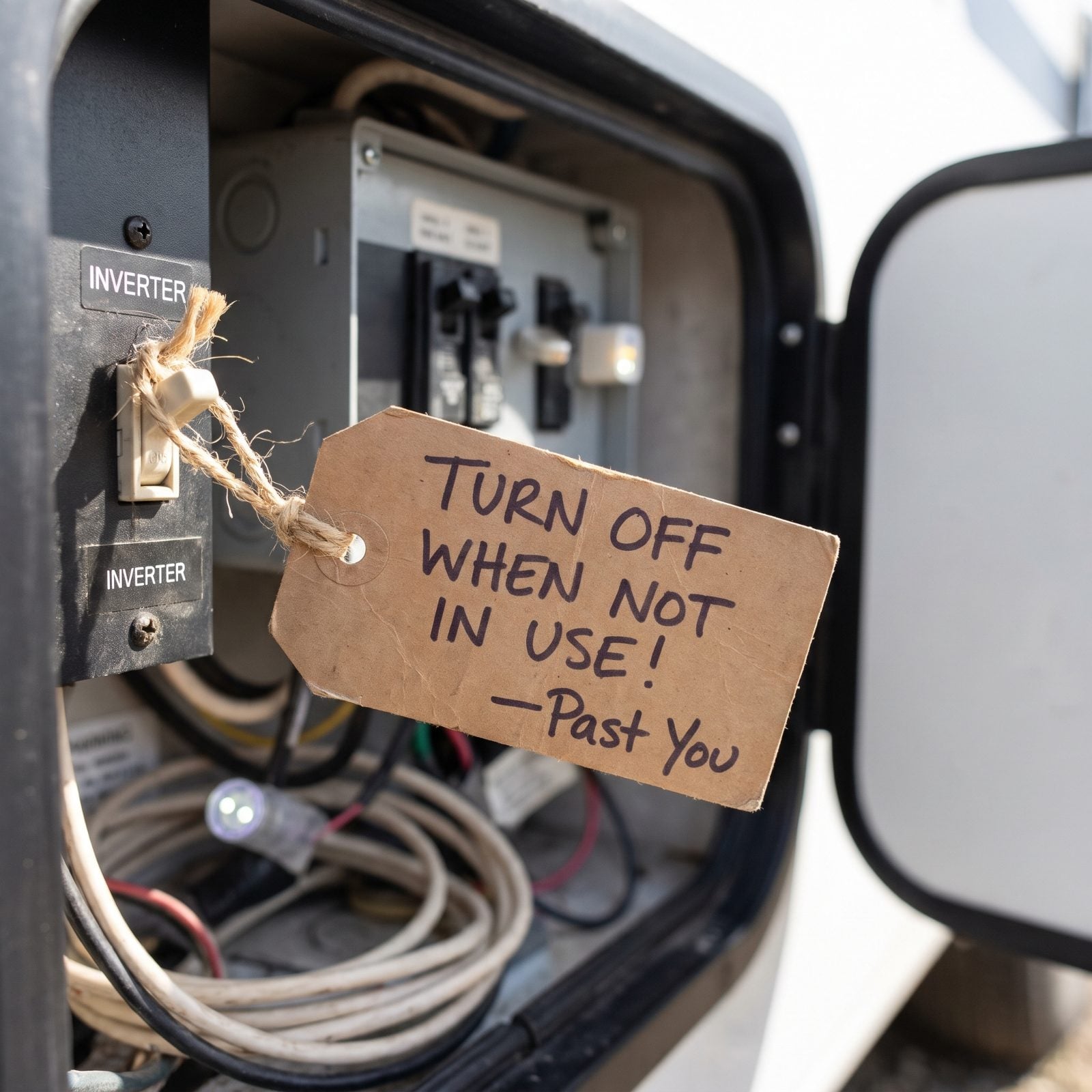
An inverter left on overnight quietly eats your battery just idling — converting nothing, staying wide awake. You discover this on day four, when the whole bank reads low and you cannot for the life of you figure out why.
So I tie a little tag to the switch. Low-tech, a bit embarrassing, completely effective. Your eyes snag on that tag before bed, long after the glowing green light has faded into furniture.
2. Charge Cordless Tool Batteries Straight From 12-Volt DC
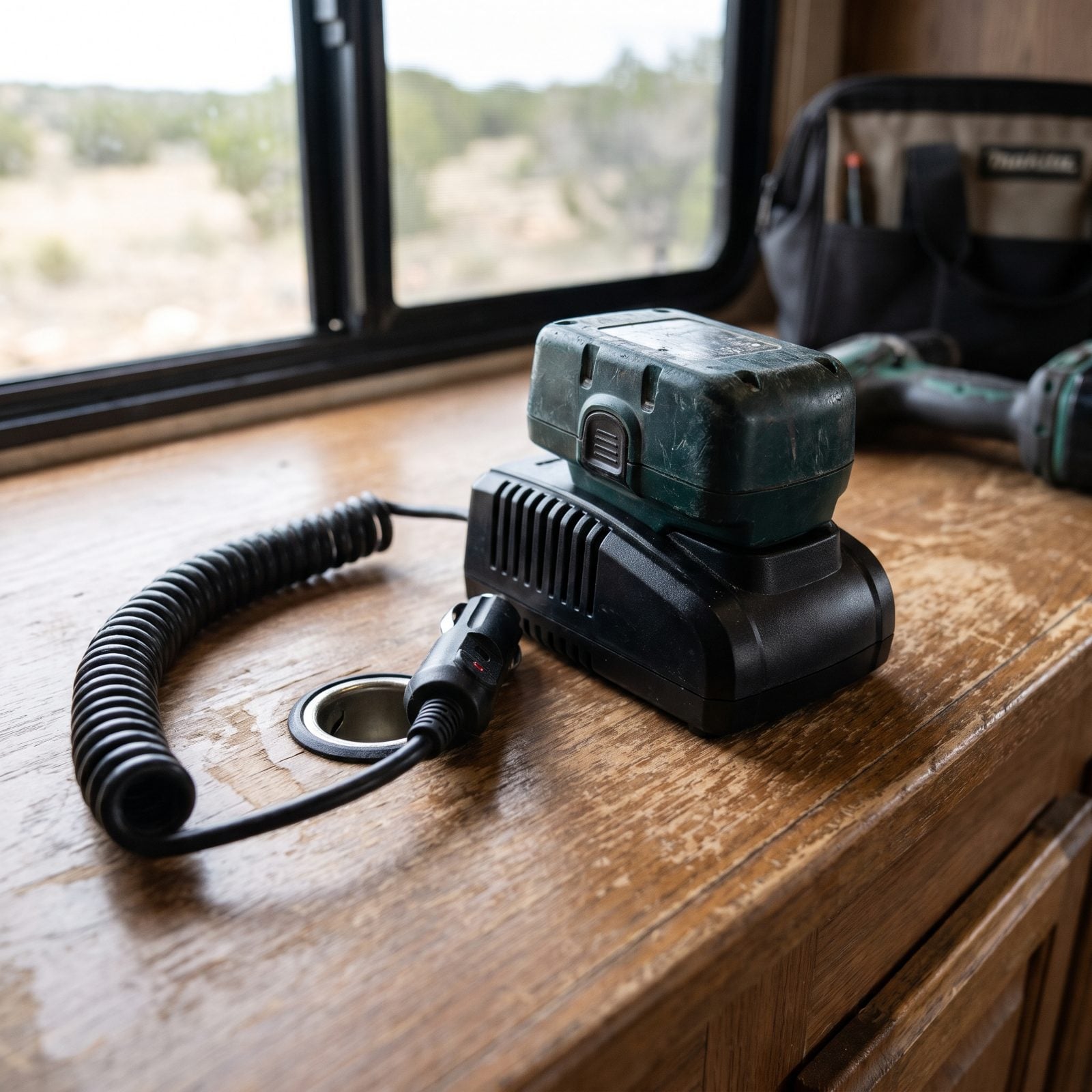
If you run power tools off-grid, a 12V tool charger is one of the quietly smart buys. Skip the inverter entirely and pull straight from the battery bank at 12 volts — the voltage it’s already sitting at.
Charge through an inverter and you lose a slice to the conversion from DC up to AC and back down. Cut the inverter out of the loop and that loss vanishes. Over a week of trimming firewood or rebuilding a busted leveling block, it adds up more than you’d guess.
1. Store Portable Solar Panels in a Zippered Mattress Sleeve
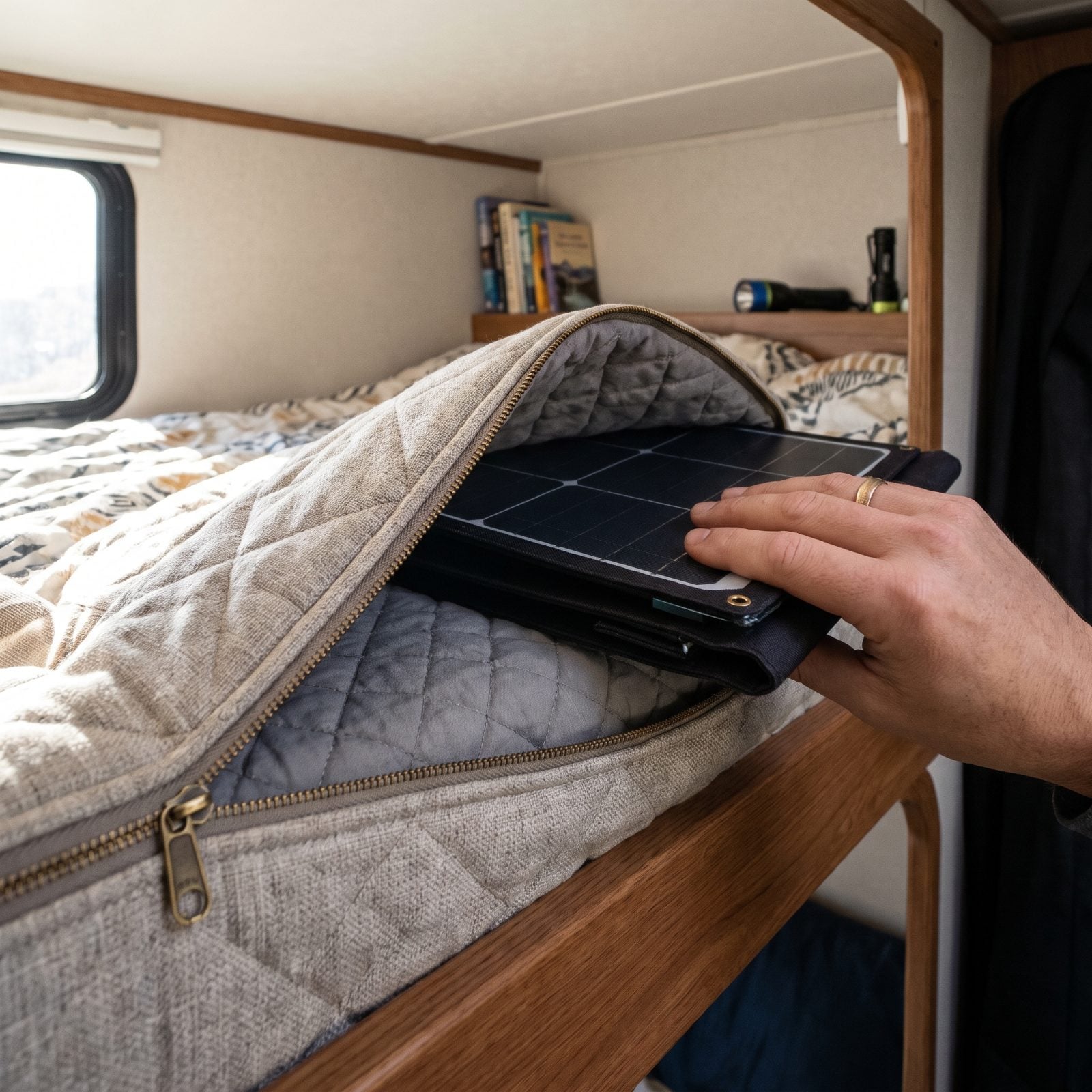
Portable panels scratch when they rattle around a closet, and the carry bags they ship with are flimsy junk. A spare quilted, zippered mattress cover, unzipped along one side, becomes padded armor for the folded panels and their coiled cable.
One of those repurposing tricks that feels obvious the second you’ve seen it. The quilting soaks up bumps and knocks, the zipper keeps grit out, and the panels slide flat inside the mattress cover itself instead of hogging a cabinet. Costs nothing extra. That’s the entire argument.